Find the Best Sewer Line Repair Companies for Your Business
No obligation • Fast responses • Nationwide coverage

Why you can trust Search a Plumber
Search a Plumber is a leading United States resource for finding and evaluating professional plumbing services. Our team researches licensing, experience, and customer feedback to create unbiased, fact-driven overviews. Companies cannot pay to change ratings or placement, ensuring homeowners get trustworthy information.
Search providers near you
Find Sewer Line Repair Companies near you
A damaged sewer line is a serious issue that can disrupt your home, pose health risks, and lead to costly property damage if ignored. Understanding your repair options is the first step to a lasting solution. This guide explains the causes of sewer line failure, compares modern trenchless methods with traditional excavation, and outlines what to expect during a repair project. You can use this information to find qualified local professionals who can accurately diagnose your issue and recommend the best course of action for your property.
Search providers near you
What Causes Sewer Line Damage?
Before discussing repair methods, it's helpful to know what typically leads to a failing sewer main. The most common culprits are natural forces and aging infrastructure.
- Tree Root Intrusion: This is a leading cause of blockages and breaks. Roots are drawn to the moisture and nutrients inside sewer pipes. They can enter through tiny cracks or loose joints and, over time, expand to completely block or fracture the pipe 1 2 3.
- Aging and Corroding Pipes: Many older homes have sewer lines made of materials like clay tile, cast iron, or Orangeburg (bituminized fiber pipe). These materials deteriorate over decades, becoming brittle, prone to cracking, and susceptible to collapse.
- Ground Shifting and Settlement: Soil movement is a major threat. Expansive clay soils that swell with moisture and shrink during droughts, frost heave in colder climates, and vibrations from nearby construction or seismic activity can all cause pipes to crack, separate at joints, or develop a problematic sag (called a "belly") 4.
- Blockages from Improper Use: Flushing "flushable" wipes, feminine hygiene products, paper towels, or pouring fats, oils, and grease (FOG) down drains creates stubborn clogs that build up over time, restricting flow and increasing pressure on aging pipes.
- Faulty Initial Installation: Pipes installed with an incorrect slope (preventing proper drainage) or poor connections can lead to chronic problems from the start 5.
Recognizing the Signs You Need Sewer Line Repair
Don't wait for a catastrophic failure. Be alert to these warning signs:
- Multiple Drain Clogs: Frequent backups in toilets, tubs, and multiple sinks simultaneously, especially when using appliances like washing machines.
- Unpleasant Odors: Persistent sewer gas smells in your yard, basement, or coming from drains.
- Unusual Lawn Conditions: Unexplained soggy, sunken, or overly lush patches of grass in your yard, particularly along the suspected path of the sewer line.
- Gurgling Sounds: Hearing gurgling noises from toilets or drains when water is running elsewhere.
- Foundation Cracks or Settlement: In severe cases, leaking sewer water can erode soil under your foundation, leading to new cracks or settling.
If you notice any of these issues, the next step is a professional diagnosis, typically involving a sewer camera inspection to pinpoint the exact problem.
Trenchless Sewer Repair: A Modern, Less-Invasive Solution
Trenchless technology has revolutionized sewer line repair by fixing pipes with minimal digging. It's often the preferred choice when the existing pipe is structurally sound enough to host a new lining but has cracks, leaks, or root intrusions.
How Trenchless Repair Works: Two Primary Methods
- Pipe Lining (Cured-in-Place Pipe or CIPP): This method creates a "pipe within a pipe." A flexible tube saturated with a resin is inserted into the damaged sewer line through an existing access point (like a cleanout). The liner is then inflated, pressing the resin against the interior walls of the old pipe. The resin is cured using hot water or UV light, forming a hard, seamless, and corrosion-resistant new pipe 6 7.
- Pipe Bursting: This technique is used to completely replace a severely damaged line. A conical bursting head is pulled through the old pipe, fracturing it outward while simultaneously pulling a new, high-density polyethylene (HDPE) pipe into place behind it. The new pipe is typically one size larger than the old one 8.
Advantages of Trenchless Sewer Line Replacement
- Minimal Property Disruption: Only small access pits are needed, preserving your lawn, landscaping, driveways, and hardscapes 9.
- Faster Completion: Most trenchless projects can be completed in one to two days, significantly faster than traditional excavation 10.
- Often Lower Overall Cost: While the per-foot material cost can be higher, you save thousands by avoiding extensive excavation, backfilling, and complex restoration of surfaces.
- Durable Result: The new pipe liners are jointless and resistant to root intrusion and corrosion, often with a 50-year lifespan 11.
Limitations of Trenchless Methods
- Not for All Damage: It cannot fix a pipe that has completely collapsed, is severely misaligned, or has a major "belly" 12.
- Access Requirements: Requires existing cleanouts or the creation of access points at the beginning and end of the run.
- Upfront Cost: The specialized equipment and materials can mean a higher initial quote compared to the pipe-cost alone of a traditional dig.
Find the perfect sewer line repair companies for your needs
Get personalized recommendations and expert advice
Traditional Excavation: The Dig-and-Replace Method
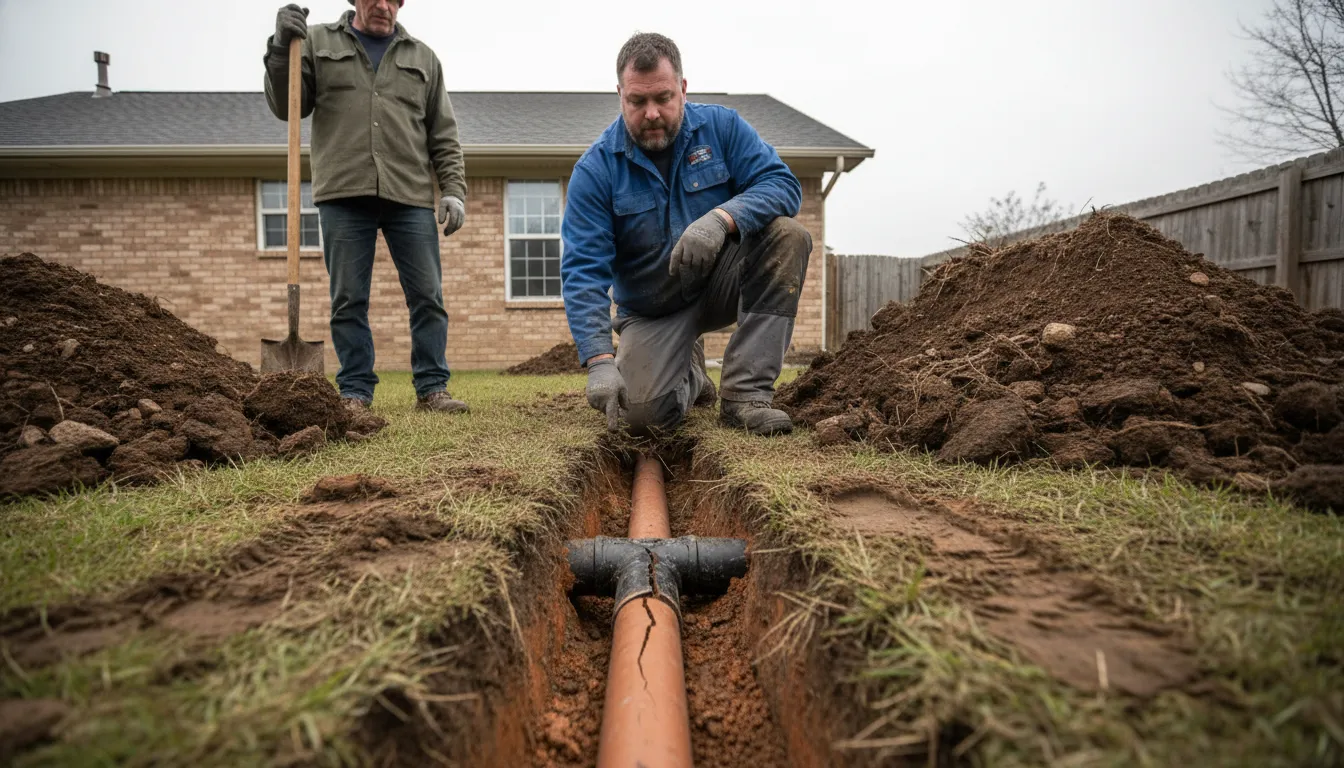
Traditional sewer line repair is exactly what it sounds like: a trench is dug along the entire length of the damaged pipe to expose it, remove it, and install a new one. This method is necessary when the pipe is beyond rehabilitation.
The Traditional Sewer Replacement Process
- Site Marking and Permitting: The utility locator service (811) is called to mark all public underground lines. The contractor obtains necessary permits from the local municipality.
- Full Excavation: Heavy equipment is used to dig a trench, often 4-6 feet deep or more, following the path of the sewer line. This can cut across yards, gardens, and sometimes driveways or walkways 13.
- Pipe Removal and Replacement: The old pipe sections are removed, and new piping (typically PVC or HDPE) is laid in the trench, connected, and tested 14.
- Backfill and Restoration: The trench is backfilled with soil and compacted in layers. The final and most costly phase is restoration-re-sodding the lawn, re-pouring concrete, rebuilding decks, or replanting landscaping to return the property to its pre-excavation state 15 16.
When Traditional Excavation is the Best Choice
- The pipe has collapsed or is severely misaligned.
- The sewer line needs to be re-routed or have its slope corrected.
- Multiple major failures exist along a long section of pipe.
- Local regulations or the specific condition of the infrastructure require full replacement.
Cost Comparison: Trenchless vs. Traditional Sewer Line Repair
Costs are highly variable, depending on location, length and depth of the line, soil conditions, extent of damage, and required permits. However, a clear comparative framework exists.
Trenchless Repair Costs: Typically range from $60 to $250 per linear foot. For an average project, total costs often fall between $6,000 and $12,000 17 18. The price reflects the technology and materials but excludes major restoration expenses.
Traditional Repair Costs: The pipe work itself may range from $50 to $450 per linear foot 19. However, this is rarely the final cost. The significant expense comes from the labor and materials needed for excavation and, crucially, property restoration. Restoring a landscaped yard, concrete driveway, or patio can add thousands of dollars, often making the total project cost higher than a comparable trenchless repair 20 21.
| Consideration | Trenchless Repair | Traditional Dig-and-Replace |
|---|---|---|
| Property Impact | Minimal (small access points) | Significant (large trenches across property) |
| Project Timeline | Usually 1-2 days | Several days to a week or more |
| Upfront Pipe Cost | Generally higher per foot | Lower per foot for the pipe itself |
| Restoration Cost | Very low or none | Very high (landscaping, concrete, etc.) |
| Overall Project Cost | Often lower | Often higher due to restoration |
| Ideal For | Pipes with cracks, leaks, root intrusions | Collapsed, severely misaligned, or failed pipes |
Choosing the Right Method for Your Home
The decision between trenchless and traditional sewer line repair isn't yours to make alone-it depends on the condition of your pipe. A reputable professional will always start with a video camera inspection to show you the problem. Based on that diagnosis, they will recommend the most effective and economical solution.
Ask your contractor:
- Can you show me the video inspection and explain the exact damage?
- Is my pipe a candidate for trenchless repair, or is excavation necessary?
- What is the complete project quote, including all restoration?
- What warranties do you provide on the repair and the new pipe material?
Frequently asked questions
Sources
Footnotes
-
Sewer Line Damage | Aurora Plumbing and Electric Supply - https://www.auroraplumbing.com/understanding-the-causes-of-sewer-line-damage ↩
-
Signs of Tree Roots in Your Sewer Lines | ABC Blog - https://blog.abchomeandcommercial.com/tree-roots-sewer-lines/ ↩
-
Tree Roots & Sewer Line Plumbing: Causes, Risks, And Effective ... - https://www.fastresponseplumbingsf.com/impact-of-tree-roots-on-residential-sewer-line-plumbing/ ↩
-
Impact Of Ground Shifting On Sewer Lines: Risks To Infrastructure - https://www.fastresponseplumbingsf.com/impact-of-ground-shifting-on-sewer-lines/ ↩
-
What Causes Sewer Line Damage? 7 Common Residential ... - https://anchorplumbingservices.com/causes-of-sewer-line-damage/ ↩
-
From Start to Finish: Understanding Trenchless Sewer Line ... - https://jollyplumbing.com/how-does-trenchless-sewer-line-replacement-work/ ↩
-
How Trenchless Sewer Repair Works: A Step-by-Step ... - https://fivestarservicepros.com/blog/how-trenchless-sewer-repair-works-a-step-by-step-breakdown/ ↩
-
2 Types of Trenchless Sewer Repair Methods: Which One is Ideal? - https://www.americansewerspecialist.com/2-types-of-trenchless-sewer-repair-methods-which-one-is-ideal/ ↩
-
The Benefits of Trenchless Sewer Repair vs. Traditional ... - https://superiorplumbingar.com/blog-posts/the-benefits-of-trenchless-sewer-repair-vs-traditional-methods/ ↩
-
Step-by-Step: What to Expect During a Trenchless Sewer Project - https://trenchfree.com/step-by-step-what-to-expect-during-a-trenchless-sewer-project/ ↩
-
Sewer Pipe Lining vs Residential Excavation: Homeowner Guide - https://www.128plumbing.com/sewer-pipe-lining-vs-residential-excavation/ ↩
-
Sewer Repair Options: Trenchless vs. Traditional Methods | TYCO - https://tycoplumbingco.com/sewer-repair-options-trenchless-vs-traditional-methods/ ↩
-
Traditional Excavation for Sewer Line Repair: A Process ... - https://bullseyeplumbing.com/traditional-excavation-for-sewer-line-repair-a-process-timeline/ ↩
-
Step-by-Step Guide To Replacing Old Sewer Lines Safely - https://www.superbrothers.com/step-by-step-guide-to-replacing-old-sewer-lines-safely/ ↩
-
Sewer Line Replacement: Complete Guide & Cost Breakdown 2025 - https://flomaxxinc.net/blogs/understanding-sewer-line-replacement-guide-cost-process/ ↩
-
The Step By Step Process Of A Sewer Excavation Repair Or ... - https://americanrooterpa.com/blog/the-step-by-step-process-of-a-sewer-excavation-repair-or-replacement/ ↩
-
Is Trenchless Sewer Line Repair Cheaper? - AP Plumbing - https://applumbing.com/blog/is-trenchless-sewer-line-repair-cheaper/ ↩
-
Cost Comparison: Trenchless vs. Traditional Sewer Line Repair - https://www.advancedtrenchlesssolutions.com/blog/cost-comparison-trenchless-vs-traditional-sewer-line-repair ↩
-
Trenchless vs Traditional Sewer Repair: Pros, Cons & Cost ... - https://utah-trenchless.com/blog/trenchless-vs-traditional-sewer-repair/ ↩
-
Is Trenchless Sewer Line Repair Cheaper? - AP Plumbing - https://applumbing.com/blog/is-trenchless-sewer-line-repair-cheaper/ ↩
-
Sewer Pipe Lining vs Residential Excavation - 128 Plumbing - https://www.128plumbing.com/sewer-pipe-lining-vs-residential-excavation/ ↩