Find the Best Sewer Line Repair Companies for Your Business
No obligation • Fast responses • Nationwide coverage

Why you can trust Search a Plumber
Search a Plumber is a leading United States resource for finding and evaluating professional plumbing services. Our team researches licensing, experience, and customer feedback to create unbiased, fact-driven overviews. Companies cannot pay to change ratings or placement, ensuring homeowners get trustworthy information.
Search providers near you
Best Sewer Line Repair Companies in Delaware Ranked
A damaged sewer line is a serious issue that can lead to backups, property damage, and health hazards. Sewer line repair involves diagnosing and fixing the underground pipe that carries wastewater from your home to the public sewer main. This guide explains the process, common materials, and key considerations for Delaware homeowners, helping you understand your options and connect with qualified local professionals for an assessment.
Common Causes of Sewer Line Problems in Delaware
Several factors can lead to the failure of your main sewer line. Understanding the root cause is the first step toward an effective repair.
- Root Intrusion: Tree and shrub roots are drawn to the moisture and nutrients in sewer pipes. They can infiltrate through small cracks or pipe joints, eventually causing complete blockages or breaking the pipe apart.
- Aging and Corroding Pipes: Many older Delaware homes have sewer lines made of cast iron or clay (Vitrified Clay Pipe - VCP). Over decades, cast iron can rust and corrode from the inside, narrowing the pipe. Clay pipes are brittle and prone to cracking from ground pressure or settling.
- Ground Shifting and Settlement: Soil movement, freeze-thaw cycles, and general settling of the earth over time can put stress on sewer pipes, causing them to crack, misalign (creating a "belly" where waste collects), or collapse.
- Grease and Debris Buildup: Pouring fats, oils, and grease (FOG) down drains is a common cause of blockages. Over time, these substances solidify inside pipes, restricting flow. Non-flushable items like wipes can also cause major clogs.
- Physical Damage: Construction work, heavy vehicle traffic over the pipe's location, or accidental digging can crush or break sewer lines.
Identifying a Sewer Line Issue: Key Signs
Don't ignore these warning signs of a potential main line problem:
- Multiple Drain Backups: Toilets, showers, and sinks are all backing up simultaneously, especially when using a washing machine.
- Gurgling Sounds: You hear gurgling noises from toilets or drains when water is running elsewhere in the house.
- Sewage Odors: Persistent foul smells in your yard, basement, or near floor drains.
- Unusually Lush or Soggy Patches in Yard: A broken sewer line acts as an underground irrigation system, creating patches of grass that are greener, softer, or wetter than the surrounding area.
- Foundation Cracks or Settlement: In severe cases, leaking sewage can wash away soil under your foundation, leading to cracks or sinking.
The Diagnostic Process: Video Inspection
The first and most critical step for any suspected sewer line issue is a professional video inspection. A licensed plumber will insert a high-resolution, waterproof camera into your cleanout or through a roof vent. This allows them to:
- Pinpoint the exact location and depth of the problem.
- Identify the cause (roots, break, belly, etc.).
- Assess the pipe material (clay, cast iron, PVC).
- Determine the overall condition of the entire line.
- Provide a clear visual record to help you understand the necessary repairs and obtain accurate quotes.
Find the perfect sewer line repair companies for your needs
Get personalized recommendations and expert advice
Understanding Your Sewer Pipe Materials
The material of your existing sewer line heavily influences repair options and costs.
- Clay (Vitrified Clay Pipe - VCP): Common in homes built before the 1960s. Clay is durable but brittle. It is susceptible to cracking from ground movement and is a prime target for root intrusion at its jointed sections.
- Cast Iron: Also found in older homes. While strong, cast iron is subject to internal corrosion and rust over 50+ years, which can eventually eat through the pipe wall and cause blockages or leaks 1.
- PVC (Polyvinyl Chloride): The standard for modern installations. PVC is lightweight, corrosion-resistant, and has smooth joints that deter roots. It is the most durable option for new installations or full replacements.
Repair and Replacement Methods
Once the problem is diagnosed, your professional will recommend the most effective solution. Methods fall into two main categories: trenchless and traditional excavation.
Trenchless Repair Methods
These techniques minimize digging, preserving your landscaping, driveway, and hardscapes.
- Pipe Lining (Cured-In-Place Pipe - CIPP): A flexible, resin-saturated liner is inserted into the damaged pipe and inflated. The resin cures in place, forming a new, seamless, and durable pipe within the old one. This is excellent for fixing cracks, holes, and root-damaged sections without excavation.
- Pipe Bursting: Used when the old pipe is too damaged to line. A bursting head is pulled through the old pipe, fracturing it outward while simultaneously pulling a new HDPE (high-density polyethylene) pipe into place. This replaces the line without digging a continuous trench.
Traditional Excavation (Open-Trench)
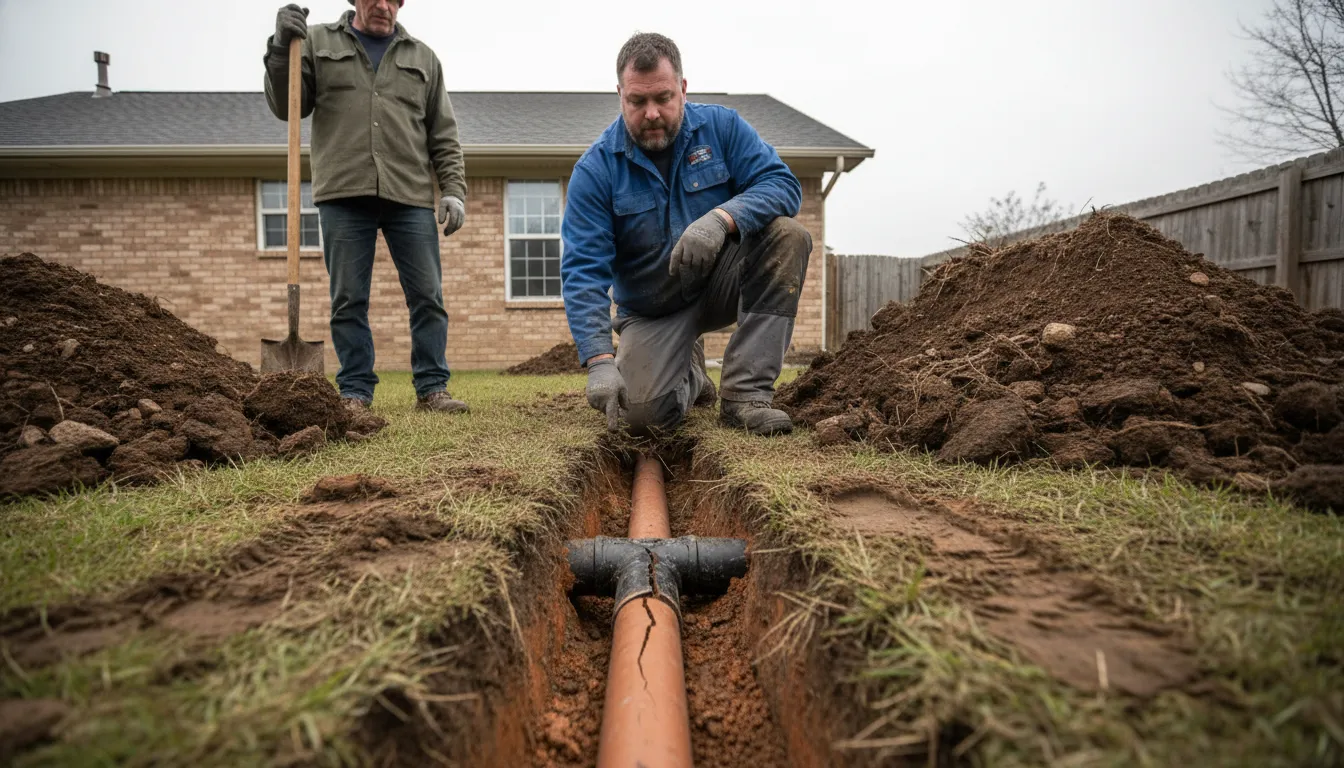
This involves digging a trench to fully access and replace the damaged section of pipe.
- When It's Necessary: Required for severely collapsed pipes, major misalignments ("bellies"), or when transitioning between different pipe materials. It is often the only option for failed clay or cast iron lines that cannot be lined or burst.
- Considerations: While highly effective, it is the most invasive method, requiring restoration of the excavated area (lawn, pavement, etc.). Depth and access obstacles (like trees, decks, or pools) significantly impact the complexity and cost.
Delaware-Specific Regulations and Steps
Sewer line repair in Delaware involves specific regulatory steps to ensure safety and compliance.
- Call 811 Before Digging: This free, mandatory service marks the location of public underground utility lines (gas, water, electric, telecom) on your property. It is legally required and prevents dangerous accidents and service disruptions.
- Permitting: Significant sewer work requires permits. A reputable contractor will typically handle this. Permits for work on private property are obtained from your local municipality (city or county). If the repair extends into the public right-of-way (like the area between the sidewalk and street), a permit from the Delaware Department of Transportation (DelDOT) is also required 2 3.
Factors Influencing Cost in Delaware
Sewer line repair costs in Delaware vary widely based on several key factors. Always get a detailed, written estimate after a video inspection.
- Extent and Method of Repair: A small, localized CIPP liner repair will cost less than a full-line pipe bursting or traditional excavation replacement.
- Length and Depth of the Line: Longer lines and deeper pipes (which require more excavation and safety shoring) increase material and labor costs.
- Pipe Material and Condition: The difficulty of removing old cast iron or clay pipe can add to the cost compared to replacing PVC.
- Access and Obstacles: Repairing a line under a driveway, patio, mature tree, or garden adds significant complexity and expense. Trenchless methods can sometimes mitigate these costs.
- Restoration: After traditional excavation, you must budget for backfilling, compacting, and restoring the landscape, concrete, or pavement that was disturbed.
General Cost Ranges: While every project is unique, homeowners can expect a broad range. Minor trenchless spot repairs may start around $1,000 to $5,000. A full sewer line replacement using traditional excavation for a standard 75-foot line can range from $4,000 to $15,000 or more, with higher costs for complex access, greater depth, and longer runs 4 5 6.
Frequently asked questions
Sources
Footnotes
-
How Much Does a Sewer Line Repair Cost in Chicago? - https://www.baethkeplumbing.com/blog/sewer-line-repair-cost-in-chicago/ ↩
-
Utilities Manual - Delaware Regulations - Administrative Code - https://regulations.delaware.gov/AdminCode/title2/2401 ↩
-
Utilities Manual - Delaware Department of Transportation - https://deldot.gov/Business/drc/manuals/utilities_manual_2008_may_5.pdf ↩
-
Understanding Sewer Line Replacement: What to Expect - https://flomaxxinc.net/blogs/understanding-sewer-line-replacement-guide-cost-process/ ↩
-
Sewer Line Repair on the Main Line - Family Roots Plumbing - https://familyrootsplumbing.com/drain-sewer/sewer-lines/ ↩
-
How Is the Cost of Sewer Line Repair Determined? - https://www.callwaldrop.com/blog/how-is-the-cost-of-sewer-line-repair-determined/ ↩