Find the Best Sewer Line Repair Companies for Your Business
No obligation • Fast responses • Nationwide coverage

Why you can trust Search a Plumber
Search a Plumber is a leading United States resource for finding and evaluating professional plumbing services. Our team researches licensing, experience, and customer feedback to create unbiased, fact-driven overviews. Companies cannot pay to change ratings or placement, ensuring homeowners get trustworthy information.
Search providers near you
Best Sewer Line Repair Companies in Arkansas Ranked
A failing sewer line is a serious issue that can disrupt your home, pose health risks, and lead to costly property damage. Sewer line repair involves diagnosing and fixing the underground pipe that carries all wastewater from your home to the public sewer main. In Arkansas, this process is governed by specific local codes, requires permits, and often involves navigating challenges like old pipe materials and variable soil conditions. This guide explains the key steps, costs, and regulations for Arkansas homeowners, helping you understand the process and connect with qualified local professionals to restore proper drainage.
Common Causes of Sewer Line Problems in Arkansas
Several factors unique to Arkansas homes can lead to sewer line failure. Understanding the cause is the first step toward an effective repair.
- Aging Pipe Materials: Many older homes in Arkansas have sewer lines made of cast iron, clay (vitrified clay pipe), or Orangeburg (bituminized fiber pipe). These materials are prone to cracking, root intrusion, and collapse over decades of use 1.
- Root Intrusion: Tree and shrub roots are drawn to the moisture and nutrients in sewer pipes. They can infiltrate through small cracks or pipe joints, eventually causing complete blockages or breaking the pipe apart.
- Ground Shifting and Settlement: Arkansas soil, particularly clay, can expand when wet and contract when dry. This movement places stress on buried pipes, leading to misaligned joints, cracks, or breaks.
- Grease and Debris Buildup: Pouring fats, oils, and grease (FOG) down drains is a common cause of blockages. Over time, these substances solidify inside pipes, restricting flow and causing backups.
- Corrosion: Old cast iron pipes can corrode from the inside out, eventually thinning the pipe wall and leading to leaks or collapses.
Diagnosing the Problem: The Video Inspection
Before any digging begins, a professional diagnosis is essential. A sewer camera inspection involves sending a high-resolution, waterproof camera on a flexible rod through your cleanout or toilet drain. This allows a technician to see the exact condition of your pipe, pinpoint the location and nature of the problem (e.g., a crack at 25 feet, a root ball at 40 feet), and determine the most effective repair method 2 3. This service typically costs between $200 and $500+ in Arkansas.
Arkansas Regulations: Permits and 811 Locates
Sewer line repair is not a DIY project and is heavily regulated for public health and safety. Arkansas homeowners must follow these critical steps:
- Call 811 for Utility Locates: This is the law and your first call. Dialing 811, the national "Call Before You Dig" number, initiates a process where all public utilities (gas, electric, water, communications) will come to your property and mark the location of their underground lines with paint or flags. This free service prevents dangerous and costly strikes and is required before any excavation, even for a small repair 4 5.
- Obtain a Permit: A permit from your local authority is almost always required for sewer line repair or replacement. The permitting body is typically either your County Health Unit (under the Arkansas Department of Health) or the local Water Reclamation Authority (like the Little Rock Water Reclamation Authority - LRWRA) 6. The permit ensures the work meets state and local plumbing codes.
- Schedule Inspections: The permitting agency will require inspections at key stages, such as after the trench is dug but before the new pipe is laid, and after the repair is complete but before the trench is backfilled. Passing inspection is crucial for final approval.
Repair Methods: From Traditional Digging to Trenchless Solutions
The chosen repair method depends on the problem's location, severity, pipe material, and your property's layout. Costs vary significantly based on the method.
Traditional Excavation (Trenching)
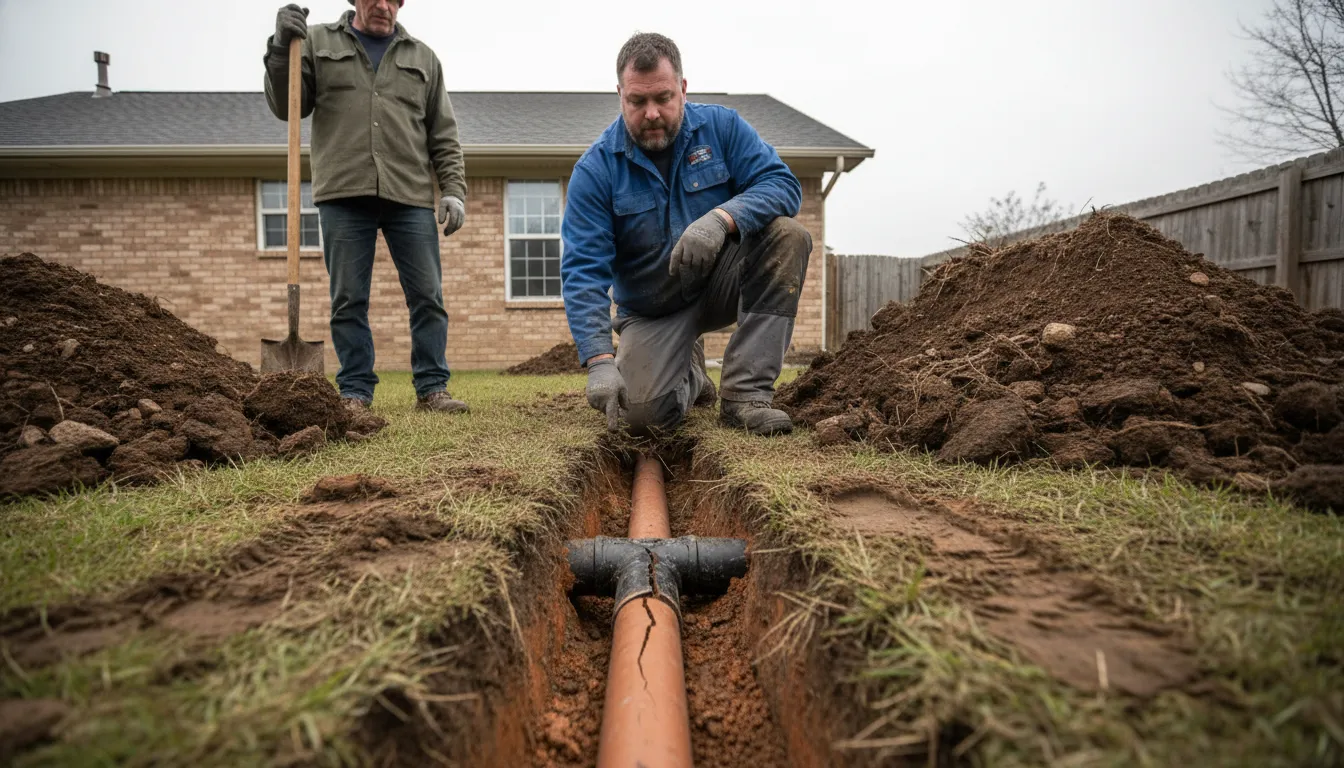
This involves using a backhoe or other equipment to dig a trench along the path of the sewer line to fully expose the damaged section. The old pipe is removed, a new pipe (typically PVC) is installed, and the trench is backfilled.
- Best for: Short repairs, severe collapses, or when other utilities are not in the way.
- Considerations: This is invasive, requiring destruction and later restoration of lawns, landscaping, driveways, or sidewalks. The depth of excavation in Arkansas is generally 3 to 8 feet or more, as pipes must be buried below the local frost line and maintain a proper drainage slope of at least 1/4-inch per foot 7 8 9.
- Cost Range: For a targeted spot repair using trenching, homeowners might expect costs from $1,000 to $4,000 or more, heavily dependent on depth and access.
Trenchless Repair Methods
These advanced techniques minimize surface disruption by repairing or replacing the pipe from within.
- Pipe Lining (Cured-in-Place Pipe - CIPP): A flexible, resin-saturated liner is inserted into the old pipe and inflated. The resin cures, forming a hard, seamless "pipe within a pipe."
- Pipe Bursting: A bursting head is pulled through the old pipe, fracturing it outward while simultaneously pulling a new HDPE (high-density polyethylene) or PVC pipe into place behind it.
- Best for: Lines under driveways, patios, mature landscaping, or long runs where excavation would be prohibitively disruptive.
- Considerations: Not suitable for all situations (e.g., severely collapsed or misaligned pipes). Requires access pits at the beginning and end of the run.
- Cost Range: Trenchless methods generally range from $3,000 to $10,000 or more, but can save substantially on restoration costs.
Full Sewer Line Replacement
When a line is extensively damaged or made of obsolete material like Orangeburg, full replacement is often the most durable, long-term solution. This typically involves excavation along the entire run from the house to the sewer main. It is the most extensive and costly option, with prices in Arkansas often ranging from $5,000 to $15,000+, before accounting for landscape or hardscape restoration 10 11 12.
Find the perfect sewer line repair companies for your needs
Get personalized recommendations and expert advice
Understanding the Full Cost: Repair and Restoration
The total cost of a sewer project includes more than just the pipe work. Be sure to factor in:
- Restoration: After the pipe is repaired and inspected, the excavated area must be restored. This can be a significant added cost.
- Lawn/Sod Repair: $0.50 to $2.00+ per square foot.
- Driveway/Concrete Repair: $15+ per square foot for repaving or reinstatement 13.
- Landscaping: Replacing shrubs, trees, or irrigation systems.
- Permit Fees: Vary by municipality but are a necessary part of the project budget.
- Complexity Factors: Depth, length of repair, soil conditions (rocky soil requires more labor), and ease of access for equipment all influence the final price.
The Step-by-Step Process for Arkansas Homeowners
- Recognize the Signs: Slow drains, gurgling toilets, sewage backups in basement drains, or foul odors in the yard.
- Hire a Professional: Contact a licensed, insured plumbing contractor experienced in sewer line work.
- Video Inspection: The plumber performs a camera inspection to diagnose the issue.
- Call 811: The homeowner or contractor calls to have utilities marked.
- Obtain Permit: The contractor usually pulls the required permit from the local health department or water authority.
- Execute Repair: The work is performed using the agreed-upon method (excavation or trenchless).
- Inspection: The permitting agency inspects the repair.
- Backfill & Restore: Once approved, the trench is backfilled and compacted, and restoration of the surface begins.
Choosing the Right Professional in Arkansas
Selecting a qualified contractor is critical. Look for:
- Arkansas Plumbing License: Verify the plumber holds a current state license.
- Specialized Experience: Ask how many sewer line repairs they perform annually and if they offer both trenching and trenchless options.
- Insurance: Ensure they carry both liability and workers' compensation insurance.
- Detailed Estimates: Get written, detailed estimates that break down labor, materials, permit fees, and restoration costs. Be wary of quotes that seem unusually low.
- References and Reviews: Check online reviews and ask for references from past sewer repair customers.
Frequently asked questions
Sources
Footnotes
-
table of contents - Arkansas Division of Environmental Quality - https://www.adeq.state.ar.us/downloads/webdatabases/permitsonline/npdes/permitinformation/ar0020320_technical%20memo%20standard%20specifications_20110801.pdf ↩
-
Understanding Sewer Line Replacement: What to Expect - https://flomaxxinc.net/blogs/understanding-sewer-line-replacement-guide-cost-process/ ↩
-
Sewer Line Repair and Replacement - https://www.thisoldhouse.com/plumbing/sewer-line-repair ↩
-
Sewer Service Line Replacement Program | LRWRA - https://www.lrwra.com/programs/sslrp/ ↩
-
Rules and Regulations - Arkansas Secretary of State - https://www.sos.arkansas.gov/uploads/rulesRegs/Arkansas%20Register/2008/dec_2008/007.04.08--001.pdf ↩
-
A.C.A. § 14-236-101 - Arkansas Department of Health - https://healthy.arkansas.gov/wp-content/uploads/Act402_and_Onsite_Wastewater_Rules.pdf ↩
-
Chapter 3 General Regulations: Arkansas Plumbing Code, 2018 - https://up.codes/viewer/arkansas/ar-plumbing-code-2018/chapter/3/general-regulations ↩
-
Digging Deeper: How Deep are Water Lines Buried? - https://www.blplumbingserviceinc.com/how-deep-are-water-lines-buried/ ↩
-
Slope requirements for sewer drainage pipes - Facebook - https://www.facebook.com/groups/1552624902330335/posts/1867251307534358/ ↩
-
How Is the Cost of Sewer Line Repair Determined? - https://www.callwaldrop.com/blog/how-is-the-cost-of-sewer-line-repair-determined/ ↩
-
Complete Guide to Residential Sewer Line Maintenance & Repair - https://sswaterworks.com/complete-guide-to-residential-sewer-line/ ↩
-
How Much Does Sewer Line Repair Cost in Dallas? - https://totalplumbing.net/how-much-does-sewer-line-repair-cost-in-dallas/ ↩
-
Digging Trench for Water Line Installation, Repair, or Replacement - https://texomaexcavationandconstruction.com/digging-trench-for-water-line-installation-repair-or-replacement/ ↩