Find the Best Sewer Line Repair Companies for Your Business
No obligation • Fast responses • Nationwide coverage

Why you can trust Search a Plumber
Search a Plumber is a leading United States resource for finding and evaluating professional plumbing services. Our team researches licensing, experience, and customer feedback to create unbiased, fact-driven overviews. Companies cannot pay to change ratings or placement, ensuring homeowners get trustworthy information.
Search providers near you
Best Sewer Line Repair Companies in Maine Ranked
A failing sewer line is a serious issue for any Maine homeowner, leading to unpleasant backups, property damage, and potential health hazards. Sewer line repair involves diagnosing and fixing the underground pipe that carries all your home's wastewater to the municipal sewer main or a private septic system. This guide explains the unique considerations for sewer work in Maine, from the common pipe materials in our older homes to navigating local permits and choosing the right repair method. You can use this information to understand the process, ask informed questions, and find qualified local professionals to assess and resolve your sewer line problems.
Common Sewer Pipe Materials in Maine Homes
The type of pipe buried under your property is a primary factor in its longevity and the repair options available. Maine's housing stock spans centuries, leading to a mix of materials.
Older Homes (Pre-1970s): It's very common to find clay tile or cast iron (CI) sewer lines in historic New England homes. Clay pipes are durable but can crack from ground movement or be infiltrated by seeking tree roots at the joints. Cast iron is strong but succumbs to internal corrosion and rust over decades, eventually thinning and breaking. These older materials often require full-section replacement or specialized lining.
Newer Construction (1970s-Present): Modern homes typically use PVC or ABS plastic piping. These materials are resistant to corrosion and root intrusion, with leak-proof glued joints. Failures in these systems are usually due to improper installation, ground settling, or accidental damage during other excavation work, which can sometimes allow for more targeted, spot repairs 1.
Key Factors Influencing Sewer Repair in Maine
Several local conditions significantly impact the complexity and cost of a sewer line project.
Depth and Soil Conditions: Sewer lines in Maine must be buried below the frost line (typically 4-5 feet, but often deeper) to prevent freezing. Excavating an 8-foot deep trench is far more labor-intensive and costly than working on a line only 4 feet down 2. Rocky or difficult soil common in the state can also slow excavation.
Access and Obstacles: The path of your sewer line greatly affects the job. Repairing a line that runs under a driveway, patio, or mature landscaping adds substantial cost for removal and restoration. A line running under a home's concrete slab foundation is one of the most complex and expensive scenarios, requiring careful breaking and repouring of concrete 3.
Utility Locates (Maine 811): This is a critical and mandatory first step. Before any digging begins, you or your contractor must dial 811 or file an online request at least three business days in advance. This free service ensures all underground public utility lines (gas, electric, water, communications) are marked with colored paint or flags. It's a safety and legal requirement in Maine 4.
Local Permits and Sewer Districts: Most Maine municipalities require a permit for sewer line excavation and connection. Reputable contractors will usually handle this process. It's essential to know if your home is served by a specific sewer district (e.g., Brunswick Sewer District, Portland Water District), as they have their own regulations and permit requirements for any work connecting to their main line 5 6.
Find the perfect sewer line repair companies for your needs
Get personalized recommendations and expert advice
Sewer Line Repair Methods & Cost Considerations
There are several technical approaches to fixing a sewer line, broadly categorized into traditional and trenchless methods.
Traditional Trenching (Dig & Replace)
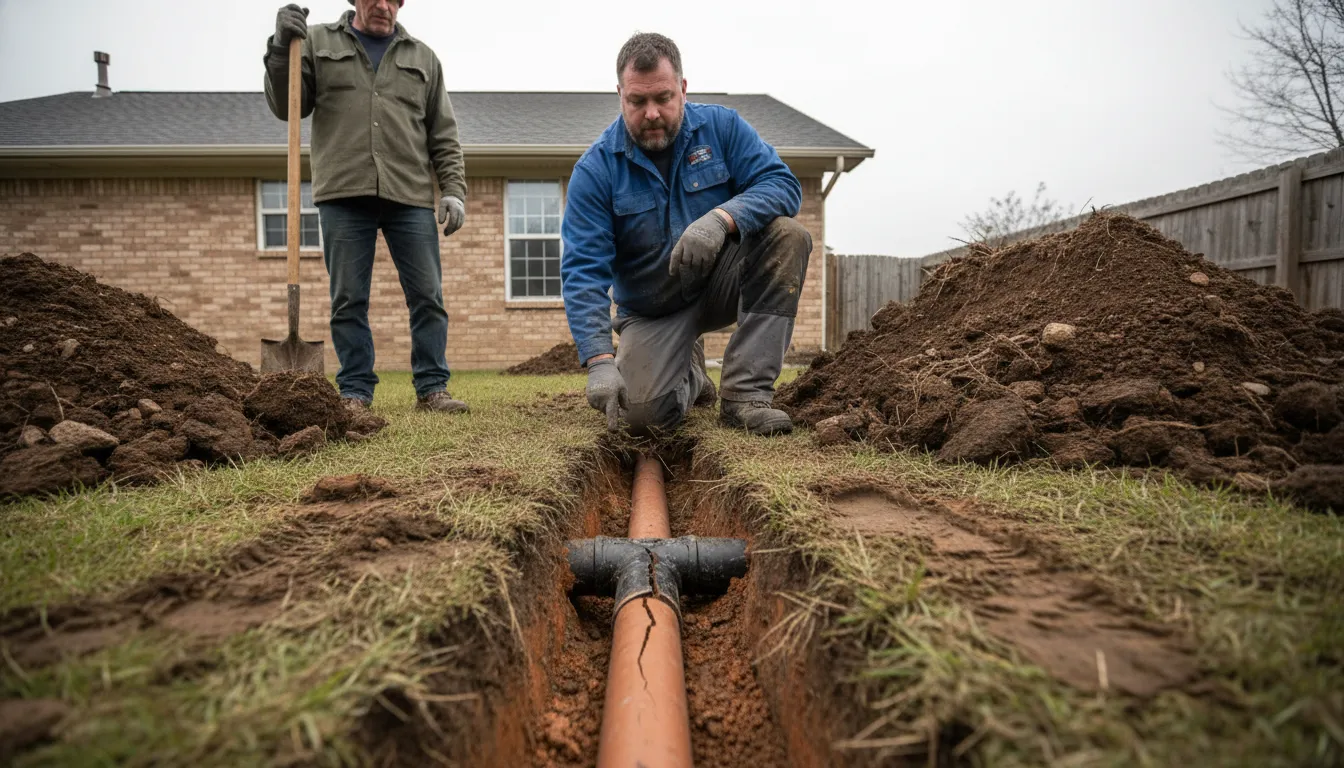
This is the conventional method where a trench is excavated along the entire length of the failed pipe to remove it and install a new one.
- Process: Full excavation from the home to the sewer main.
- Pros: Provides a complete view of the pipe, allows for replacement with modern materials, and is a definitive fix.
- Cons: Highly disruptive to yards, driveways, and landscaping; requires significant restoration; often more labor-intensive.
- Cost Factors: Costs are typically calculated per linear foot and vary by material. PVC replacement may range from $50-$100 per foot, while replacing old cast iron can cost $100-$200 per foot 7. A full line replacement can range from $3,000 to over $30,000 depending on length, depth, and obstacles8.
Trenchless Repair Methods
These techniques minimize excavation, often requiring only small access pits at the beginning and end of the section.
- Cured-In-Place Pipe (CIPP) Lining: A flexible, resin-saturated liner is inserted into the old pipe and inflated. The resin cures, forming a hard, seamless "pipe within a pipe."
- Pipe Bursting: A bursting head is pulled through the old pipe, simultaneously fracturing it outward while dragging a new HDPE (high-density polyethylene) pipe into place behind it.
- Pros: Much less disruptive to property; often faster; can be a cost-effective solution for long runs under obstacles.
- Cons: Not suitable for all pipe failures (e.g., completely collapsed pipes); requires specific pipe condition and access points.
- Cost: Trenchless methods can be a few thousand dollars for a short section but vary widely based on technology and project scope9 10.
Spot Repair
For a single, isolated problem like a crack or a small section of root intrusion, a localized repair may be possible.
- Process: Excavating only the immediate area of the damage and replacing a short segment of pipe.
- Pros: Least expensive option; minimal disruption.
- Cons: Only viable if the rest of the pipe is in sound condition. A camera inspection is crucial to verify this.
- Cost: Can start around $650 and go up to $7,500 or more for a more involved 30-foot section repair11 12.
The Decision Process: From Symptoms to Solution
- Recognize the Signs: Frequent drain clogs, gurgling toilets, sewage backups in basement drains, soggy patches or sinkholes in the yard, and unexplained foul odors are all red flags.
- Get a Professional Inspection: A licensed plumber will perform a sewer camera inspection. A small camera is snaked through the line, providing a real-time video diagnosis of the problem's location, cause, and severity. This is the most important step for an accurate repair plan and estimate.
- Review Repair Options & Quotes: Based on the video, the professional will explain which repair methods are viable for your specific situation-considering pipe material, damage type, location, and access. They should provide a detailed written estimate.
- Understand the Full Scope: Ensure the quote includes all costs: permits, Maine 811 locates, excavation, repair method, materials, and full site restoration (backfilling, grading, reseeding, or repaving).
- Choose a Qualified Contractor: Select a licensed, insured plumber or sewer specialist with proven experience in the recommended repair method. Check references and verify they will handle all necessary permits and utility notifications.
Long-Term Health of Your Sewer Line
Once repaired, you can take steps to protect your investment.
- Mind Your Landscaping: Know where your sewer line runs and avoid planting trees with aggressive root systems (like willows or maples) near it.
- Be Careful What You Flush: Only human waste and toilet paper should go down the drain. Avoid "flushable" wipes, feminine hygiene products, cooking grease, and paper towels.
- Consider Preventative Maintenance: For older lines, periodic camera inspections can catch small issues like root hairs or minor cracks before they become major failures.
Navigating a sewer line repair in Maine requires understanding local geology, regulations, and the technologies available. By starting with a thorough camera inspection and working with a knowledgeable professional, you can ensure your home's essential wastewater system is restored reliably and efficiently.
Frequently asked questions
Sources
Footnotes
-
Complete Guide to Residential Sewer Line Maintenance & Repair - https://sswaterworks.com/complete-guide-to-residential-sewer-line/ ↩
-
Need To Replace A Sewer Line? 4 Important Points To Consider - https://www.balkanplumbing.com/repair-sewer-line-timeframe-factors/ ↩
-
Cost to Replace Cast Iron Drain Pipe Under Slab - https://www.benjaminfranklinplumbing.com/league-city/blog/2024/december/cost-to-replace-cast-iron-drain-pipe-under-slab-key-factors-and-pricing-guide/ ↩
-
Understanding Sewer Line Replacement: What to Expect - https://flomaxxinc.net/blogs/understanding-sewer-line-replacement-guide-cost-process/ ↩
-
Standard Specifications and Guide 2025 Update.pdf - https://www.brunswicksewer.org/Standard%20Specifications%20and%20Guide%202025%20Update.pdf ↩
-
Sewer Line Repairs and Replacement - https://www.siteprep.com/sewer-repairs/ ↩
-
Understanding Sewer Line Replacement: A Comprehensive Guide - https://dirtcheapsewer.com/understanding-sewer-line-replacement/ ↩
-
Sewer Replacement Cost... - https://northeastsewer.com/2013/06/sewer-replacement-cost/ ↩
-
Sewer Rehabilitation | Portland, ME - Official Website - https://www.portlandmaine.gov/576/Sewer-Rehabilitation ↩
-
How Is the Cost of Sewer Line Repair Determined? - https://www.callwaldrop.com/blog/how-is-the-cost-of-sewer-line-repair-determined/ ↩
-
Everything You Need to Know About Sewer Line Replacement - https://www.splashplumbing.com/everything-you-need-to-know-about-sewer-line-replacement-a-comprehensive-guide-for-homeowners-in-2025/ ↩
-
Main Sewer Line Replacement Cost - https://nodig.com/main-sewer-line-replacement-cost ↩