Find the Best Sewer Line Repair Companies for Your Business
No obligation • Fast responses • Nationwide coverage

Why you can trust Search a Plumber
Search a Plumber is a leading United States resource for finding and evaluating professional plumbing services. Our team researches licensing, experience, and customer feedback to create unbiased, fact-driven overviews. Companies cannot pay to change ratings or placement, ensuring homeowners get trustworthy information.
Search providers near you
Best Sewer Line Repair Companies in Connecticut Ranked
A failing sewer line is a serious issue that can lead to backups, property damage, and significant inconvenience. Sewer line repair involves diagnosing and fixing the underground pipe that carries wastewater from your home to the municipal sewer main. In Connecticut, this work is governed by specific state and local codes and often requires navigating older infrastructure. This guide provides clear, practical information to help you understand the repair process, costs, and key considerations for finding a qualified professional to restore your home's essential plumbing system.
Understanding Your Sewer Line System
The sewer lateral is your home's private responsibility, typically running from the foundation wall to the connection point at the public sewer main in the street or an easement. In Connecticut, many homes, especially those built before the 1970s, have sewer lines made from older materials that are now reaching the end of their lifespan. Understanding what your pipe is made of is the first step in diagnosing problems.
- Clay or Concrete Pipes: Common in older homes, these are prone to root intrusion from seeking moisture, cracking from ground movement, and misalignment at the joints over time.
- Cast Iron or Steel Pipes: Also found in older installations, these metal pipes are susceptible to corrosion and rust, which can eventually lead to cracks or complete collapse.
- PVC or HDPE Pipes: Modern materials used in newer installations and replacements. They are more durable and resistant to root intrusion and corrosion, but can still be damaged by severe ground shifting or improper installation 1.
Common Causes of Sewer Line Failure in CT
Several factors contribute to sewer line problems, often in combination. Connecticut's climate and soil conditions play a significant role.
- Tree Root Intrusion: This is a leading cause of blockages and damage. Roots are attracted to the moisture and nutrients in sewer pipes, especially at joints in older clay pipes. They can create dense blockages and exert pressure that cracks or collapses pipes.
- Ground Shifting and Settlement: Freeze-thaw cycles, soil erosion, and general settling over time can put stress on sewer lines, causing them to crack, break, or become misaligned. Proper winterization, including insulating cleanouts, is a key preventative measure.
- Aging and Material Deterioration: All materials degrade. Clay pipes become brittle, cast iron rusts, and even modern pipes can fail due to manufacturing defects or improper installation.
- Grease and Debris Buildup: Pouring fats, oils, and grease (FOG) down drains or flushing inappropriate items can create stubborn blockages that put pressure on the pipe walls and restrict flow.
- Bellied or Sagging Pipes: A section of the pipe can sink due to ground conditions, creating a low spot where waste and solids collect, leading to chronic blockages.
The Diagnostic Process: Camera Inspection
Before any repair can be planned, a professional must accurately diagnose the problem. A sewer camera inspection is a non-invasive, essential first step. A plumber will feed a high-resolution, waterproof camera on a flexible rod into your sewer line via a cleanout. This allows them to:
- Pinpoint the exact location and depth of the problem.
- Identify the type of damage (crack, break, root mass, collapse, bellied section).
- Assess the pipe's material and overall condition.
- Determine the most effective and cost-efficient repair method.
Having a video record is also often required by local building departments when applying for a repair permit.
Key Factors Influencing Repair Scope and Cost in Connecticut
The cost and complexity of sewer line repair in Connecticut are not one-size-fits-all. Several critical factors will determine the final project scope and price, which can range from $1,000 for a minor spot repair to $30,000 or more for a full, complex replacement.
- Depth and Location of the Pipe: Deeper lines require more extensive excavation, which increases labor, time, and cost significantly. The pipe's path-whether it runs under a lawn, driveway, garden, or patio-also dictates the repair approach and restoration needs.
- Extent and Type of Damage: Is it a single, localized crack, or is the pipe riddled with holes and breaks? A complete collapse requires a different solution than minor root intrusion. The repair method must match the problem.
- Accessibility: The presence of a cleanout (an access point to the sewer line) is crucial for inspection and many repair techniques. If one doesn't exist, installing one becomes an additional first step 2 3.
- Length of the Damaged Section: Repairs are often priced per linear foot. A 10-foot section of damaged pipe will cost less to address than 50 feet.
- Local Regulations and Permits: All sewer repair work in Connecticut requires permits from the local building department. In some cases, work may also need approval from the Connecticut Department of Energy and Environmental Protection (CT DEEP), especially if it's near wetlands or involves certain discharge issues. Repairs must comply with the Connecticut State Building Code, which adopts the International Plumbing Code (IPC) with amendments 4.
Find the perfect sewer line repair companies for your needs
Get personalized recommendations and expert advice
Sewer Line Repair Methods
Once diagnosed, your plumbing professional will recommend the most suitable repair method. The two primary categories are traditional excavation (trenching) and modern trenchless technologies.
Trenchless Repair Methods
Trenchless methods are often preferred because they minimize disruption to your property, landscaping, and hardscapes like driveways.
- Cured-in-Place Pipe (CIPP) Lining: This is a common trenchless solution for pipes with cracks, holes, or minor root damage but that are still structurally intact. A resin-saturated felt tube is inverted or pulled into the old pipe and inflated. The resin cures, forming a hard, seamless "pipe-within-a-pipe." CIPP lining typically costs $80 to $250+ per foot and is ideal for preventing root intrusion and sealing leaks.
- Pipe Bursting: This method is used when the old pipe is too damaged to line and needs full replacement. A bursting head is pulled through the old pipe, fracturing it outward while simultaneously pulling a new HDPE pipe into place behind it. It requires small access pits but avoids a long, open trench.
Traditional Trench (Excavation) Methods
Sometimes, excavation is the only or most practical solution.
- Spot Repair: For a single, isolated problem (e.g., one broken section), a plumber will excavate down to that specific spot, replace the damaged segment, and backfill. This is often the most cost-effective solution for localized damage.
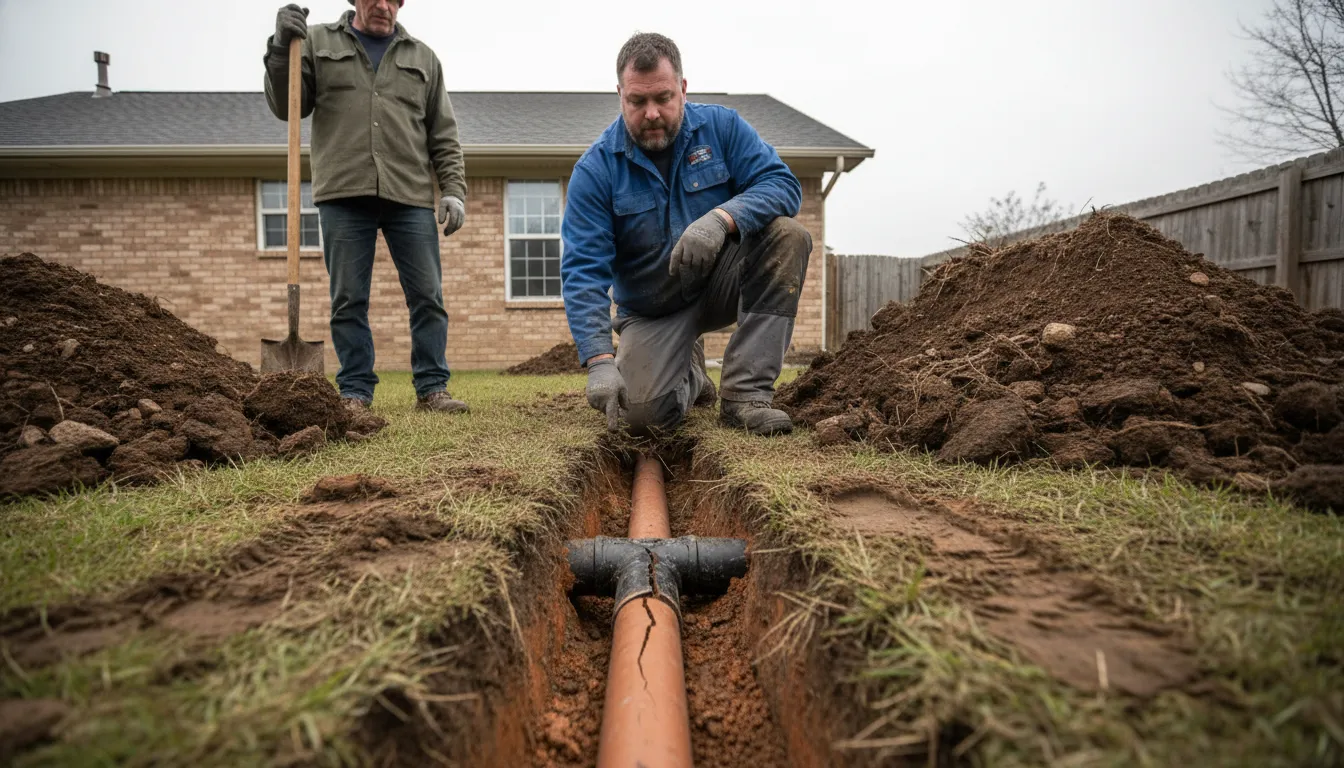
- Full Trench Replacement: When a pipe is extensively damaged, collapsed, or severely bellied, a full replacement is necessary. A trench is dug along the entire length of the pipe, the old pipe is removed, and a new one is installed. This is the most invasive and typically most expensive option, with costs often averaging $12,000 to $15,000 for a standard 100-foot residential line, but can reach $5,000 to $30,000+ depending on depth and obstacles.
Mandatory Steps: Permits and Utility Locates
Before any digging or repair begins, two non-negotiable steps must be completed in Connecticut.
- Call 811 "Call Before You Dig": This free, mandatory service is the law. You or your contractor must call at least a few business days before any excavation. Utility companies will then come to your property to mark the approximate locations of public underground lines (gas, water, electric, cable). This is critical for safety and avoiding costly, dangerous strikes 5 6.
- Obtain Local Permits: Your plumbing contractor will typically pull the required permits from your town or city's building department. The permit process ensures the work is performed to code and may require pre- and post-repair video inspections. Failure to get permits can result in fines and problems when you sell your home.
Cost Breakdown and Considerations
While every job is unique, here is a general breakdown of what influences the final bill for sewer line repair in Connecticut:
- Diagnostic Camera Inspection: $250 - $500.
- Trenchless CIPP Lining: $80 - $250+ per linear foot, depending on diameter and project complexity 7.
- Full Trench Replacement: $5,000 - $30,000+, with a typical range of $12,000 - $15,000 for a 100-foot line. Depth, access, and restoration work (like repaving a driveway) are major cost drivers 8 9 10 11.
- Collapsed Line Repair: $7,500 - $30,000+, as this often requires extensive excavation and replacement 12 13.
- Permit Fees: Vary by municipality but are a necessary line item.
- Restoration Costs: Refilling the trench, reseeding lawn, or replacing concrete/asphalt. A reputable contractor will include this in the estimate.
Choosing a Qualified Professional in Connecticut
Selecting the right contractor is as important as choosing the right repair method. Look for:
- Proper Licensing: Ensure they are licensed by the State of Connecticut.
- Insurance and Bonding: Verify they carry general liability and workers' compensation insurance.
- Local Experience: A company familiar with your town's specific permit process, soil conditions, and common issues will navigate the project more efficiently.
- Detailed, Written Estimates: Get at least three detailed estimates that break down labor, materials, permit fees, and restoration. Be wary of quotes that seem unusually low.
- References and Reviews: Check online reviews and ask for references from recent, similar jobs.
- Warranty: A strong warranty on both materials and labor is a sign of a confident, reputable professional.
Frequently asked questions
Sources
Footnotes
-
How Certified Plumbers Remove Old Sewer Lines - https://www.veteranplumbing.us/how-certified-plumbers-remove-old-sewer-lines/ ↩
-
Need To Replace A Sewer Line? 4 Important Points To Consider - https://www.balkanplumbing.com/repair-sewer-line-timeframe-factors/ ↩
-
Complete Guide to Residential Sewer Line Maintenance ... - https://sswaterworks.com/complete-guide-to-residential-sewer-line/ ↩
-
2022 Connecticut State Building Code - https://www.cga.ct.gov/rr/related/20220524_2022%20Connecticut%20State%20Building%20Code/1%29%20Proposed%202022%20Connecticut%20State%20Building%20Code.pdf ↩
-
Sewer Specifications Gravity PDF - Middletown, CT - https://www.middletownct.gov/DocumentCenter/View/1308/Sewer-Specifications-Gravity-PDF ↩
-
Essential Guide to Sewer Repair in CT: How to Address ... - https://www.sewerrepairct.com/essential-guide-to-sewer-repair-in-ct-how-to-address-common-issues-in-2025/ ↩
-
How Much Does Pipe Lining Cost: A Detailed Cost Breakdown - https://www.benjaminfranklinplumbing.com/league-city/blog/2024/december/how-much-does-pipe-lining-cost-a-detailed-cost-breakdown/ ↩
-
Everything You Need to Know About Sewer Line Replacement - https://www.splashplumbing.com/everything-you-need-to-know-about-sewer-line-replacement-a-comprehensive-guide-for-homeowners-in-2025/ ↩
-
Understanding Sewer Line Replacement: What to Expect - https://flomaxxinc.net/blogs/understanding-sewer-line-replacement-guide-cost-process/ ↩
-
How Much Does Sewer Line Replacement Cost? - CPI Service - https://cpiservice.com/blog/sewer-line-replacement-cost/ ↩
-
The Cost of Sewer Line Replacement: What to Expect - https://dirtcheapsewer.com/the-cost-of-sewer-line-replacement/ ↩
-
2025 Sewer Line Repair & Replacement Costs | What to Expect - https://modernize.com/plumbing/systems/drainage/sewer-line-repair-replace-cost ↩
-
How Is the Cost of Sewer Line Repair Determined? - https://www.callwaldrop.com/blog/how-is-the-cost-of-sewer-line-repair-determined/ ↩