Find the Best Water Treatment Installation Companies for Your Business
No obligation • Fast responses • Nationwide coverage

Why you can trust Search a Plumber
Search a Plumber is a leading United States resource for finding and evaluating professional plumbing services. Our team researches licensing, experience, and customer feedback to create unbiased, fact-driven overviews. Companies cannot pay to change ratings or placement, ensuring homeowners get trustworthy information.
Search providers near you
Find Water Treatment Installation Companies near you
Improving your home's water quality is a significant investment in your health, your appliances, and your overall comfort. Water treatment systems, including water softeners and various filtration technologies, are designed to tackle specific problems like hard water minerals, chlorine taste, sediment, and biological contaminants. Understanding the options available-from whole-home systems to point-of-use solutions-is the first step toward cleaner, better-tasting water. This guide provides a clear overview of the technologies, costs, and considerations for water treatment in the US, helping you identify the right solution for your household's needs and connect with qualified local professionals for installation and service.
Search providers near you
Understanding Your Water Treatment Needs
Before investing in a system, it's crucial to identify what you want to remove from your water. Common issues include:
- Hard Water: Characterized by scale buildup in pipes and appliances, soap scum, dry skin, and stiff laundry. This is caused by dissolved calcium and magnesium minerals.
- Chlorine Taste and Odor: Municipal water suppliers use chlorine for disinfection, which can leave an unpleasant taste and smell.
- Sediment: Visible particles like sand, silt, or rust that can clog fixtures and appliances.
- Specific Contaminants: These can include lead, nitrates, arsenic, pesticides, or volatile organic compounds (VOCs), which may require targeted filtration.
- Biological Threats: Bacteria, viruses, and cysts that can pose health risks, especially with well water.
A professional water test is the best way to get a complete picture of your water's composition and determine the most effective treatment strategy.
Core Water Treatment Technologies
Water treatment systems use different methods to address specific problems. Often, a combination of technologies provides the most comprehensive solution.
Water Softeners (Ion Exchange)
This is the most common and effective method for removing water hardness. A traditional salt-based water softener contains a tank filled with resin beads charged with sodium or potassium ions. As hard water flows through, the beads attract and hold the calcium and magnesium ions, releasing sodium ions in exchange, thereby "softening" the water. Periodically, the system enters a regeneration cycle, flushing the trapped minerals to the drain and recharging the beads with a brine solution from a separate salt tank.
Key Considerations: These systems require a drain line, a power source, and space for both the mineral tank and the brine tank. Regular salt refills and occasional resin bed cleaning are part of the maintenance.
Salt-Free Water Conditioners
For those who want to prevent scale without adding sodium to their water or dealing with salt bags, salt-free systems are an alternative. They often use a technology called Template Assisted Crystallization (TAC). Instead of removing hardness minerals, they convert them into microscopic crystals that cannot stick to surfaces, preventing scale buildup in pipes and appliances 1. It's important to note that these are conditioners, not softeners; they don't remove the minerals, so you won't get the same soap-lathering or skin-softening benefits.
Filtration Systems
Filtration addresses a wide range of contaminants beyond hardness. Systems can be installed for the whole house or at specific points of use, like under a kitchen sink.
- Activated Carbon Filters: Excellent for removing chlorine, bad tastes, odors, and some organic chemicals. Water passes through a cartridge of highly porous carbon that adsorbs contaminants 2. These are common in whole-home systems and pitcher filters.
- Sediment Filters: Simple mechanical filters (often made of pleated polyester or string) that trap dirt, sand, and rust particles. They are frequently used as a pre-filter to protect more advanced systems downstream.
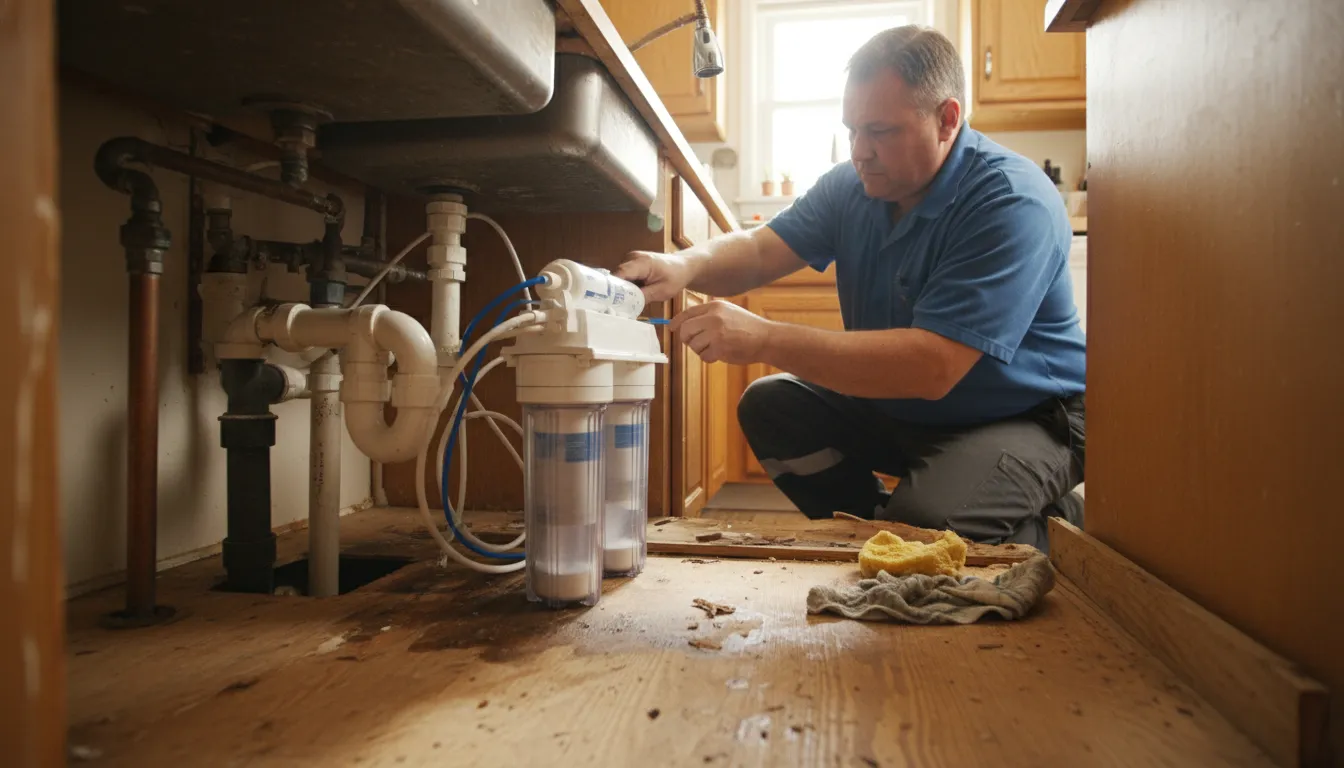
- Reverse Osmosis (RO): One of the most thorough filtration methods. Water is forced under pressure through a semi-permeable membrane with extremely tiny pores, removing up to 99% of contaminants, including dissolved solids, lead, nitrates, fluoride, and more 3. RO systems typically include pre-filters (sediment and carbon) and a post-filter. They are most commonly installed under the sink for drinking and cooking water, though whole-home RO systems exist at a higher cost.
- Ultraviolet (UV) Purification: This technology uses ultraviolet light to disinfect water by inactivating bacteria, viruses, and other microorganisms. UV systems do not remove chemicals or particles, so they are almost always paired with pre-filtration.
System Installation and Placement
Professional installation is highly recommended for whole-home water treatment systems. A qualified technician will ensure the system is correctly integrated into your home's plumbing, with proper water flow, pressure, and drainage.
Typical installation locations include:
- Point of Entry (POE): Where the main water line enters your home. This treats all water used in the house-for showers, laundry, appliances, and sinks. Softeners and whole-house filters are installed here.
- Point of Use (POU): At a specific fixture, such as under the kitchen sink (for an RO system), on a refrigerator line, or in a shower. This targets water used for drinking, cooking, or bathing.
The installer will need access to the main water line, a drain for wastewater (for softeners and RO systems), and an electrical outlet for systems with digital controls or UV lamps. Adequate space in a basement, utility room, or garage is also necessary 4.
Find the perfect water treatment installation companies for your needs
Get personalized recommendations and expert advice
Costs of Water Softening and Filtration Systems
The total investment for a water treatment system includes the equipment and professional installation. Prices vary widely based on technology, capacity (based on your home's size and water usage), and brand.
- Ion Exchange Water Softeners: $400 to over $3,000 for the unit, depending on whether it's a single-tank or more efficient dual-tank (demand-initiated) system.
- Whole-Home Carbon Filtration Systems: $1,000 to $2,500 for the unit.
- Reverse Osmosis Systems: Under-sink drinking water systems range from $100 to $1,500. Whole-home RO systems are a significant investment, starting around $4,000 and can exceed $11,000 5.
- UV Purification Systems: $200 to $3,000+.
- Salt-Free Conditioning Systems: $500 to $4,000 6.
Installation costs typically add several hundred to over a thousand dollars to the total, depending on plumbing complexity. A comprehensive whole-home system combining a softener and a filter can represent a total initial investment of $1,200 to $5,800 or more 7 8.
Ongoing Maintenance and Operating Costs
To keep any system performing effectively, regular maintenance is non-negotiable.
- Salt-Based Softeners: You must keep the brine tank filled with salt (or potassium chloride) pellets. The frequency depends on your water hardness and household size.
- All Filters: Cartridges and membranes have a finite lifespan. Sediment and carbon pre-filters may need changing every 3-12 months. RO membranes can last 2-3 years. Following the manufacturer's schedule is essential for water quality and to protect the equipment 9.
- UV Systems: The UV lamp loses intensity over time and must be replaced annually, even if it still lights up.
- Annual Servicing: Having a professional inspect your system yearly is wise. They can check for leaks, ensure proper regeneration cycles, test water quality, and perform any necessary cleaning or adjustments 10 11.
Choosing the Right System for Your Home
Selecting a water treatment system is not one-size-fits-all. Follow these steps:
- Test Your Water: Start with a detailed analysis to know exactly what you're dealing with.
- Define Your Goals: Is your primary concern scale prevention (softening), better taste (carbon filtration), contaminant removal (RO), or disinfection (UV)?
- Consider Capacity: Size the system based on your home's number of bathrooms and occupants. An undersized system will be inefficient.
- Evaluate Space and Utilities: Ensure you have the necessary space, drain access, and power for the system you choose.
- Plan for Maintenance: Be realistic about the ongoing time and cost of replacements and servicing.
- Consult a Professional: A reputable water treatment specialist can review your test results, assess your home's plumbing, and recommend a system that provides an effective, efficient solution tailored to your needs and budget 12.
Frequently asked questions
Sources
Footnotes
-
Water Softener Systems: 2025 Buyer's Guide, Costs, Benefits - https://www.frizzlife.com/blogs/guide/water-softener-systems-2025-buyer-s-guide-costs-benefits ↩
-
Homeowners Guide to Whole Home Water Filter and ... - https://www.carrollwater.com/blog/homeowners-guide-to-whole-home-water-filter-system/ ↩
-
How Water Softeners Work | Woodland, CA - https://www.cityofwoodland.gov/764/How-Water-Softeners-Work ↩
-
Where Are Water Softeners Installed: 7 Powerful Best Spots 2025 - https://www.aaastl.com/blog/where-are-water-softeners-installed/ ↩
-
Home Water Treatment Systems: Types, Features, Benefits & More - https://modernize.com/water-treatment ↩
-
Home Water Filtration System Cost - https://www.puresoftwatertreatments.com/home-water-filtration-system-cost ↩
-
2026 Water Softener Costs by Capacity, Size, Type & More - https://modernize.com/water-treatment/types/water-softener-installation-cost ↩
-
How Much Does It Cost to Install a Water Filtration System In 2026? - https://modernize.com/water-treatment/types/water-filtration-system-cost ↩
-
Best Whole House Water Filtration System: 2025 Guide - https://www.culligan.com/blog/everything-you-need-to-know-about-home-water-filtration-systems ↩
-
Water Filtration System Costs & Installation Guide - https://www.benjaminfranklinplumbing.com/league-city/blog/2025/january/how-much-does-water-filtration-system-cost-a-comprehensive-pricing-guide/ ↩
-
How Does A Water Softener Work? - Aquasure USA - https://aquasureusa.com/blogs/water-guide/how-does-a-water-softener-work ↩
-
Purchasing and Maintaining A Water Softener - https://www.energy.gov/energysaver/purchasing-and-maintaining-water-softener ↩