Find the Best Water Treatment Installation Companies for Your Business
No obligation • Fast responses • Nationwide coverage

Why you can trust Search a Plumber
Search a Plumber is a leading United States resource for finding and evaluating professional plumbing services. Our team researches licensing, experience, and customer feedback to create unbiased, fact-driven overviews. Companies cannot pay to change ratings or placement, ensuring homeowners get trustworthy information.
Search providers near you
Best Water Treatment Installation Companies in Connecticut Ranked
Connecticut homeowners often face water quality challenges, from hard water that leaves scale on fixtures to iron staining and other contaminants. Addressing these issues is essential for protecting your plumbing, improving appliance efficiency, and ensuring better-tasting, safer water for your household. This guide provides a detailed overview of water treatment options, helping you understand the solutions available and how to connect with qualified local professionals who can assess your specific needs and install the right system.
Understanding Connecticut's Common Water Issues
The quality of your water depends largely on its source. Whether you're on a municipal supply or a private well, several common problems can affect homes across the state.
Hard Water is a prevalent issue, characterized by high levels of calcium and magnesium minerals. This leads to limescale buildup inside pipes, water heaters, and on faucets and showerheads. You might notice soap doesn't lather well, dishes have spots after washing, and your skin feels dry after showering. Over time, scale accumulation can significantly reduce the efficiency and lifespan of your appliances.
Iron and Manganese are frequent concerns, especially for well owners. Dissolved iron causes telltale reddish-brown stains on sinks, tubs, toilets, and laundry. It can also impart a metallic taste and odor to your water. Manganese behaves similarly, often causing black or purple staining.
pH Imbalance is another critical factor. Water that is too acidic (low pH) can corrode copper pipes, leading to blue-green stains and potentially leaching metals like lead from older plumbing into your water. Conversely, highly alkaline water can also cause scaling and other issues.
Well Water Contaminants require special attention. Beyond minerals, private wells can be susceptible to bacteria, nitrates from agricultural runoff, naturally occurring radon, and man-made chemicals like PFAS. Professional testing is the only way to identify these invisible threats.
Types of Water Treatment Systems
Choosing the right system starts with a professional water test. Based on the results, a specialist might recommend one or a combination of the following technologies.
Ion Exchange Water Softeners are the standard solution for hard water. They work by exchanging calcium and magnesium ions for sodium (or potassium) ions, effectively removing the minerals that cause scale. These are typically whole-house systems installed where the main water line enters your home.
Iron and Manganese Filters use specialized filtration media to oxidize and filter out these metals. They are often installed in tandem with a softener for comprehensive treatment, particularly for well water 1.
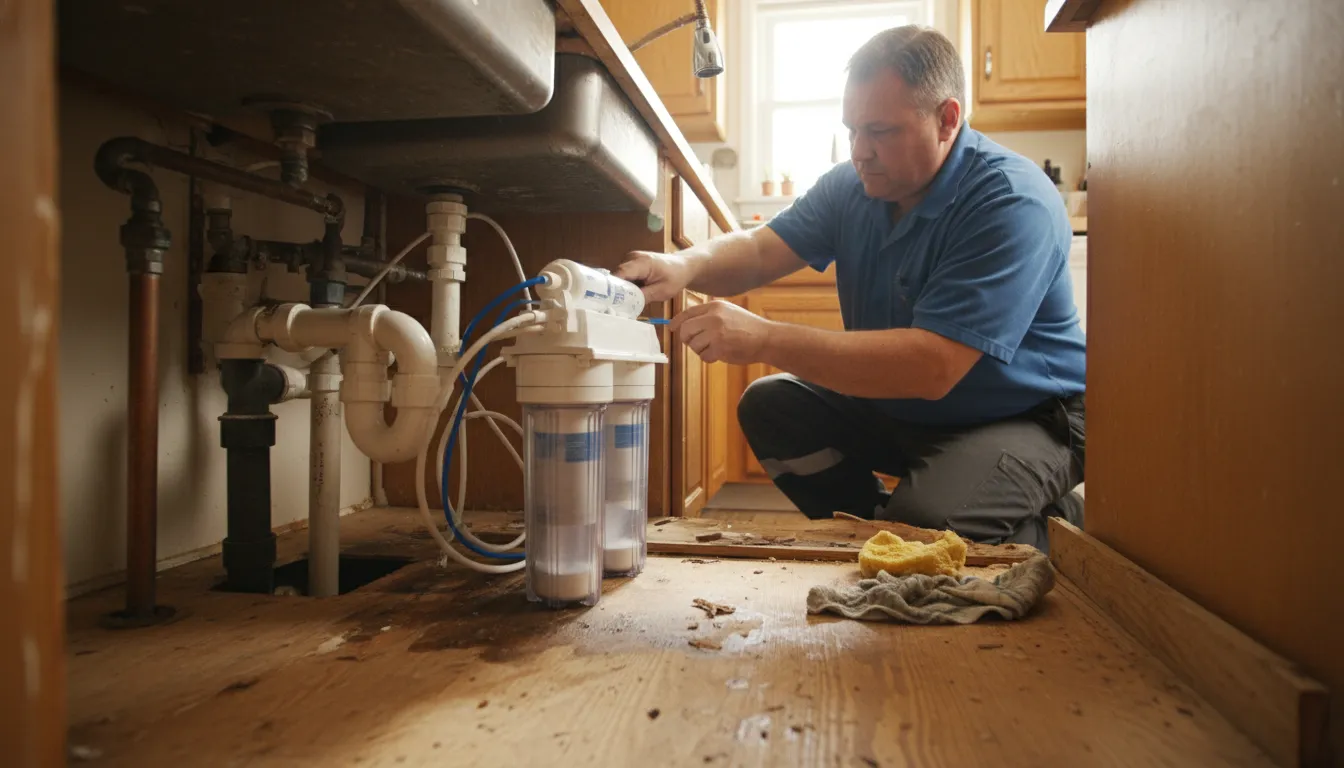
Reverse Osmosis (RO) Systems provide highly purified water for drinking and cooking. A point-of-use RO system installed under your kitchen sink forces water through a semi-permeable membrane, removing a wide array of contaminants, including dissolved solids, nitrates, and certain chemicals 2. Whole-home RO systems are also available but are less common due to higher cost and water usage.
UV (Ultraviolet) Disinfection Systems are crucial for microbiological safety. By exposing water to ultraviolet light, these systems effectively destroy bacteria, viruses, and other pathogens without adding chemicals, making them an excellent choice for treating well water 3.
pH Neutralizers correct acidic water by passing it through a calcite or other neutralizing media tank. This raises the pH to a non-corrosive level, protecting your entire plumbing system from damage 4.
Whole-Home Filtration Systems use large carbon or sediment filters to remove chlorine, bad tastes, odors, and particulate matter from all the water entering your home. These are popular for municipal water supplies treated with chlorine.
The Professional Installation Process
Proper installation is key to system performance and longevity. A professional installation typically follows these steps 5:
- Comprehensive Water Testing: This is the essential first step. A technician will take samples, often testing for hardness, iron, pH, TDS (Total Dissolved Solids), and other relevant parameters. For wells, a more extensive lab test is recommended 6.
- System Selection and Sizing: Based on test results, water usage (number of bathrooms, occupants), and your home's plumbing, the professional will recommend a system with the correct capacity and technology mix.
- Site Preparation and Plumbing: The installer will identify the optimal location, usually near the main water entry point. The process involves cutting into the main water line, installing bypass valves (for future maintenance), and connecting drain lines for system backwashing and regeneration 7.
- System Setup and Programming: The unit is secured, all connections are made, and the control valve is programmed based on your water hardness level and estimated usage patterns. For softeners, salt is added to the brine tank.
- Final Testing and Orientation: The system is activated and cycled. The technician will check for leaks, verify settings, and walk you through basic operation, maintenance tasks, and what to expect as the system starts working.
Find the perfect water treatment installation companies for your needs
Get personalized recommendations and expert advice
Ongoing Maintenance and Costs
Like any home appliance, water treatment systems require regular upkeep to function correctly.
For Water Softeners: Maintenance is relatively straightforward but consistent. You'll need to keep the brine tank filled with salt (or potassium chloride) pellets, which typically costs between $5 and $15 per month depending on water hardness and household size 8. The brine tank itself should be cleaned of salt mush and debris every 3 to 6 months. An annual professional checkup is advisable to inspect the resin tank, clean the venturi, and ensure the control valve is functioning properly 8.
For Filtration Systems: Maintenance primarily involves scheduled filter changes. The frequency and cost depend on the filter type and your water quality. Whole-house sediment filters may need changing every 3-6 months, while carbon filters might last 6-12 months. Replacement filters can range from $50 to $400 annually. UV lamp bulbs must be replaced annually to maintain their germicidal effectiveness.
Understanding the Investment
The cost of water treatment in Connecticut varies based on system type, capacity, and installation complexity.
- Water Softeners: A standard ion-exchange softener, including professional installation, typically ranges from $1,000 to $3,000 9. Some companies offer rental options, which can cost $30 to $50 per month, often including maintenance and salt 10.
- Whole-Home Filtration Systems: For systems addressing multiple contaminants (e.g., sediment, chlorine, taste/odor), installed costs generally fall between $2,000 and $5,000 or more 11 12.
- Specialized Systems: Adding an iron filter, pH neutralizer, or UV system will increase the total project cost. A point-of-use reverse osmosis system for the kitchen typically costs $500 to $2,000 installed 13.
While the upfront investment can be significant, it should be weighed against the costs of untreated water: higher energy bills from scaled-up water heaters, frequent appliance repairs or replacements, increased soap and detergent use, and potential plumbing repairs due to corrosion.
Choosing a Provider in Connecticut
When looking for a water treatment professional, seek out companies with specific expertise. Look for certifications from organizations like the Water Quality Association (WQA). A reputable provider will always insist on testing your water before making any recommendations. They should be transparent about all costs-equipment, installation, and ongoing maintenance. Finally, read reviews and ask for references to ensure they have a track record of quality service and customer support in your local area.
Frequently asked questions
Sources
Footnotes
-
The Best Iron Removal Water System CT for Clear, Safe ... - https://www.aerusofwesthartford.com/post/iron-removal-water-system-ct ↩
-
Water Treatment Solutions for Connecticut - https://tmscomfort.com/plumbing-services/water-treatment-solutions/ ↩
-
5 Types of Systems to Expect From a Water Treatment Company - https://www.watersystemsspecialtiesct.com/5-types-of-systems-to-expect-from-a-water-treatment-company ↩
-
Water Treatment Companies Watertown, CT - https://www.watersystemsspecialtiesct.com/water-testing ↩
-
Efficient Well Water Systems Installation - https://www.aws-ct.com/installation-process ↩
-
Water Filter Installation - Storrs Mansfield Plumbing Solutions - https://www.plumbingstorrsmanfield.com/water-filter-installation/ ↩
-
Installing a whole house water filter and water softener system - https://www.youtube.com/watch?v=aE4kYTACSOo ↩
-
Water Softener Maintenance Over Lifespan Jan, 2026 - https://www.softprowatersystems.com/pages/how-much-maintenance-does-a-water-softener-require ↩ ↩2
-
Water Softener System Cost in Danbury, CT (2025 Guide) - https://hvwellpump.com/water-softener-system-cost/ ↩
-
Water Filtration System vs Water Softener: What's Right for Your ... - https://hvwellpump.com/water-filtration ↩
-
Home Water Filtration System Cost - https://www.puresoftwatertreatments.com/home-water-filtration-system-cost ↩
-
Pros & Cons of Water Filtration Systems - Saffer Plumbing - https://www.safferplumbing.com/pros-and-cons-of-water-filtration-systems/ ↩
-
Water Filtration System Costs & Installation Guide - https://www.benjaminfranklinplumbing.com/league-city/blog/2025/january/how-much-does-water-filtration-system-cost-a-comprehensive-pricing-guide/ ↩