Find the Best Water Treatment Installation Companies for Your Business
No obligation • Fast responses • Nationwide coverage

Why you can trust Search a Plumber
Search a Plumber is a leading United States resource for finding and evaluating professional plumbing services. Our team researches licensing, experience, and customer feedback to create unbiased, fact-driven overviews. Companies cannot pay to change ratings or placement, ensuring homeowners get trustworthy information.
Search providers near you
Top Water Treatment Installation Companies in Danbury, Connecticut Ranked
If you live in Danbury, you've likely noticed the telltale signs of hard water: stubborn white scale on faucets and showerheads, soap that doesn't lather well, and dry, itchy skin after a shower. These issues are more than just a nuisance; they can shorten the lifespan of your water heater, dishwasher, and other appliances, leading to costly repairs and higher energy bills. A water treatment system is a practical solution that protects your home, your health, and your wallet. This guide will help you understand your options for water softening and filtration, from basic systems to comprehensive whole-house solutions, so you can make an informed decision for your household.

Understanding Danbury's Water Hardness
The first step in solving a water quality problem is understanding what you're dealing with. In Danbury, the average water hardness is measured at approximately 102 milligrams per liter (mg/L), or 6 grains per gallon (GPG) 1. This classifies the city's water supply as "moderately hard."
What does that mean for you? Water hardness is caused by dissolved minerals, primarily calcium and magnesium, which are naturally present as water moves through soil and rock. At 6 GPG, these minerals will gradually build up inside your pipes and on your fixtures as limescale. You'll see it as a chalky white residue on shower doors, faucet aerators, and inside your kettle. This scale acts as an insulator in your water heater, forcing it to work harder and use more energy. It also interferes with the effectiveness of soaps and detergents, leaving dishes spotty and laundry feeling stiff.
Types of Water Treatment Systems
Not all water problems require the same solution. Depending on your specific concerns-whether it's just mineral scale, a desire for better-tasting water, or the removal of specific contaminants-different systems are available. Here's a breakdown of the primary technologies used in Danbury homes.
Salt-Based Water Softeners (Ion Exchange)
This is the most common and effective solution specifically for hard water. An ion exchange water softener works by trading the hardness minerals (calcium and magnesium ions) in your water for sodium (or potassium) ions. The process happens inside a tank filled with resin beads. As hard water flows through, the beads grab the calcium and magnesium and release sodium in exchange, resulting in soft water 2.
Periodically, the system must "regenerate" or recharge. This involves flushing the resin tank with a highly concentrated saltwater (brine) solution, which washes away the accumulated hardness minerals and recharges the beads with sodium ions, ready for another cycle 3. These systems are ideal for whole-house protection against scale.
Whole-House Water Filtration Systems
While a softener handles minerals, a filtration system addresses a broader range of concerns. Whole-house filters, installed at your main water line, are designed to reduce sediment, chlorine taste and odor, and certain other contaminants from all the water entering your home. They are excellent for improving overall water quality for drinking, bathing, and washing. Many homeowners in Danbury choose to pair a whole-house filter with a water softener for comprehensive treatment-the filter handles chlorine and particulates upfront, which can extend the life of the softener's resin.
Reverse Osmosis (RO) Systems
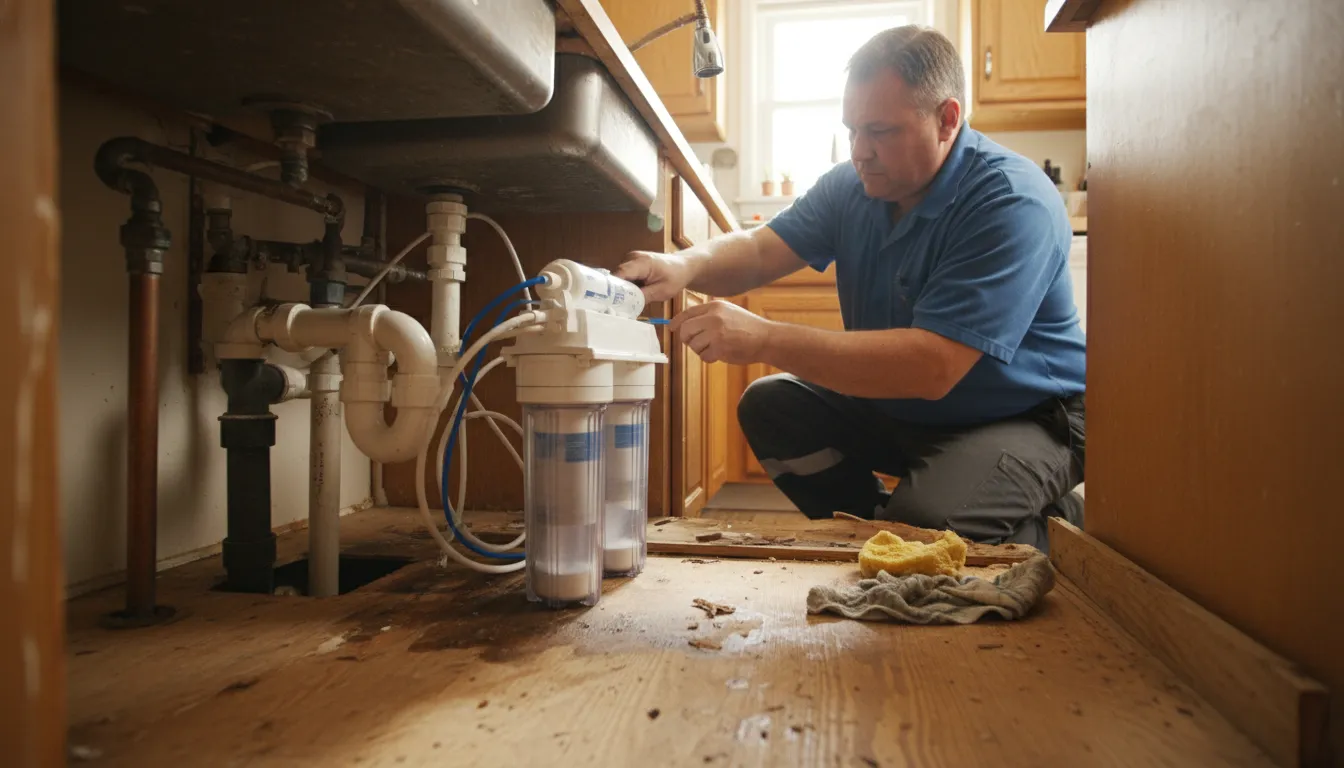
For the purest drinking water, a reverse osmosis system is the gold standard. RO uses a semi-permeable membrane to remove up to 99% of dissolved solids, including heavy metals, fluoride, nitrates, and more 4 5. It's important to note that RO systems are typically installed as a point-of-use system under a specific kitchen sink, providing filtered water for drinking and cooking. They are often used in conjunction with a whole-house softener; the softener protects the plumbing and appliances, while the RO system delivers premium water at the tap.
Hybrid and Combination Systems
The market also offers integrated units that combine softening and filtration into a single appliance. These hybrid systems can be a space-saving solution that provides multi-stage treatment, addressing hardness while also reducing chlorine, sediment, or other specific contaminants 6.
The Professional Installation Process
Installing a water treatment system is not a typical DIY project. It requires knowledge of local plumbing codes, proper sizing, and correct integration into your home's main water line. Here's what you can expect when you work with a professional.
-
Professional Water Testing: The process always begins with a water test. Reputable local companies often offer this service for free. A test will confirm the exact hardness level and can also check for other parameters like iron, pH, or chlorine. This data is crucial for recommending the right type and size of system.
-
System Sizing and Selection: A technician will help you choose a system with the proper "grain capacity" based on your water hardness and household size (number of people and bathrooms). An undersized softener will run out of capacity too quickly, while an oversized one is inefficient and wastes water and salt.
-
Installation Day: Professional installation is usually a swift process. A skilled plumber will identify the best location (often near the main water shut-off and water heater), cut into the main line, and install the control head, resin tank, and brine tank. The work typically involves soldering or using push-fit connections and programming the control valve. Most standard installations are completed in just a few hours.
Find the perfect water treatment installation companies for your needs
Get personalized recommendations and expert advice
Cost Considerations for Danbury Homeowners
Investing in water quality involves upfront equipment and installation costs, plus modest ongoing maintenance. Understanding these can help you budget effectively.
-
Equipment and Installation: For a standard salt-based water softener system in Danbury, total installed costs typically range from $1,000 to $3,000 7. The final price depends on the system's capacity, brand, and any additional filtration features. More advanced combination systems or those for larger homes can range from $4,000 to $6,000 installed 7 8. This cost generally includes the equipment, all necessary plumbing modifications, and the initial setup and programming by a certified technician.
-
Ongoing Maintenance and Operating Costs: The primary ongoing cost for a salt-based softener is the salt used for regeneration. You'll need to add bags of pellet salt to the brine tank every one to two months, depending on your water usage and hardness. For filtration systems, cartridge filters need to be replaced periodically (often every 6-12 months). The resin in a softener may also need replacement after 10-15 years of service 9.
Benefits Beyond Soft Water
The advantages of installing a water treatment system extend far beyond eliminating spotty dishes.
- Appliance Longevity and Efficiency: By preventing scale buildup, you protect your water heater, dishwasher, washing machine, and coffee maker. This can double the lifespan of these appliances and help them operate at peak efficiency, saving on energy and repair costs 10.
- Skin and Hair Health: Soft water allows soaps and shampoos to rinse away completely, leaving skin less dry and itchy and hair more manageable.
- Cleaning Efficiency: You'll use less soap, detergent, and dishwashing liquid. Without mineral interference, you'll get cleaner dishes, brighter laundry, and spend less time scrubbing scale from bathroom surfaces.
- Better Tasting Water: When paired with a filtration component, a system can remove chlorine and other elements that affect taste and odor, providing better-quality water from every tap.
Finding the Right Local Professional
Choosing a qualified installer is as important as choosing the right system. Look for established local companies with strong reputations, like those offering free in-home water tests and consultations. A trustworthy professional will explain your options clearly, provide a detailed written quote, and use high-quality, name-brand equipment. They should also explain the warranty and what ongoing service and support they offer.
Frequently asked questions
Sources
Footnotes
-
Water Hardness Connecticut | Aquatell US. - https://www.aquatell.com/pages/water-hardness-connecticut ↩
-
Purchasing and Maintaining A Water Softener | Department of Energy - https://www.energy.gov/energysaver/purchasing-and-maintaining-water-softener ↩
-
Water Softener - 5 Recharge / Regeneration Stages - https://products.geappliances.com/appliance/gea-support-search-content?contentId=21020 ↩
-
What Does a Home Water Filtration System Cost? - https://nexgenairandplumbing.com/blog/what-does-a-home-water-filtration-system-cost/ ↩
-
How to Choose a Water Softener for Your Home | Step-by-Step Guide - https://homewater101.com/articles/find-water-softening-solution ↩
-
Water Filtration System in Danbury - https://carminesac.com/plumbing/water-filtration-systems/ ↩
-
Water Softener System Cost in Danbury, CT (2025 Guide) - https://hvwellpump.com/water-softener-system-cost/ ↩ ↩2
-
2026 Water Softener Costs by Capacity, Size, Type & More - https://modernize.com/water-treatment/types/water-softener-installation-cost ↩
-
How Much Is a Water Softener System? - Neighborhood Plumbing - https://neighborhoodpha.com/how-much-is-a-water-softener-system/ ↩
-
Water Softener in Danbury, CT: Hard Water Solutions for Your ... - https://www.culligan.com/blog/featured-article/water-softener-in-danbury-ct-hard-water-solutions-for-your-home ↩