Find the Best Water Treatment Installation Companies for Your Business
No obligation • Fast responses • Nationwide coverage

Why you can trust Search a Plumber
Search a Plumber is a leading United States resource for finding and evaluating professional plumbing services. Our team researches licensing, experience, and customer feedback to create unbiased, fact-driven overviews. Companies cannot pay to change ratings or placement, ensuring homeowners get trustworthy information.
Search providers near you
Top Water Treatment Installation Companies in Bridgeport, Connecticut Ranked
Living in Bridgeport means dealing with the area's very hard water, which can leave scale on fixtures, reduce appliance efficiency, and affect the taste and feel of your water. A water softener or filtration system is the solution, designed to remove excess minerals and contaminants to protect your home and improve your water quality. This guide will help you understand your options, from whole-house softening to point-of-use filtration, so you can find the right local professional to assess your needs and install an effective system.
Understanding Bridgeport's Water Hardness
The water in Bridgeport, like much of Connecticut, is classified as "very hard." Measurements show an average hardness level of approximately 168 parts per million (PPM) of calcium and magnesium carbonates. This mineral content is a natural result of water moving through geological formations in the region.
Hard water isn't a health hazard, but it causes several practical issues in your home. You'll notice it as scale-the chalky, white buildup on showerheads, faucets, and inside appliances like your water heater and dishwasher. This scale reduces heating efficiency, shortens appliance lifespans, and can even restrict water flow in pipes over time. Hard water also reacts with soap, making it harder to create a lather and often leaving a filmy residue on skin, hair, and dishes 1. For homeowners with private wells, additional concerns like iron, manganese, or sediment may also be present, leading to staining and odd tastes or odors.
Core Solutions: Softening vs. Filtration
It's important to distinguish between water softening and water filtration, as they address different problems. Often, a complete home water treatment plan will include elements of both.
Water Softeners specifically target water hardness-the calcium and magnesium ions. The most common and effective type for Bridgeport's water is a salt-based ion exchange softener 2. This system works by exchanging the hardness minerals for sodium ions, resulting in soft water that prevents scale and improves soap performance throughout your entire home.
Water Filtration Systems are designed to remove specific contaminants, particles, or impurities. This is a broad category that includes:
- Whole-House Filters: These are installed at the point where water enters your home and can address issues like sediment, chlorine taste and odor, and in some cases, iron.
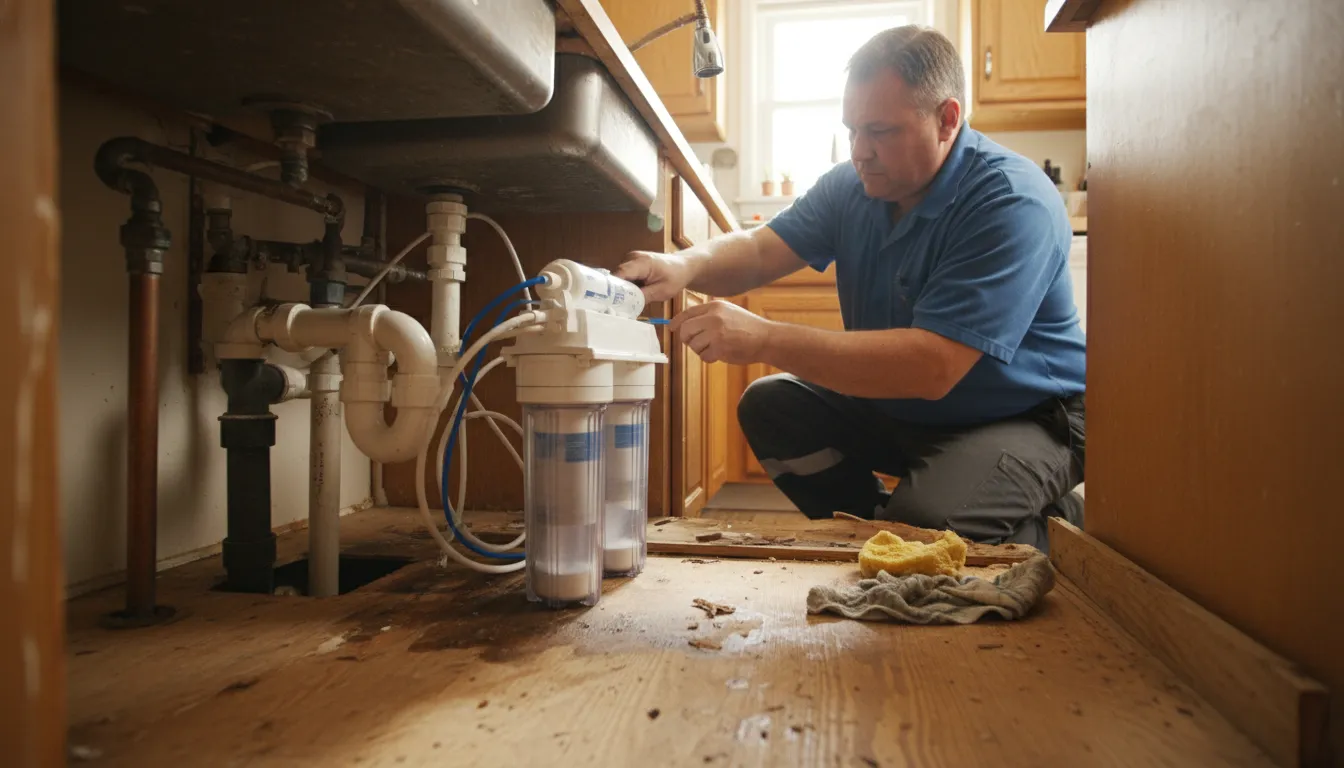
- Reverse Osmosis (RO) Systems: Typically installed under a kitchen sink, RO is a powerful point-of-use filtration that forces water through a semi-permeable membrane, removing a wide array of contaminants including lead, fluoride, nitrates, and many dissolved solids for superior drinking and cooking water.
- Specialized Filters: For homes with high iron or manganese, an air injection or oxidizing filter may be necessary to remove the metals that cause reddish-brown staining and metallic tastes.
Find the perfect water treatment installation companies for your needs
Get personalized recommendations and expert advice
Types of Systems for Bridgeport Homes
Choosing the right system depends on your water test results, household size, and specific concerns. Here are the primary options available from local water treatment specialists.
1. Ion Exchange Water Softeners
This is the go-to solution for combating Bridgeport's hard water. These units use resin beads charged with sodium or potassium ions to swap places with calcium and magnesium. They require periodic regeneration with salt (from a brine tank) to recharge the beads. Proper sizing, based on your home's grain-per-gallon hardness and daily water usage, is critical for efficiency and cost-effectiveness 3.
2. Whole-House Water Filtration Systems
Installed at your main water line, these systems provide broad protection. A basic sediment filter can protect appliances and plumbing from sand and silt, while more advanced carbon filters effectively remove chlorine, improving taste and smell for all the water in your house. For well water, multi-stage systems that combine sediment filtration, air injection for iron, and carbon filtration are common.
3. Reverse Osmosis Drinking Water Systems
For the purest drinking water, an under-sink RO system is highly recommended. It's considered one of the most thorough filtration methods, capable of removing up to 99% of dissolved solids, including many that a standard softener or filter cannot touch. It's an excellent complement to a whole-house softener, addressing hardness everywhere and providing ultra-pure water at your kitchen tap.
4. Combination and Specialty Systems
Many providers offer packaged solutions that combine a softener with a filter in a single, compact unit. Furthermore, for homes with bacterial concerns (often from well water), Ultraviolet (UV) disinfection systems can be added to the treatment train to sterilize water without chemicals.
The Professional Process: From Test to Tap
A successful water treatment installation relies on a professional approach. Here's what you can expect when working with a local Bridgeport expert.
Step 1: Professional Water Testing This is the essential first step. While DIY test strips can give a basic idea, a professional test from a certified lab or a qualified technician will provide a comprehensive analysis. It will precisely measure hardness levels, pH, iron, manganese, TDS (Total Dissolved Solids), and other relevant parameters 4. This report is the blueprint for recommending the correct system.
Step 2: System Sizing and Selection Using your water test results and information about your household size and water usage patterns, the professional will calculate the required system capacity. An undersized softener will exhaust its resin too quickly, while an oversized one is wasteful. They will then recommend the specific type and model of softener, filter, or RO system that matches your needs and budget.
Step 3: Professional Installation Proper installation by a licensed plumber or water treatment specialist is crucial. It involves integrating the system with your home's main water line, ensuring correct bypass valves are in place, setting up drainage for regeneration cycles, and programming the control valve based on your water hardness. Poor installation can lead to leaks, improper operation, and voided warranties.
Step 4: Ongoing Maintenance Water treatment systems are not "set it and forget it." Salt-based softeners require regular salt replenishment (typically every 1-2 months). All filtration systems have cartridges or membranes that need replacement on a schedule-every 6 months for pre-filters, 2-3 years for RO membranes, etc.. Many local companies offer maintenance plans to handle these tasks and perform annual check-ups to ensure everything is working optimally.
Cost Considerations for Bridgeport Homeowners
Investing in a water treatment system involves upfront equipment and installation costs, followed by predictable ongoing maintenance expenses.
Equipment and Installation Costs:
- Basic Water Softeners: A standard, properly sized ion exchange softener for a typical Bridgeport home, including professional installation, generally ranges from $1,500 to $4,000.
- Whole-House Filtration Systems: Basic sediment/carbon filter systems can start around $1,000 to $3,000 installed. More advanced systems that handle iron or combine multiple technologies will be on the higher end of this range or above 5.
- Reverse Osmosis Systems: A point-of-use under-sink RO system, installed, typically costs between $500 and $2,000, depending on the features and filtration stages.
- Advanced/Combination Systems: Whole-house systems that include softening, filtration, and possibly UV disinfection can range from $3,000 to $5,000 or more 6 7.
Annual Maintenance Costs: Plan for ongoing costs to keep your system performing. This includes salt for softeners (roughly 6-10 bags per year) and replacement filter cartridges or RO membranes. On average, annual maintenance costs for a softener and basic filter system fall between $150 and $300 8 9. Scheduling regular professional service can help avoid larger repair costs down the line.
Frequently asked questions
Sources
Footnotes
-
Connecticut - HydroFLOW USA: Award Winning Water Treatment ... - https://hydroflow-usa.com/connecticut-water-hardness/ ↩
-
Water Softening Vs. Water Filtration: Which Do You Need? - Culligan - https://www.culligan.com/blog/featured-article/water-softening-vs-water-filtration-which-do-you-need-38 ↩
-
2026 Water Softener Costs by Capacity, Size, Type & More - https://modernize.com/water-treatment/types/water-softener-installation-cost ↩
-
City and Well Water Testing | Connecticut - https://www.h2oequipment.com/water-testing/ ↩
-
Well Water Filtration Services in Connecticut - Greco & Haines - https://www.grecoandhaines.com/water-filtration-softeners/ ↩
-
Whole House Water Treatment Systems in Connecticut - https://hvwellpump.com/whole-house-water-treatment-system/ ↩
-
Water Softener System Cost in 2025: Types, Installation & ... - https://anchorplumbingservices.com/water-softener-system-cost/ ↩
-
Water Treatment Solutions for Connecticut - https://tmscomfort.com/plumbing-services/water-treatment-solutions/ ↩
-
Water Softener System Cost in Danbury, CT (2025 Guide) - https://hvwellpump.com/water-softener-system-cost/ ↩