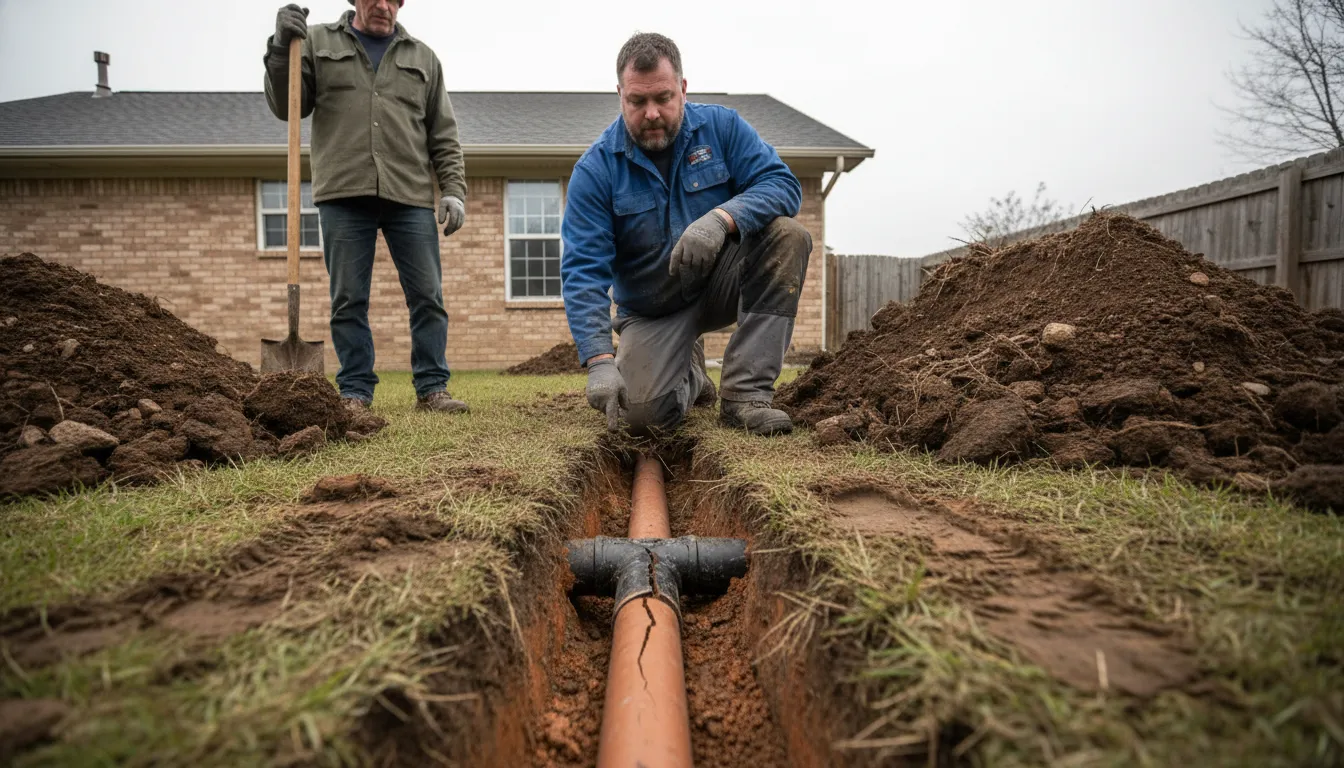
Find the Best Sewer Line Repair Companies for Your Business
No obligation • Fast responses • Nationwide coverage

Why you can trust Search a Plumber
Search a Plumber is a leading United States resource for finding and evaluating professional plumbing services. Our team researches licensing, experience, and customer feedback to create unbiased, fact-driven overviews. Companies cannot pay to change ratings or placement, ensuring homeowners get trustworthy information.
Search providers near you
Top Sewer Line Repair Companies in Kyle, Texas Ranked
A damaged sewer line is a serious issue that can disrupt your home's entire plumbing system and lead to costly property damage. Sewer line repair involves diagnosing and fixing the underground pipe that carries all your home's wastewater to the city's main line. In Kyle, local soil conditions and climate create unique challenges for these pipes. This guide explains the common causes of sewer line failure in our area, compares the modern trenchless and traditional excavation repair methods, and provides the information you need to find a qualified local professional for an assessment.
Roto-Rooter Plumbing & Water Cleanup of New Braunfels
1111 N Walnut Ave Ste 202, New Braunfels, TX 78130
Roto-Rooter Plumbing & Water Cleanup of New Braunfels offers a wide range of plumbing services for residential and commercial clients in San Antonio, TX. Their expertise includes sewer and drain cleaning, water heater repair and installation, sump pump repair, leak detection, and trenchless sewer line repair. The company is equipped to handle emergencies 24/7, providing same-day service for urgent plumbing issues such as burst pipes, sewer backups, and water heater failures. With a history dating back to 1935, Roto-Rooter combines decades of experience with advanced technology to serve the local community effectively.
Mr. Rooter Plumbing of New Braunfels
863 I-35 Suite I, New Braunfels, TX 78130
Mr. Rooter Plumbing of New Braunfels offers a wide range of plumbing services including drain cleaning, hydro jetting, sewer line repair, water heater installation and repair, leak detection, and gas line installation. Serving San Antonio, TX, and surrounding areas such as Canyon Lake and Seguin, they provide both residential and commercial plumbing solutions. The company is backed by a national brand with over 50 years of experience and is fully licensed and insured. They also offer 24/7 emergency plumbing services and warranty their parts and labor under the Neighborly Done Right Promise®.
Magic Plumbing ATX
2122 Oxford Ave, Austin, TX 78704
Magic Plumbing ATX provides comprehensive plumbing and HVAC services for residential and commercial clients in Austin, TX. Their licensed team handles everything from water heater repair and installation, drain cleaning, sewer line repair, to repiping and leak detection. They also offer hydro jetting to clear stubborn clogs and maintain sewer flow. Serving a wide area across Austin and nearby communities, Magic Plumbing ATX is available 24/7 for emergency plumbing needs, ensuring prompt assistance whenever problems arise.
SimsCo Mechanical Plumbing
7305 Seneca Falls Loop, Austin, TX 78739
SimsCo Mechanical Plumbing is a plumbing service provider based in Austin, TX, offering a wide range of residential and commercial plumbing solutions. Their services include water heater repair and installation, tankless water heater upgrades, sewer line repair, leak detection, repiping, and gas line installation. They specialize in tank-to-tankless water heater conversions featuring brands like Rinnai® and Navien®, providing energy-efficient systems with long-term warranties. SimsCo Mechanical Plumbing also handles commercial tenant finish-outs with project management and permits. The company offers emergency services such as burst pipe repairs and gas leak response available 24/7. Licensed and insured, they emphasize a clear three-step process for scheduling, planning, and solving plumbing issues.
Plumbing Outfitters
9415 Burnet Rd Suite 110, Austin, TX 78758
Plumbing Outfitters is a locally owned plumbing company serving Austin, TX. Led by Master Plumber Warren Stroud and co-owner Ashley Stroud, they provide a range of plumbing services including sewer camera inspections, water heater repair and installation, water softener installation, sump pump repair, drain cleaning, hydro jetting, sewer line repair, leak detection, repiping, gas line installation, and toilet repair. Their licensed plumbers use advanced tools like sewer cameras and pressure testing to accurately diagnose issues and ensure code-compliant repairs. Plumbing Outfitters has decades of combined experience working in Austin homes and neighborhoods, offering 24-hour emergency plumbing services to address urgent problems promptly.
Understanding Your Main Sewer Line
Your main sewer line, or main drain line, is a crucial but hidden component of your home. It runs underground from your home's foundation, typically beneath your yard, driveway, or landscaping, and connects to the municipal sewer main at the street or property edge. When this line is compromised, every drain in your house can be affected. Symptoms include multiple slow drains, gurgling sounds from toilets, sewage backups in floor drains or tubs, and unpleasant odors in your yard. Addressing these signs quickly with a professional inspection can prevent a minor issue from becoming a major excavation project.
Common Causes of Sewer Line Failure in Kyle
Central Texas presents specific environmental factors that stress underground plumbing. Understanding these can help you identify potential risks to your property.
- Tree Root Intrusion: This is a primary cause of sewer line problems in the Kyle region. Trees and large shrubs seek out water and nutrients, and the small cracks or loose joints in older pipes are an easy target. Roots can infiltrate, causing complete blockages and exerting pressure that cracks or collapses the pipe.
- Aging Pipe Materials: Older homes in the area may have sewer lines made of clay tile or cast iron. Clay pipes are brittle and prone to cracking from soil movement, while cast iron can corrode and deteriorate over decades, making both susceptible to root intrusion and collapse.
- Soil Movement (Expansive Clay): The clay-heavy soils common in Central Texas are known as "expansive." They swell when wet and shrink during dry periods, creating significant shifting and ground movement. This constant stress can misalign pipe joints, crack pipes, and cause sections to sag or break.
- Clogs and Grease Buildup: While not always a structural failure, the accumulation of fats, oils, grease, and non-flushable items (like wipes) can create severe blockages that put pressure on the pipe and mimic or exacerbate existing damage 1.
Repair Method 1: Traditional Excavation
Traditional sewer repair is the method most people picture: a backhoe digs a large trench along the path of the damaged pipe to fully expose it for repair or replacement.
How It Works: Plumbers locate the damaged section, excavate the soil above it, remove the broken pipe, and install a new section (typically modern PVC). The trench is then backfilled, leaving significant restoration work for driveways, sidewalks, and landscaping.
Pros and Cons:
- Pros: It can be the most cost-effective method for very short, accessible repairs. It is also the only viable option for pipes that have completely collapsed or are severely misaligned, as the old pipe must be physically removed 2 3.
- Cons: The process is highly disruptive to your property. It destroys lawns, gardens, patios, and driveways, leading to substantial additional costs and time for restoration. The excavation itself is labor-intensive and can take longer than trenchless alternatives 4.
Repair Method 2: Modern Trenchless Technology
Trenchless sewer repair offers a less invasive solution by repairing or replacing the pipe from the inside using small access pits, eliminating the need for a long, destructive trench.
Primary Trenchless Techniques:
- Pipe Lining (Cured-in-Place Pipe - CIPP): A flexible, resin-saturated liner is inserted into the damaged pipe and inflated. The resin cures, forming a hard, seamless "pipe within a pipe" that seals cracks and holes. This is excellent for repairing corroded or root-damaged pipes but does slightly reduce the internal diameter.
- Pipe Bursting: This method is for full replacement. A conical bursting head is pulled through the old pipe, fracturing it outward while simultaneously pulling a new, high-density polyethylene (HDPE) pipe into place. It replaces the old line with a new, often larger-diameter pipe.
Pros and Cons:
- Pros: Minimal surface disruption preserves your landscaping, hardscaping, and driveway. The process is typically faster than excavation once begun, with less noise and mess. While the upfront repair cost can be higher, you save significantly on landscape and hardscape restoration.
- Cons: Higher upfront cost per linear foot for the repair itself. It may not be suitable for pipes that have fully collapsed or have severe sags (bellying), as the liner or bursting head needs a clear path. It also requires specialized equipment and trained technicians 5.
Find the perfect sewer line repair companies for your needs
Get personalized recommendations and expert advice
Cost Considerations for Kyle Homeowners
Sewer line repair costs in Kyle vary widely based on the method, extent of damage, pipe material, depth, and accessibility. Local pricing research indicates the following ranges, though obtaining multiple detailed quotes is essential 6 7.
- Trenchless Repair (Pipe Lining): Often ranges from $3,000 to $9,000 or more, with a typical cost of $80 to $250+ per linear foot.
- Full Line Replacement (Traditional Excavation): Can range from $4,000 to $15,000+. The final price depends heavily on the length of the trench, depth of the pipe, and the complexity (and cost) of restoring driveways, landscaping, and other surfaces.
- Pipe Bursting (Trenchless Replacement): Often falls in the range of $6,000 to $12,000+.
Key Financial Insight: For a short, easily accessible repair, traditional excavation might have a lower initial price tag. However, for longer runs or lines under valuable landscaping, a trenchless method often proves more cost-effective overall when the avoided restoration expenses are factored in 8 9. The only way to get an accurate comparison is through a professional video camera inspection.
The Critical First Step: Video Camera Inspection
Before any repair method is chosen, a professional video camera inspection is non-negotiable. A plumber will feed a specialized, waterproof camera into your sewer line, providing a real-time view of the interior. This inspection precisely identifies the location, nature, and severity of the problem-whether it's a root mass, a cracked joint, a belly, or a collapsed section 10 11 12. This diagnosis is the foundation for an accurate repair plan and a fair, transparent quote. It tells you exactly what you're dealing with and allows a professional to recommend the most appropriate and cost-effective solution for your specific situation in Kyle.
Choosing a Local Professional
Selecting the right contractor is as important as choosing the repair method. Look for a licensed, insured plumber with specific experience in both trenchless and excavation-based sewer repair. Ask for references and examples of past work. A reputable professional will always recommend a camera inspection first, provide a detailed written estimate that breaks down labor, materials, and any potential restoration costs, and clearly explain why a particular method is best for your home's unique conditions.
Frequently asked questions
Sources
Footnotes
-
Sewer Line Repair: Preventative Maintenance Tips to Avoid Future Problems - https://summersphc.com/peru/2025/08/sewer-line-repair-preventative-maintenance-tips-to-avoid-future-problems/ ↩
-
Traditional vs. Trenchless Sewer Line Repair & Replacement - https://www.rotorooter.com/blog/plumbing/traditional-vs-trenchless-sewer-lines/ ↩
-
Trenchless Sewer Line Repair vs Traditional: Which Is Better - https://cactusplumbingandair.com/trenchless-sewer-line-repair-vs-traditional/ ↩
-
Pipe Lining vs. Traditional Pipe Replacement - Kyle Plumbing - https://kyleplumbing.com/pipe-lining-vs-traditional-pipe-replacement/ ↩
-
Trenchless Sewer Repair vs. Traditional Excavation - AQUALIS - https://aqualisco.com/trenchless-sewer-repair-vs-traditional/ ↩
-
Is Trenchless Sewer Line Repair Cheaper? - AP Plumbing - https://applumbing.com/blog/is-trenchless-sewer-line-repair-cheaper/ ↩
-
Trenchless Sewer Line Replacement - Free Estimates - https://reliantplumbing.com/drains/sewer-system-repair/trenchless-pipe-repair/ ↩
-
Trenchless vs. Traditional Sewer Repair - https://sewerlinesonly.com/trenchless-vs-traditional-sewer-repair-which-is-more-cost-effective-for-lakewood-homeowners/ ↩
-
Cost Comparison: Trenchless vs. Traditional Sewer Line Repair - https://www.advancedtrenchlesssolutions.com/blog/cost-comparison-trenchless-vs-traditional-sewer-line-repair ↩
-
How Much Does Sewer Line Repair Cost in San Antonio? - https://anchorplumbingservices.com/sewer-line-repair-cost/ ↩
-
Trenchless Sewer Repair vs. Traditional Excavation: Which is Better? - https://alphaenvironmental.net/blog/trenchless-sewer-repair-vs-traditional-excavation-which-is-better/ ↩
-
Sewer Repair Options: Trenchless vs. Traditional Methods | TYCO - https://tycoplumbingco.com/sewer-repair-options-trenchless-vs-traditional-methods/ ↩