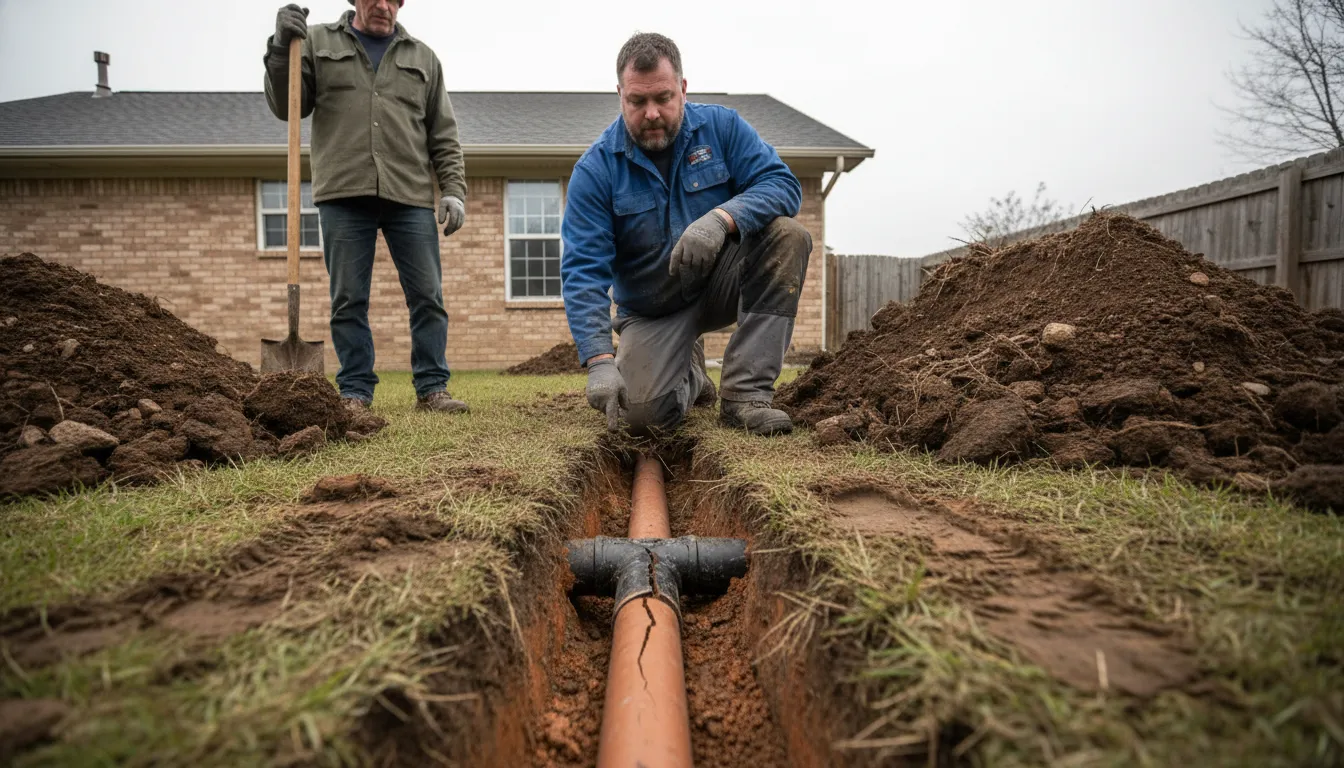
Find the Best Sewer Line Repair Companies for Your Business
No obligation • Fast responses • Nationwide coverage

Why you can trust Search a Plumber
Search a Plumber is a leading United States resource for finding and evaluating professional plumbing services. Our team researches licensing, experience, and customer feedback to create unbiased, fact-driven overviews. Companies cannot pay to change ratings or placement, ensuring homeowners get trustworthy information.
Search providers near you
Top Sewer Line Repair Companies in Cedar Hill, Texas Ranked
A damaged sewer line is a serious issue that can disrupt your home, create health hazards, and lead to costly property damage. Sewer line repair involves diagnosing and fixing the underground pipe that carries all your home's wastewater to the city's main sewer line. This guide explains what Cedar Hill homeowners need to know about common causes, repair methods, and how to find qualified local professionals to restore proper function to your home's essential plumbing system.
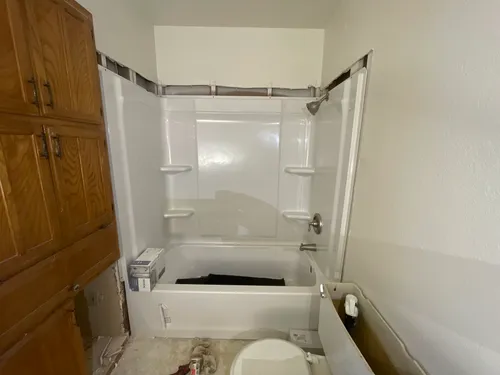
Bow Tie Plumbing
1285 N Main St Suite 306, Mansfield, TX 76063
Bow Tie Plumbing is a family-owned plumbing company serving Arlington, TX, and the broader DFW area. With over 50 years of combined experience, they offer a wide range of services including water heater installation and repair, drain cleaning, sewer line repair, leak detection, repiping, and toilet repair. The company uses advanced techniques such as hydrostatic and smoke testing to identify plumbing issues and provides specialized services like tunneling for foundation access. Bow Tie Plumbing is known for transparent pricing, free estimates within 24 hours, and a 1-year labor warranty on their work.
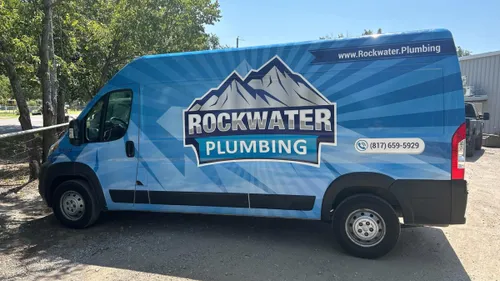
Rockwater Plumbing
509 SW Wilshire Blvd Suite G2, Burleson, TX 76028
Rockwater Plumbing is a plumbing contractor based near Fort Worth, TX, specializing in sewer line repair, leak detection, and repiping services. They handle projects involving the replacement of old cast iron and copper pipes with modern materials like PVC. Rockwater Plumbing is experienced in diagnosing complex plumbing issues, including breaks in cold water lines, and managing challenges such as root intrusion under slabs. The company serves residential clients in the Fort Worth area and is known for thorough problem assessment and comprehensive repiping solutions.
On Point Plumbing DFW
1145 Hidden Oaks Dr, Bedford, TX 76022
On Point Plumbing DFW provides a range of plumbing services in Dallas, TX, including sewer camera inspections, water heater installations, drain cleaning, sewer line repairs, and leak detection. Serving Bedford, Arlington, Dallas, Fort Worth, Weatherford, Aledo, and surrounding areas, they use advanced cameras and pressure gauges to diagnose plumbing issues accurately. The company combines over 50 years of experience with licensed and insured professionals to deliver code-compliant work. They also offer 24/7 emergency support for urgent plumbing needs.
Adr plumbing Co
Plano, TX
Adr Plumbing Co is a plumbing service provider based in Plano, TX, offering a wide range of services including water heater repair and installation, tankless water heater services, drain cleaning, sewer line repair, leak detection, repiping, toilet repair, and garbage disposal repair. They serve residential and property management clients with expertise in trenchless sewer repair and tunneling for under-slab repairs. Established in 2019, Adr Plumbing Co combines over 20 years of industry experience with well-stocked service vehicles to efficiently handle plumbing issues from minor leaks to major sewer line replacements. The company operates around the clock to address plumbing emergencies and routine maintenance needs.

J5 Plumbing Co.
7600 Benbrook Pkwy, Benbrook, TX 76126
J5 Plumbing Co. is a plumbing contractor based in Fort Worth, TX, offering a range of services including drain cleaning, hydro jetting, sewer line repair, and repiping. With over 25 years of experience, the company handles various plumbing issues such as sewer line replacement and cast iron pipe replacement. Their team is knowledgeable about different plumbing techniques and provides practical solutions without unnecessary repairs.
Understanding Your Home's Sewer System in Cedar Hill
Your home's main sewer line is a critical, yet out-of-sight, component of your plumbing. It runs from the foundation of your house, underneath your yard, and connects to the public sewer main, typically located at the street or property line. When this line fails, the consequences are immediately apparent inside your home through multiple drain backups, gurgling toilets, or foul sewage odors. In Cedar Hill and the greater Dallas-Fort Worth area, several local factors make sewer lines particularly vulnerable to failure.
Common Causes of Sewer Line Failure in DFW
The specific soil and environmental conditions in our region contribute to many sewer line problems. Understanding these causes can help you identify issues early.
- Tree Root Intrusion: This is a leading cause of blockages. Roots from trees and large shrubs are naturally drawn to the moisture and nutrients inside sewer pipes. They can infiltrate through small cracks or loose joints, eventually creating a dense mass that completely blocks the flow.
- Expansive Clay Soil: The DFW area, including Cedar Hill, is known for its expansive clay soil. This soil swells significantly when wet and shrinks during dry periods. This constant movement puts tremendous stress on buried sewer pipes, leading to cracks, misaligned joints, or even complete breaks over time.
- Aging and Corroding Pipes: Many older homes in the area have sewer lines made of cast iron or clay tile. These materials degrade with age. Cast iron can rust and corrode, while clay tiles can crack or collapse. Even older PVC pipes may become brittle.
- Blockages and Bellied Pipes: While roots and soil are major culprits, simple blockages from grease, foreign objects, or accumulated debris can also cause backups. Additionally, sections of pipe can sink or "belly" due to soil erosion, creating a low spot where waste collects and causes repeated clogs 1.
Diagnosing Sewer Line Problems: The Camera Inspection
Before any repair can be planned, an accurate diagnosis is essential. The modern tool for this is a sewer camera inspection. A local, licensed plumber will insert a high-resolution, waterproof camera on a flexible rod into your cleanout or through a roof vent. This allows them to see the exact condition of your pipe in real time, identifying the location, nature, and severity of the problem-whether it's a root mass, a crack, a break, or a belly.
This inspection is a critical investment. It prevents unnecessary excavation for a simple clog and provides the visual evidence needed to determine the most effective and cost-efficient repair method. Any reputable sewer repair company in Cedar Hill should recommend and provide a camera inspection before providing a quote.
Sewer Line Repair Methods: Traditional vs. Trenchless
Once the problem is identified, you will typically have two primary repair approaches: traditional excavation or modern trenchless technology. The best choice depends on the pipe's condition, its location under your property, and your budget considerations.
Traditional Excavation (Dig-and-Replace)
This is the conventional method that has been used for decades.
- How It Works: Plumbers use a backhoe or other equipment to dig a large trench along the path of the sewer line to fully expose the damaged section. The old pipe is removed and entirely replaced with new piping, and the trench is then backfilled.
- Pros: It is often the lower-cost option per linear foot for the repair itself. It is also the only viable solution for pipes that have completely collapsed or have severe, multiple failures in a short span.
- Cons: The major downside is the significant disruption and destruction it causes. Your yard, landscaping, driveways, sidewalks, or fences may need to be dug up. While the pipe repair cost might be lower, the cost to restore your property (sod, concrete, pavers) can add thousands to the final bill.
Trenchless Sewer Repair
Trenchless methods have revolutionized sewer repair by minimizing surface disruption. Two main techniques are commonly used in Cedar Hill.
- Pipe Lining (Cured-In-Place Pipe or CIPP): This method creates a "pipe within a pipe." A flexible tube coated with resin is inserted into the old, damaged pipe. It is then inflated and left to cure, forming a hard, seamless new pipe lining that seals cracks and blocks root intrusion.
- Pipe Bursting: This technique is used for replacement when the old pipe is too damaged to line. A conical bursting head is pulled through the old pipe, fracturing it outward while simultaneously pulling a new, durable pipe (like HDPE) into place behind it 2.
- Pros of Trenchless: The primary advantage is minimal digging. Only one or two small access pits are needed. This preserves your lawn, hardscaping, and trees, leading to much faster project completion and drastically lower restoration costs 3 4.
- Cons of Trenchless: The upfront cost for the repair itself is typically higher per foot than traditional digging. It also may not be suitable for pipes with sharp, multiple bends or those that have completely collapsed and cannot guide the lining or bursting equipment 5 6.
Find the perfect sewer line repair companies for your needs
Get personalized recommendations and expert advice
Cost Considerations for Sewer Repair in Cedar Hill
Sewer line repair is a significant investment, and costs in Cedar Hill can vary widely based on the method, the extent of damage, and the pipe's depth and location. It's crucial to get detailed quotes that outline all costs.
- General Repair Range: For a standard repair, homeowners might expect a range from $2,500 to $8,000 or more, heavily dependent on the circumstances.
- Full Traditional Replacement: A complete dig-and-replace of a long sewer line can range from $4,000 to $15,000+ 7.
- Trenchless Repair/Replacement: Trenchless methods like lining or bursting often cost $3,000 to $12,000+, frequently calculated at a rate of $100 to $200 per linear foot 8 9 10.
- The Hidden Cost of Excavation: When comparing quotes, always account for restoration. Traditional excavation can add $1,000 to $5,000 or more for landscape repair and $2,000 to $8,000+ for driveway or sidewalk replacement, costs that are largely avoided with trenchless methods 11.
The key takeaway is to get a camera inspection and obtain quotes for both trenchless and traditional methods from licensed Cedar Hill plumbers. This allows for an apples-to-apples comparison of the total project cost, including any necessary restoration 12.
Choosing a Sewer Repair Professional in Cedar Hill
Selecting the right contractor is as important as choosing the repair method. Look for a local company with specific expertise in main sewer line and drain repair. They should be licensed, insured, and willing to provide references. A trustworthy professional will always recommend a camera inspection first, clearly explain the problem and your options (both trenchless and traditional), and provide a detailed, written estimate. Be wary of anyone who insists on one method without a proper diagnosis or who provides a quote over the phone without seeing the problem.
Frequently asked questions
Sources
Footnotes
-
Sewer Line Repair & Replacement - https://eliteplumbingdfw.com/sewer-line-repair-replacement/ ↩
-
Trenchless Sewer Repair vs. Traditional Excavation - TDT Plumbing - https://tdtplumbing.com/trenchless-sewer-repair/difference-to-traditional-repair/ ↩
-
No Dig Sewer Repair: What to Expect in Fort Worth - Mother - https://www.callmother.com/blogs/no-dig-sewer-repair-fort-worth ↩
-
Trenchless Sewer Repair: Lower Cost, Lower Impact Sewer Repair - https://www.sewerflowllc.com/2025/03/06/trenchless-sewer-repair-lower-cost-lower-impact-sewer-repair/ ↩
-
Dallas Sewer Repair + Replacement Cost Guide - Mother - https://www.callmother.com/blogs/main-sewage-line-replacement-best-texas-guide ↩
-
Trenchless Sewer Line Repair vs Traditional: Which Is Better - https://cactusplumbingandair.com/trenchless-sewer-line-repair-vs-traditional/ ↩
-
How Much Does Sewer Line Repair Cost in San Antonio? - https://anchorplumbingservices.com/sewer-line-repair-cost/ ↩
-
Trenchless vs. Traditional Sewer Repair - https://sewerlinesonly.com/trenchless-vs-traditional-sewer-repair-which-is-more-cost-effective-for-lakewood-homeowners/ ↩
-
How Much Does Sewer Line Repair Cost in Dallas? - https://totalplumbing.net/how-much-does-sewer-line-repair-cost-in-dallas/ ↩
-
Trenchless Sewer Line Replacement - Free Estimates - https://reliantplumbing.com/drains/sewer-system-repair/trenchless-pipe-repair/ ↩
-
Cost Comparison: Trenchless vs. Traditional Sewer Line Repair - https://www.advancedtrenchlesssolutions.com/blog/cost-comparison-trenchless-vs-traditional-sewer-line-repair ↩
-
Sewer Repair Cost: Trenchless Vs Traditional Methods - https://www.superbrothers.com/sewer-repair-cost-trenchless-vs-traditional-methods/ ↩