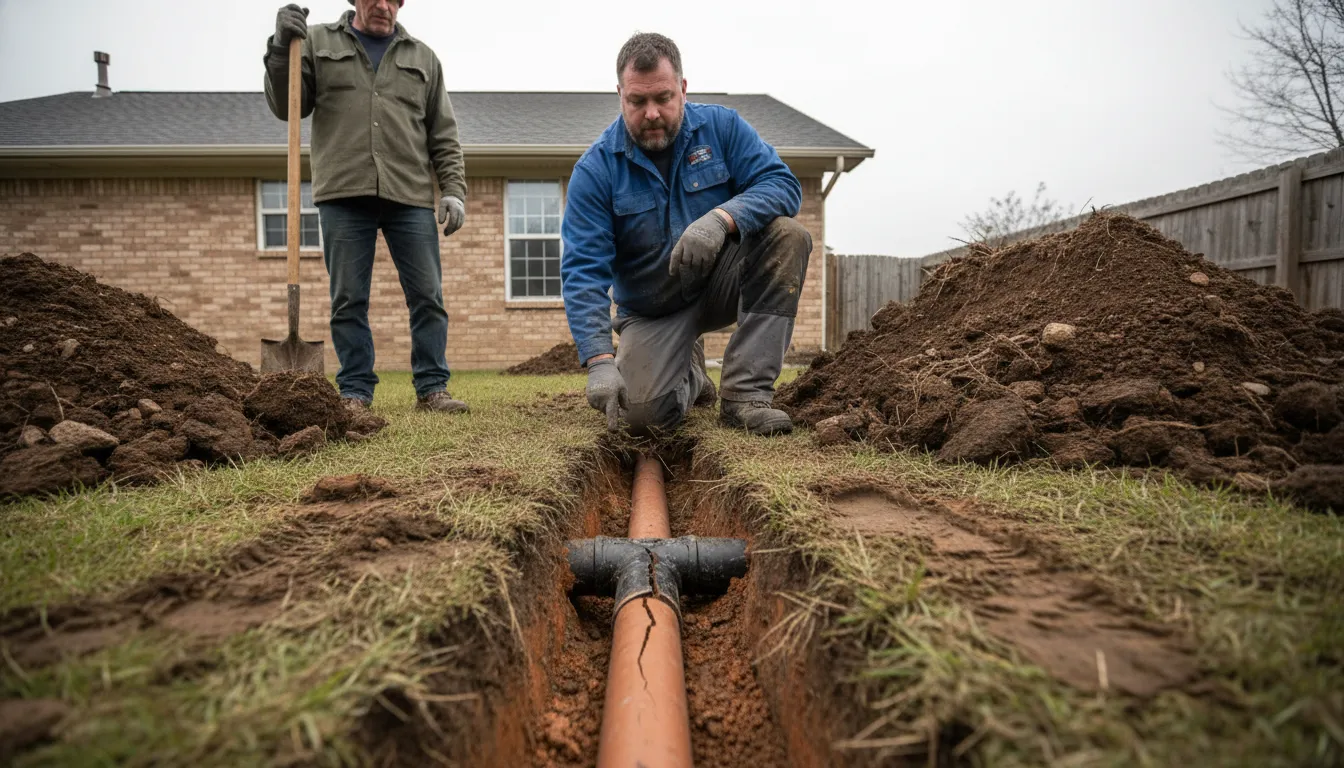
Find the Best Sewer Line Repair Companies for Your Business
No obligation • Fast responses • Nationwide coverage

Why you can trust Search a Plumber
Search a Plumber is a leading United States resource for finding and evaluating professional plumbing services. Our team researches licensing, experience, and customer feedback to create unbiased, fact-driven overviews. Companies cannot pay to change ratings or placement, ensuring homeowners get trustworthy information.
Search providers near you
Top Sewer Line Repair Companies in Howell, New Jersey Ranked
A damaged sewer line is a serious issue that can disrupt your home's entire plumbing system and lead to costly property damage. Sewer line repair involves diagnosing and fixing the underground pipe that carries all your home's wastewater to the public main. This guide explains the common causes of sewer line failure in Howell, the modern and traditional repair methods available, and how to evaluate your options to find a qualified local specialist for the job.
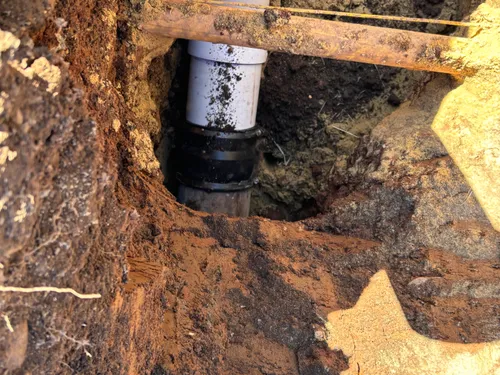
Command Plumbing Inc.
305 Amboy Ave, Woodbridge, NJ 07095
Command Plumbing Inc. offers a range of plumbing services in New York, NY, including sewer camera inspections, drain cleaning, hydro jetting, sewer line repair, and trenchless sewer repair. They serve both residential and commercial clients and use high-definition video inspection equipment to diagnose sewer line issues accurately. The company has developed a preventive maintenance program for commercial sewer lines and provides certified repairs such as pipe lining and pipe bursting. Command Plumbing Inc. is available for emergency maintenance and has experience serving multiple areas in New Jersey and New York.
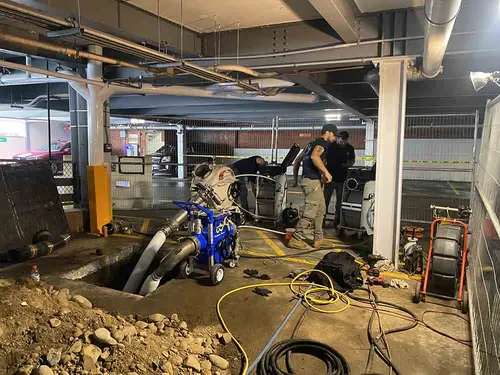
Metro Sewer Service LLC
18 Covington Cir, Staten Island, NY 10312
Metro Sewer Service LLC provides sewer and drain inspections, repairs, and water heater installations in New York, NY. They use advanced CCTV technology for visual inspections to identify sewer line defects and offer trenchless sewer repair methods such as pipe bursting and a trenchless brush coating system for pipe restoration. The company also detects leaks and performs repiping services. Their trenchless brush coating system offers a durable, corrosion-resistant repair with a combined 20-year warranty. Metro Sewer Service LLC serves residential and commercial properties with a focus on minimizing excavation and disruption.

Society Hill Plumbing, LLC | Best Plumbing Service Philadelphia
Philadelphia, PA
Society Hill Plumbing, LLC | Best Plumbing Service Philadelphia provides plumbing services in Philadelphia, PA. They handle both residential and commercial plumbing needs, including water heater repairs and sewer line replacements. The company offers emergency plumbing services with a 24/7 response team to address urgent issues promptly. With years of experience, Society Hill Plumbing focuses on delivering reliable solutions and quality workmanship.
Integrated construction & utilities
59 Suydam Ave, Edison, NJ 08817
Integrated Construction & Utilities is a sewer repair contractor serving New York, NY, specializing in trenchless sewer line repair and replacement. The company offers customized solutions for sewer backups, pipe defects, and root intrusion, using advanced methods like pipe bursting and cured-in-place pipe (CIPP) lining to minimize excavation. Their expertise includes high-pressure jetting for pipe cleaning and sewer camera inspections to diagnose issues accurately. Integrated Construction & Utilities has established itself with innovative sewer repair techniques and a focus on tailored service for complex sewer conditions.
Zachary Plumbing
Newark, NJ
Zachary Plumbing is a plumbing service provider based in Newark, NJ. They offer a wide range of services including sewer camera inspections, water heater installation and repair, drain cleaning, hydro jetting, leak detection, and repiping for gas, water, and sewer lines. The company also handles gas line installation, garbage disposal repair, and various fixture installations and repairs. Their capabilities include sewer video inspection and hydro jetting to maintain clear and functional plumbing systems.
Understanding Your Home's Sewer Line
The main sewer line, or sewer lateral, is a critical but hidden component of your home. It runs underground from your home's foundation to the public sewer main at the street (or to a septic system). Because it's buried, problems often go unnoticed until significant symptoms appear. In Howell, many homes have aging infrastructure, making sewer line issues a common concern for homeowners.
Common signs of a failing sewer line include:
- Multiple slow drains or frequent clogs throughout the home.
- Gurgling sounds coming from toilets or drains.
- Unpleasant sewage odors in your yard or basement.
- Patches of unusually lush, green grass or soggy areas in your yard.
- Sewage backups in floor drains or lower-level fixtures.
Common Causes of Sewer Line Damage in Howell
Several factors contribute to sewer line failure in our area. Understanding the cause is the first step toward an effective repair strategy.
- Tree Root Intrusion: This is a leading cause. Roots seek moisture and can infiltrate tiny cracks or loose joints in pipes, eventually growing and causing blockages or breaks.
- Aging and Corroding Pipes: Older homes in Howell may have sewer lines made of clay tile, cast iron, or Orangeburg pipe. These materials become brittle over time, corrode, and are prone to cracking and collapse.
- Ground Shifting and Settlement: New Jersey's freeze-thaw cycles and soil conditions can cause the ground to shift. This movement puts stress on pipes, leading to misaligned joints, cracks, or complete breaks 1.
- Grease and Debris Buildup: Improper disposal of fats, oils, and non-flushable items can create severe clogs that restrict flow and increase pressure within the pipe.
- General Wear and Tear: Like all things, pipes have a lifespan. Continuous use and ground pressure eventually lead to deterioration.
Modern Repair Methods: Trenchless Technology
For many homeowners, the thought of a large, disruptive trench dug across their yard is a major concern. Fortunately, trenchless sewer repair methods offer a less invasive solution and are often suitable for Howell's common sewer problems.
Cured-in-Place Pipe (CIPP) Lining
This is a form of pipe rehabilitation. A flexible, resin-saturated tube is inserted into the damaged pipe through an access point. It is then inflated and cured (often with hot water or UV light) to form a hard, seamless "pipe-within-a-pipe" 2.
- Best For: Repairing pipes with cracks, holes, corrosion, or minor root intrusion where the structural shape is largely intact.
- Advantages: Minimal digging (only at access points), often completed in a day, and preserves landscaping, driveways, and hardscapes. The new liner is resistant to roots and corrosion.
- Considerations: The existing pipe must be clear of major blockages to insert the liner. It also slightly reduces the internal diameter of the pipe.
Pipe Bursting
This is a trenchless replacement method. A conical bursting head is pulled through the old, damaged pipe, fracturing it outward while simultaneously pulling a new, high-density polyethylene (HDPE) pipe into place behind it 3.
- Best For: Completely replacing severely damaged, collapsed, or undersized pipes.
- Advantages: Creates a brand new pipe with no reduction in diameter. Still requires only small access pits, avoiding a long trench 4.
- Considerations: Requires access points at both ends of the section being replaced. May not be feasible if there are many utility lines in close proximity.
Find the perfect sewer line repair companies for your needs
Get personalized recommendations and expert advice
Traditional Sewer Repair: Open-Trench Excavation
The conventional method involves using excavation equipment to dig a trench along the entire length of the damaged sewer line, exposing it for repair or replacement.
- Best For: Situations where trenchless methods are not viable, such as pipes that have completely collapsed, have severe misalignment, or are in locations with complex underground obstructions.
- Advantages: Provides direct, full access to the pipe, allowing for a straightforward replacement. It is sometimes the only option for extreme damage.
- Disadvantages: Highly disruptive to your property. It requires extensive digging, destroys landscaping, and may damage driveways, walkways, or patios. Restoration of the yard is an additional cost and project 5 6 7.
Cost Considerations for Sewer Line Repair in Howell
The cost of sewer line repair or replacement varies widely based on the method, extent of damage, pipe location, and length. A professional video camera inspection (typically costing $200-$500+) is a crucial first investment to accurately diagnose the problem 8.
- Trenchless CIPP Lining: Often ranges from $70 to $150 per linear foot. For a standard repair, total costs can be significantly less than full excavation when landscape restoration is factored in.
- Trenchless Pipe Bursting: Generally costs between $60 and $200 per linear foot for the replacement itself 9.
- Traditional Excavation: While the per-foot cost for the pipe might seem lower, the total project cost escalates quickly due to labor-intensive digging, machinery use, and, most significantly, the cost to restore your landscaping, concrete, and other affected surfaces. Full traditional replacements can range from $12,000 to $25,000 or more for complex jobs.
- Full Line Replacement: On average, homeowners in New Jersey can expect a full sewer line replacement to cost between $3,000 and $10,000+, with prices reaching $20,000+ for difficult, long, or deep lines 10 11 12.
Choosing the Right Repair Method for Your Home
The best solution depends on the specific condition of your pipe, your property layout, and your budget. Here's a simplified guide:
- Start with an Inspection: Never guess. A video camera inspection is non-negotiable. It reveals the exact location, cause, and severity of the damage.
- Evaluate Trenchless First: If the inspection shows the pipe is broken or corroded but hasn't fully collapsed, trenchless methods like CIPP lining or pipe bursting are usually the most cost-effective and least disruptive choices 13.
- Consider Excavation When Necessary: If the pipe is shattered, severely offset, or in an area not accessible for trenchless equipment, traditional excavation may be the only reliable option.
- Get Detailed Quotes: A reputable professional will provide a detailed quote that breaks down costs for diagnosis, repair method, materials, and-importantly for excavation-landscape restoration.
Frequently asked questions
Sources
Footnotes
-
Common Sewer Line Issues For South Jersey Homes | Plumbing - https://broadleys.net/common-sewer-line-issues-for-south-jersey-homes/ ↩
-
Cost-effective plumbing: Understanding trenchless sewer repair - https://www.nj.com/sponsor-content/?ntv_ht=cZ1iaAA&prx_t=zj0JAkglpArXoTA&ntv_ui=dc0472bb-119a-4923-8fe4-d3a679fbd956&scid=210621 ↩
-
Trenchless vs. Traditional Sewer Repair - https://sewerlinesonly.com/trenchless-vs-traditional-sewer-repair-which-is-more-cost-effective-for-lakewood-homeowners/ ↩
-
Trenchless Sewer Replacement - https://allcountysewer.com/trenchless-sewer-replacement/ ↩
-
Sewer Pipe Lining vs Residential Excavation - 128 Plumbing - https://www.128plumbing.com/sewer-pipe-lining-vs-residential-excavation/ ↩
-
Trenchless Sewer Repair vs. Traditional Excavation - AQUALIS - https://aqualisco.com/trenchless-sewer-repair-vs-traditional/ ↩
-
Trenchless Sewer Repair vs. Traditional Excavation - https://alphaenvironmental.net/blog/trenchless-sewer-repair-vs-traditional-excavation-which-is-better/ ↩
-
Sewer Repair Cost: Trenchless Vs Traditional Methods - https://www.superbrothers.com/sewer-repair-cost-trenchless-vs-traditional-methods/ ↩
-
Cost Comparison: Trenchless vs. Traditional Sewer Line Repair - https://www.advancedtrenchlesssolutions.com/blog/cost-comparison-trenchless-vs-traditional-sewer-line-repair ↩
-
Sewer Line Replacement Cost: 2025 Data - NJ Pipe Doctor - https://njpipedr.com/blog/sewer-line-replacement-cost/ ↩
-
Empower Your Decision: Decoding Trenchless Sewer Repair Costs - https://pipelinerpros.com/trenchless-sewer-repair-cost/ ↩
-
How Much Does It Cost To Replace A Sewer Line? - Michael & Son - https://michaelandson.com/blog/how-much-does-it-cost-to-replace-a-sewer-line ↩
-
Trenchless Sewer Repair vs. Traditional Excavation - TDT Plumbing - https://tdtplumbing.com/trenchless-sewer-repair/difference-to-traditional-repair/ ↩