Find the Best Sewer Line Repair Companies for Your Business
No obligation • Fast responses • Nationwide coverage

Why you can trust Search a Plumber
Search a Plumber is a leading United States resource for finding and evaluating professional plumbing services. Our team researches licensing, experience, and customer feedback to create unbiased, fact-driven overviews. Companies cannot pay to change ratings or placement, ensuring homeowners get trustworthy information.
Search providers near you
Top Sewer Line Repair Companies in Hamilton, New Jersey Ranked
A damaged sewer line is a serious issue that can disrupt your home, threaten your property, and impact public health. When your main drain line fails, it requires prompt, professional attention to restore proper sanitation and protect your investment. This guide explains the common causes of sewer line problems in Hamilton, details the modern repair methods available, and helps you understand how to find a qualified local specialist to assess and fix your underground piping.
Gold Star Plumbing, LLC
Philadelphia, PA
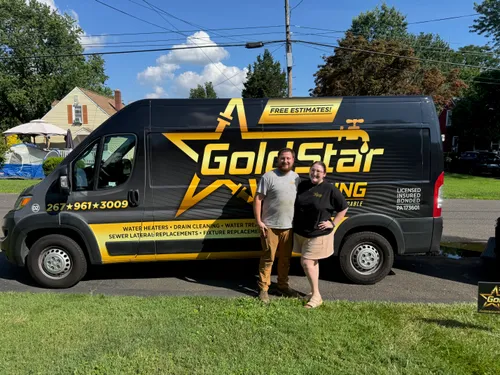
Gold Star Plumbing, LLC is a family-owned plumbing company serving Philadelphia, PA, and the surrounding Bucks and Montgomery Counties. They provide a wide range of residential plumbing services including water heater installation and repair, drain cleaning, sewer line repair, leak detection, sump pump repair, and bathroom remodeling. The team is experienced in handling mid-century plumbing upgrades and modern fixture installations with attention to local codes and seasonal needs. With over 300 families served near York Road, Jacksonville Road, and Pennypack Creek, Gold Star Plumbing emphasizes transparent pricing, clean workmanship, and respectful scheduling to minimize disruption during projects.

Daniel's plumbing drain cleaning and sewer repair of philadelphia
655 Second Street Pike, Southampton, PA 18966
Daniel's Plumbing Drain Cleaning and Sewer Repair of Philadelphia offers residential and commercial plumbing services in Philadelphia, PA. Their services include drain cleaning, water heater repair and installation, sewer line repair, and video sewer pipe inspections. The company is led by a Master Plumber certified by the City of Philadelphia and provides 24/7 emergency plumbing services. They emphasize professional, clean work with fully equipped trucks and a satisfaction guarantee.
Segrest Sewers LLC
6320 Harvey Ave, Pennsauken, NJ 08109
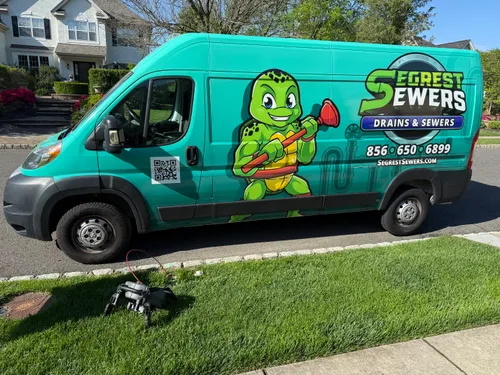
Segrest Sewers LLC provides commercial and residential sewer maintenance services in Philadelphia, PA, and surrounding areas including Cherry Hill, Mount Laurel, Marlton, Moorestown, and Haddonfield, NJ. Their services include drain cleaning, hydro jetting, sewer line repairs or replacements, preventative maintenance, and full video sewer inspections using advanced camera technology. This allows them to accurately diagnose issues and plan effective repairs. Segrest Sewers focuses on preventing major sewer problems through regular maintenance and precise interventions to help extend the life of sewer systems and reduce future costs.
Bill Frusco Plumbing Heating and Air Conditioning
513 Horsham Rd, Horsham, PA 19044
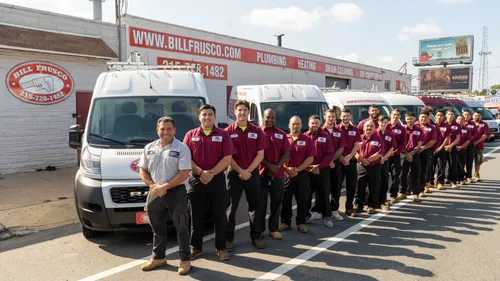
Bill Frusco Plumbing Heating and Air Conditioning is a family-owned business serving Philadelphia, PA, and surrounding counties since 1967. They offer a wide range of plumbing, heating, and cooling services including sewer and drain cleaning, water heater installation, sump pump repair, gas line installation, and leak detection. The company is a Master Licensed Plumber and provides 24/7 emergency plumbing and HVAC services to both residential and commercial customers. Their expertise includes sewer line repair and water restoration services, supported by over 50 years of experience in the industry.
Zoom Drain
Philadelphia, PA
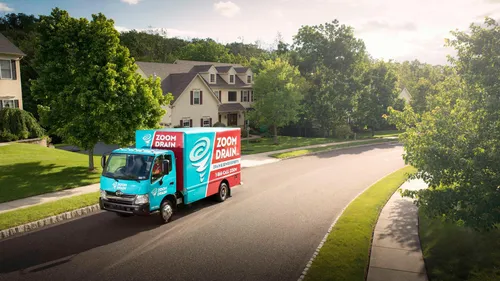
Zoom Drain is a plumbing service provider based in Philadelphia, PA, specializing in residential and commercial drain and sewer solutions. They offer a range of services including drain cleaning, sewer line inspection and repair, sump pump repair, and hydro jetting. Using advanced technologies such as video camera inspections and trenchless sewer repair, Zoom Drain aims to minimize property disruption while effectively addressing plumbing issues. Their expertise includes environmentally conscious hydro jetting and no-dig sewer line repairs, which help preserve property aesthetics and plumbing integrity. The company serves Philadelphia and surrounding areas and provides 24/7 emergency services to handle urgent plumbing problems.
Understanding Your Sewer Line in Hamilton
Your home's sewer lateral is the private pipe that carries all wastewater from your house to the public city main, typically located under the street. In Hamilton, like many older New Jersey communities, these lines are often buried several feet underground and can be decades old. Common construction materials include clay tile, cast iron, and Orangeburg pipe, all of which are susceptible to failure over time.
Recognizing the signs of a failing sewer line early can save you from more extensive damage. Key indicators include:
- Multiple slow drains or gurgling toilets throughout the house.
- Unpleasant sewage odors in your yard or basement.
- Patches of unusually lush, green grass or soggy ground in your yard.
- Sewage backups in floor drains or basement fixtures.
- Noticeable cracks in your home's foundation or driveway settlement.
Common Causes of Sewer Line Failure
Several factors contribute to the need for sewer line repair or replacement in the Hamilton area. The local climate, soil conditions, and aging infrastructure all play a role.
Tree Root Intrusion: This is a leading cause of blockages and damage. Roots seek out moisture and nutrients, and they can infiltrate even small cracks or loose joints in pipes, eventually growing and causing major clogs or breaks.
Aging and Corroding Pipes: Many Hamilton homes have original sewer lines made of cast iron or vitrified clay. Cast iron can corrode and thin over decades, while clay pipes are brittle and prone to cracking from ground pressure or settling.
Ground Shifts and Bellies: New Jersey's freeze-thaw cycles and soil composition can lead to ground movement. This can cause sections of pipe to sag, creating a "belly" where waste collects and causes repeated blockages. Severe shifts can crack or misalign pipe joints.
Grease and Debris Buildup: While not a structural failure, the gradual accumulation of fats, oils, grease, and non-flushable items can severely restrict flow, leading to backups that mimic a broken line.
Modern Repair Methods: Trenchless vs. Traditional
Today, homeowners have two primary paths for sewer line restoration: modern trenchless technologies or traditional excavation. The right choice depends on the damage's location, severity, and your property's specific conditions.
Trenchless Sewer Repair
Trenchless methods are designed to repair or replace the pipe with minimal disruption to your landscaping, driveway, and daily life. A professional will first perform a video camera inspection to confirm the pipe's condition and suitability for trenchless work.
Pipe Lining (Cured-In-Place Pipe or CIPP): This process involves inserting a flexible, resin-saturated tube into the damaged pipe. The tube is inflated, pressing the resin against the old pipe's walls, and then cured with heat or UV light to form a hard, seamless "pipe within a pipe." It seals cracks, blocks root intrusion, and restores flow. The main advantage is that it requires only small access holes at the beginning and end of the line.
Pipe Bursting: This is a true trenchless replacement method. A conical bursting head is pulled through the old, broken pipe, fracturing it outward while simultaneously pulling a new, high-density polyethylene (HDPE) pipe into place behind it. It's ideal for pipes that are too collapsed or degraded for lining, providing a brand-new pipe with a similar or slightly larger diameter 1 2.
- Pros: Minimal digging, preserves hardscapes and landscaping, typically completed in 1-2 days, and provides a durable, corrosion-resistant new pipe.
- Cons: May not be suitable for pipes with severe misalignment or multiple sharp bends. Lining can slightly reduce the internal diameter.
- Cost Range: Generally between $70 and $250 per foot, depending on the method, pipe diameter, and job complexity 3.
Traditional Excavation (Open-Trench Repair)
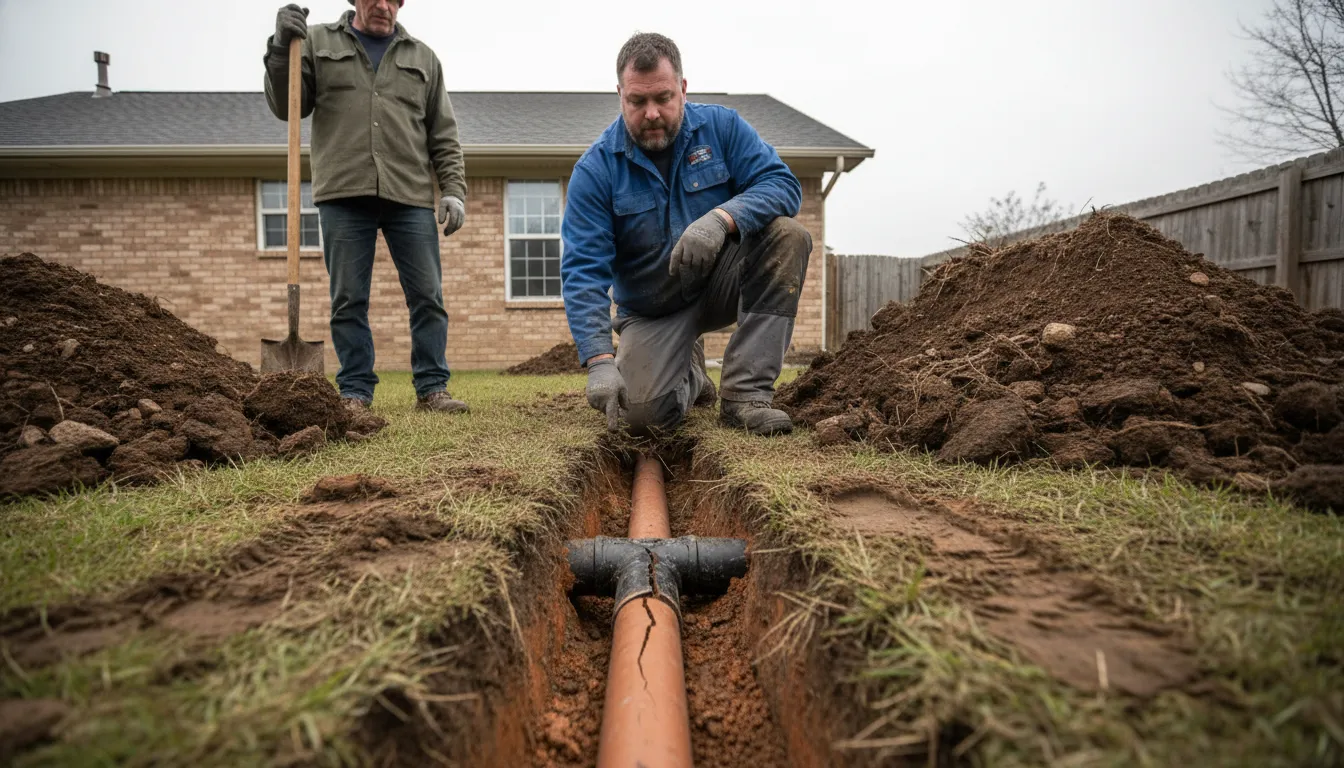
This is the conventional method, involving the digging of a long, deep trench along the entire length of the sewer line to physically remove the old pipe and install a new one.
- Pros: Allows for direct visual inspection of the entire pipe, can address any surrounding soil issues, and is often the only option for completely collapsed or inaccessible lines.
- Cons: Highly disruptive to yards, driveways, gardens, and patios. Requires extensive and costly restoration after the pipe is replaced. The process is louder, takes longer, and is more weather-dependent.
- Cost Range: The repair itself often ranges from $100 to $300+ per foot. The total project cost increases significantly when factoring in landscape repair, concrete replacement, and permit fees, easily bringing totals to $5,000-$20,000 or more 4 5.
Find the perfect sewer line repair companies for your needs
Get personalized recommendations and expert advice
The Critical Role of Video Inspection
Before any repair plan is proposed, insist on a thorough video camera inspection. A skilled technician will feed a high-resolution, waterproof camera into your sewer line, providing a real-time view of its interior condition. This inspection is non-negotiable because it 6 7:
- Accurately Diagnoses the Problem: Pinpoints the exact location, cause, and severity of the issue-whether it's a root mass, a crack, a belly, or a collapsed section.
- Determines Viable Solutions: Reveals if the pipe is a candidate for trenchless lining or bursting, or if excavation is the only feasible option.
- Provides Documentation: Gives you a recorded video file that serves as a reference for the work needed and proof of the existing condition.
Cost Considerations for Hamilton Homeowners
Sewer line repair is a significant investment. Understanding the factors that influence cost helps in budgeting and comparing estimates.
Key Cost Factors:
- Repair Method: Trenchless lining or bursting typically has a higher per-foot material cost but lower restoration costs. Excavation has a lower per-foot pipe cost but very high labor and restoration costs.
- Length and Depth: The total linear feet of pipe needing repair and how deep it's buried directly impact material and labor.
- Pipe Diameter: Larger diameter pipes require more material.
- Access Difficulty: Obstacles like trees, pools, sheds, or paved surfaces can complicate access and increase price.
- Permits: Hamilton Township may require permits for sewer line work, which add to the project cost.
- Restoration: For excavation, the cost to replant grass, re-pour concrete, or rebuild a patio is a major add-on.
Sample Cost Scenarios:
- Trenchless CIPP Lining: For a standard 100-foot residential line, costs might range from $7,000 to $15,000+.
- Trenchless Pipe Bursting: A full line replacement via bursting could range from $6,000 to $12,000+ for a similar length 8.
- Spot Repair: If the damage is isolated to a single section (e.g., a broken joint), a targeted excavation for a "point repair" can be a cost-effective solution, often between $300 and $600 for the repair itself 9.
Choosing a Sewer Repair Specialist in Hamilton
Selecting the right contractor is as important as choosing the right repair method. Look for a licensed, insured professional with specific experience in both trenchless and traditional sewer repair. They should willingly provide references, offer a detailed written estimate that includes all potential costs, and start the process with a video inspection. A reputable specialist will explain all your options without pressure and help you make an informed decision based on the long-term health of your plumbing system and property.
Frequently asked questions
Sources
Footnotes
-
Trenchless Sewer Replacement - https://allcountysewer.com/trenchless-sewer-replacement/ ↩
-
Trenchless Sewer Repair vs. Traditional Excavation - AQUALIS - https://aqualisco.com/trenchless-sewer-repair-vs-traditional/ ↩
-
Trenchless vs. Traditional Sewer Repair - https://sewerlinesonly.com/trenchless-vs-traditional-sewer-repair-which-is-more-cost-effective-for-lakewood-homeowners/ ↩
-
Sewer Line Replacement Cost: 2025 Data - NJ Pipe Doctor - https://njpipedr.com/blog/sewer-line-replacement-cost/ ↩
-
How Much Does Sewer Line Replacement Cost? | CPI Service - https://cpiservice.com/blog/sewer-line-replacement-cost/ ↩
-
Empower Your Decision: Decoding Trenchless Sewer Repair Costs - Pipeliner Pros - https://pipelinerpros.com/trenchless-sewer-repair-cost/ ↩
-
Sewer Pipe Lining vs Residential Excavation - 128 Plumbing - https://www.128plumbing.com/sewer-pipe-lining-vs-residential-excavation/ ↩
-
Trenchless Sewer Repair: Lower Cost, Lower Impact Sewer Repair - https://www.sewerflowllc.com/2025/03/06/trenchless-sewer-repair-lower-cost-lower-impact-sewer-repair/ ↩
-
Cost Comparison: Trenchless vs. Traditional Sewer Line Repair - https://www.advancedtrenchlesssolutions.com/blog/cost-comparison-trenchless-vs-traditional-sewer-line-repair ↩