Find the Best Sewer Line Repair Companies for Your Business
No obligation • Fast responses • Nationwide coverage

Why you can trust Search a Plumber
Search a Plumber is a leading United States resource for finding and evaluating professional plumbing services. Our team researches licensing, experience, and customer feedback to create unbiased, fact-driven overviews. Companies cannot pay to change ratings or placement, ensuring homeowners get trustworthy information.
Search providers near you
Top Sewer Line Repair Companies in Pueblo, Colorado Ranked
A failing sewer line is a serious issue that can disrupt your home's entire plumbing system and lead to costly property damage. Sewer line repair involves diagnosing and fixing the underground pipe that carries wastewater from your home to the city's main line. This guide explains the common causes of sewer line problems in Pueblo, compares modern and traditional repair methods, and provides the information you need to connect with qualified local professionals who can assess your specific situation.

Understanding Your Sewer Line System
The sewer lateral is a critical but hidden component of your home. It runs from the exit point of your home's main drain, typically buried several feet underground across your property, to the public sewer main located in the street or alley. Homeowners in Pueblo are generally responsible for maintaining and repairing this entire section of pipe. When it fails, the consequences-from slow drains to sewage backups-demand immediate attention. Knowing the basics of how this system works is the first step in addressing any problem.
Common Causes of Sewer Line Failure in Pueblo
Several factors specific to the Pueblo area and Colorado climate contribute to sewer line deterioration. Identifying the root cause is essential for determining the proper fix.
- Tree Root Intrusion: This is one of the most frequent issues. Trees and large shrubs seek out water and nutrients, and the small joints or cracks in older sewer pipes are perfect entry points. Roots can grow into the pipe, causing complete blockages, or exert pressure that leads to cracks and breaks.
- Aging and Corroding Pipes: Many older homes in Pueblo were built with clay tile or cast iron sewer lines. Over decades, these materials can degrade. Clay tiles can crack or shift, while cast iron is susceptible to rust and corrosion, eventually leading to holes or collapses.
- Ground Movement and Pipe Damage: Colorado's soil can shift due to freeze-thaw cycles, drought, or erosion. This movement can cause a pipe section to sag (creating a "belly" where waste collects) or to crack under the stress. Heavy loads from vehicles or construction above the pipe can also cause breaks.
Diagnostic Step: The Camera Inspection
Before any repair can be planned, a professional diagnosis is non-negotiable. Specialists use a high-resolution, waterproof camera mounted on a flexible rod that is fed through the sewer line. This inspection:
- Pinpoints the Exact Problem: Locates the precise footage of a blockage, crack, root mass, or collapse.
- Assesses the Severity: Determines whether the issue is a minor root cleaning, a section repair, or a full replacement.
- Informs the Best Method: Helps decide if a trenchless technique is viable or if traditional excavation is necessary.
- Provides a Visual Record: You can see the problem for yourself, making the recommended solution clear.
This service is typically a fixed-cost first step and is crucial for obtaining accurate repair estimates 1.
Repair Methodologies: Trenchless vs. Traditional Excavation
Once the problem is identified, the repair strategy falls into one of two main categories. The right choice depends on the damage's location, extent, and your property's layout.
Trenchless Sewer Repair
Trenchless technology has revolutionized sewer line work by minimizing the need for large, destructive trenches. There are two primary techniques:
- Cured-In-Place Pipe (CIPP) Lining: A flexible, resin-saturated tube is inverted or pulled into the damaged pipe. It is then inflated and cured (often with steam or UV light) to form a hard, seamless "pipe-within-a-pipe." This method seals cracks and holes and resists root intrusion.
- Pipe Bursting: This method is used for replacing a severely damaged line. A conical bursting head is pulled through the old pipe, fracturing it outward while simultaneously pulling a new, durable pipe (like HDPE) into place behind it.
Pros of Trenchless Methods:
- Minimal Disruption: Requires only small access pits at the beginning and end of the run, preserving lawns, driveways, and landscaping.
- Speed: Many projects can be completed in a single day.
- Durability: The new liner or pipe is often more resistant to roots and corrosion than the original.
Cons of Trenchless Methods:
- Not Universally Applicable: May not be suitable for pipes that have completely collapsed, have severe misalignment, or are in poor soil conditions.
- Higher Material Costs: The specialized materials and equipment can lead to a higher upfront cost per foot, though this is often offset by the lack of restoration expenses 2.
Traditional Excavation (Trenching)
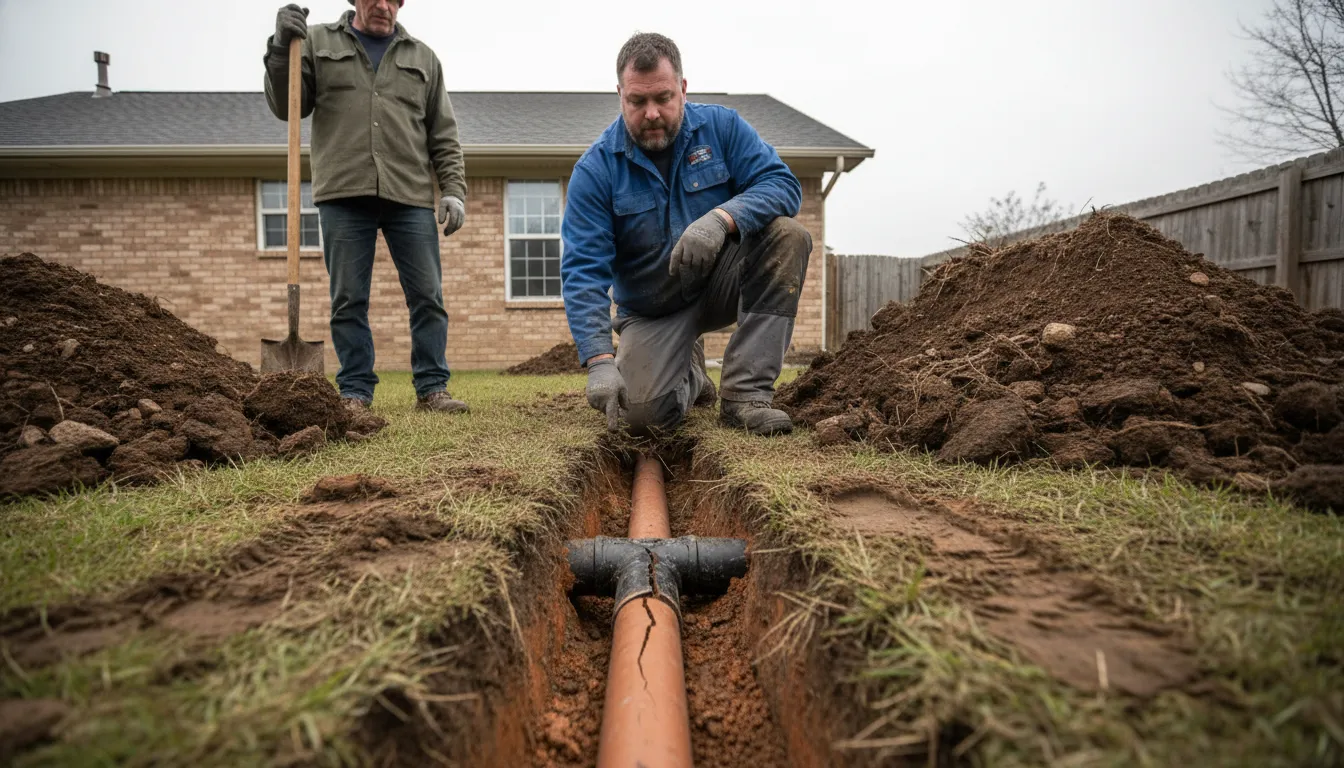
This is the conventional method where a backhoe or other equipment digs a trench along the path of the sewer line to fully expose the damaged section for repair or replacement.
Pros of Traditional Excavation:
- Comprehensive Access: Allows technicians to see and handle the entire problem, making it the only option for complex failures or complete collapses.
- Direct Solution: The old pipe is physically removed and a new one installed.
Cons of Traditional Excavation:
- Major Property Disruption: Creates a large, open trench across the property.
- Time-Consuming: The digging, repair, backfilling, and restoration process can take several days to weeks.
- High Restoration Costs: You must factor in the significant cost to repair lawns, concrete, sidewalks, or other landscaping destroyed during excavation 3 4 5.
Find the perfect sewer line repair companies for your needs
Get personalized recommendations and expert advice
Cost Considerations for Pueblo Homeowners
Sewer line repair is a significant investment, and costs in Pueblo can vary widely based on the method chosen and the scope of the problem. It's important to get multiple detailed estimates based on a camera inspection.
- Diagnostic Camera Inspection: Often a fixed fee, this is an essential first cost.
- Trenchless Repair (CIPP Lining or Pipe Bursting): Typically ranges from $50 to $250 or more per linear foot. Lining tends to be on the lower end of this range, while pipe bursting may be higher 6 7 8.
- Traditional Excavation Repair: Can range from $50 to $450 or more per linear foot. This wide range accounts for the depth of the pipe, soil conditions, and-critically-the extensive cost of restoring the excavated area (landscaping, concrete, etc.) 9.
- Full Line Replacement: For a standard residential line, total replacement costs in Pueblo often fall between $2,100 and $5,500. However, for severe damage, long runs, or complex access, costs can reach $12,000 to $30,000 10 11 12. A trenchless replacement can sometimes cut the total cost in half by eliminating restoration work 13.
Key Financial Takeaways: Always ensure your estimate includes permits, the final inspection by the city, and all restoration work. While the per-foot cost of trenchless may seem higher, the total project cost is frequently competitive with or lower than excavation when you account for not having to re-sod your entire yard or repave your driveway 14.
Choosing the Right Service Provider
Selecting a qualified professional is as important as choosing the repair method. Look for a licensed, insured plumber or sewer specialist with specific experience in both trenchless and traditional methods. They should insist on a camera inspection before providing a firm quote, clearly explain the pros and cons of each option for your situation, provide a detailed written estimate, and have positive, verifiable local references. A reputable professional will help you navigate the often-required city permits for sewer work in Pueblo.
Frequently asked questions
Sources
Footnotes
-
Sewer Line Replacement Cost Denver - https://www.simplysewersdenver.com/how-much-does-a-sewer-replacement-cost/ ↩
-
Trenchless vs. Traditional Sewer Repair - https://sewerlinesonly.com/trenchless-vs-traditional-sewer-repair-which-is-more-cost-effective-for-lakewood-homeowners/ ↩
-
Traditional Excavation Vs. Trenchless Methods - https://bullseyeplumbing.com/traditional-excavation-vs-trenchless-methods/ ↩
-
Trenchless Sewer Repair vs. Traditional Excavation: Which is Better? - https://alphaenvironmental.net/blog/trenchless-sewer-repair-vs-traditional-excavation-which-is-better/ ↩
-
Trench vs. Trenchless: Which Sewer Line Repair Method is Right for ... - https://coloradosewerline.com/trench-vs-trenchless-which-sewer-line-repair-method-is-right-for-you/ ↩
-
Is Trenchless Sewer Line Repair Cheaper? - AP Plumbing - https://applumbing.com/blog/is-trenchless-sewer-line-repair-cheaper/ ↩
-
Sewer Line Repair in Pueblo & Colorado Springs, CO - https://callbuck.com/plumbing/sewer-lines/ ↩
-
How Much Does Trenchless Sewer Line Repair Cost? - https://alphaenvironmental.net/blog/how-much-does-trenchless-sewer-repair-cost/ ↩
-
Pueblo Plumbing Service Costs & Prices - ProMatcher Cost Report - https://plumbers.promatcher.com/cost/pueblo-co-plumbers-costs-prices.aspx ↩
-
The Cost of Sewer Line Replacement: What to Expect - https://dirtcheapsewer.com/the-cost-of-sewer-line-replacement/ ↩
-
Sewer Line Replacement in Pueblo, CO - Costs 12 / 2025 - Homeyou - https://www.homeyou.com/co/sewer-line-replacement-pueblo-costs ↩
-
Empower Your Decision: Decoding Trenchless Sewer Repair Costs - Pipeliner Pros - https://pipelinerpros.com/trenchless-sewer-repair-cost/ ↩
-
Cost Comparison: Trenchless vs. Traditional Sewer Line Repair - https://www.advancedtrenchlesssolutions.com/blog/cost-comparison-trenchless-vs-traditional-sewer-line-repair ↩
-
Sewer Repair Cost: Trenchless Vs Traditional Methods - https://www.superbrothers.com/sewer-repair-cost-trenchless-vs-traditional-methods/ ↩