Find the Best Sewer Line Repair Companies for Your Business
No obligation • Fast responses • Nationwide coverage

Why you can trust Search a Plumber
Search a Plumber is a leading United States resource for finding and evaluating professional plumbing services. Our team researches licensing, experience, and customer feedback to create unbiased, fact-driven overviews. Companies cannot pay to change ratings or placement, ensuring homeowners get trustworthy information.
Search providers near you
Top Sewer Line Repair Companies in San Bernardino, California Ranked
A failing sewer line is a serious issue that can disrupt your home and pose health risks. Sewer line repair involves diagnosing and fixing the underground pipe that carries all your home's wastewater to the city's main sewer system. When this critical line is damaged, it requires prompt, professional attention to prevent backups, property damage, and costly complications. This guide explains what homeowners in San Bernardino need to know about their sewer lateral, common problems, repair methods, and how to find qualified local specialists to restore proper flow to your property.
Understanding Your San Bernardino Sewer Lateral
The pipe running from your home to the public sewer main is called a private sewer lateral. In San Bernardino, homeowners are fully responsible for maintaining and repairing this entire section, which typically extends from the house foundation, under your yard, and often beneath sidewalks or driveways before connecting to the city main in the street 1. This is a crucial piece of infrastructure that you own.
Key components of your sewer lateral system include:
- Depth and Path: Sewer pipes are buried several feet underground. Local regulations often require a minimum cover of 5 feet in public streets, 4 feet at the curb, and 3 feet in easements 2. Their path usually runs in a straight line from your home's main drain to the street.
- The Cleanout: This is your primary access point. It's usually a 3- or 4-inch capped pipe located 1 to 3 feet from your home's foundation, often visible in landscaping or inside a small green or concrete box 3. This is where plumbers insert cameras and equipment for inspection and cleaning.
- Connection Point: The lateral ends at its connection with the San Bernardino Municipal Water Department's (SBMWD) main sewer line, typically located in the street or a public easement 4.
Common Causes of Sewer Line Failure in San Bernardino
Several factors specific to the region and aging infrastructure contribute to sewer line issues here.
Tree Root Infiltration: This is a leading cause of blockages and damage. Mature trees, common in older San Bernardino neighborhoods, seek moisture. Tiny roots can infiltrate cracks or loose joints in older clay or cast-iron pipes, eventually growing large enough to cause complete blockages or break the pipe apart.
Aging and Deteriorating Pipes: Many homes in the area, especially those built before the 1970s, have original sewer lines made of clay (terra cotta) or cast iron. These materials have a lifespan of 50-60 years and are prone to cracking, collapsing, and corrosion over time 5.
Soil Movement and Seismic Activity: San Bernardino's clay-heavy soils can expand and contract with moisture, putting pressure on pipes. Furthermore, the region's seismic activity can cause the ground to shift, leading to misaligned joints, cracks, or "bellies"-sags in the pipe where waste and water collect instead of flowing freely 6.
Internal Blockages: While not always structural damage, persistent clogs are a major symptom. The primary culprits are FOG (Fats, Oils, and Grease) poured down drains, which solidify in pipes, and non-flushable items like "flushable" wipes, paper towels, and hygiene products 7 8.
Diagnostic Steps: The Camera Inspection
Before any repair can be planned, a professional diagnosis is essential. The industry standard is a video camera inspection. A specialized, waterproof camera is fed through the cleanout and travels the length of your sewer lateral, sending real-time video to a monitor.
This inspection allows a technician to:
- Pinpoint the exact location and depth of a problem.
- Identify the specific cause (roots, break, belly, etc.).
- Assess the material and condition of the existing pipe.
- Provide a clear visual record to justify the recommended repair solution.
Never agree to a major sewer repair or replacement without first seeing the camera inspection footage.
Sewer Line Repair Methods: Trenchless vs. Traditional
Once a problem is identified, you will typically have two broad categories of repair to consider: modern trenchless methods or traditional excavation.
Trenchless Sewer Repair (Minimally Invasive)
Trenchless technology has revolutionized sewer repair by fixing pipes with minimal digging. It's often recommended for pipes that are damaged but not completely collapsed.
1. Pipe Lining (Cured-In-Place Pipe or CIPP): This method involves saturating a flexible, resin-coated felt tube with epoxy and inserting it into the damaged pipe. The tube is then inflated, pressing the resin against the interior walls. It cures in place (often using hot water or UV light), forming a new, jointless, and corrosion-resistant pipe within the old one 9.
- Pros: Very minimal excavation (usually just at the access points). Preserves landscaping, driveways, and hardscapes. Can be completed in 1-2 days. Creates a structurally improved pipe.
- Cons: Not suitable for pipes that have lost their grade (slope) or are fully collapsed. Slightly reduces the internal pipe diameter.
2. Pipe Bursting: This method is used for full replacement without a trench. A conical bursting head is pulled through the old pipe, fracturing it outward. Simultaneously, a new pipe (typically HDPE) is pulled in behind the head, replacing the old line in the same path 10 11.
- Pros: Installs a brand-new, durable pipe. Still requires only small access pits at the beginning and end of the run.
- Cons: Requires more pulling force than lining. May not be feasible under certain obstructions.
The major advantage of trenchless methods is the dramatic reduction in restoration costs-saving an estimated 30-40% compared to traditional excavation when you factor in repairing landscapes, concrete, and other surfaces.
Traditional Excavation (Open Trench Repair)
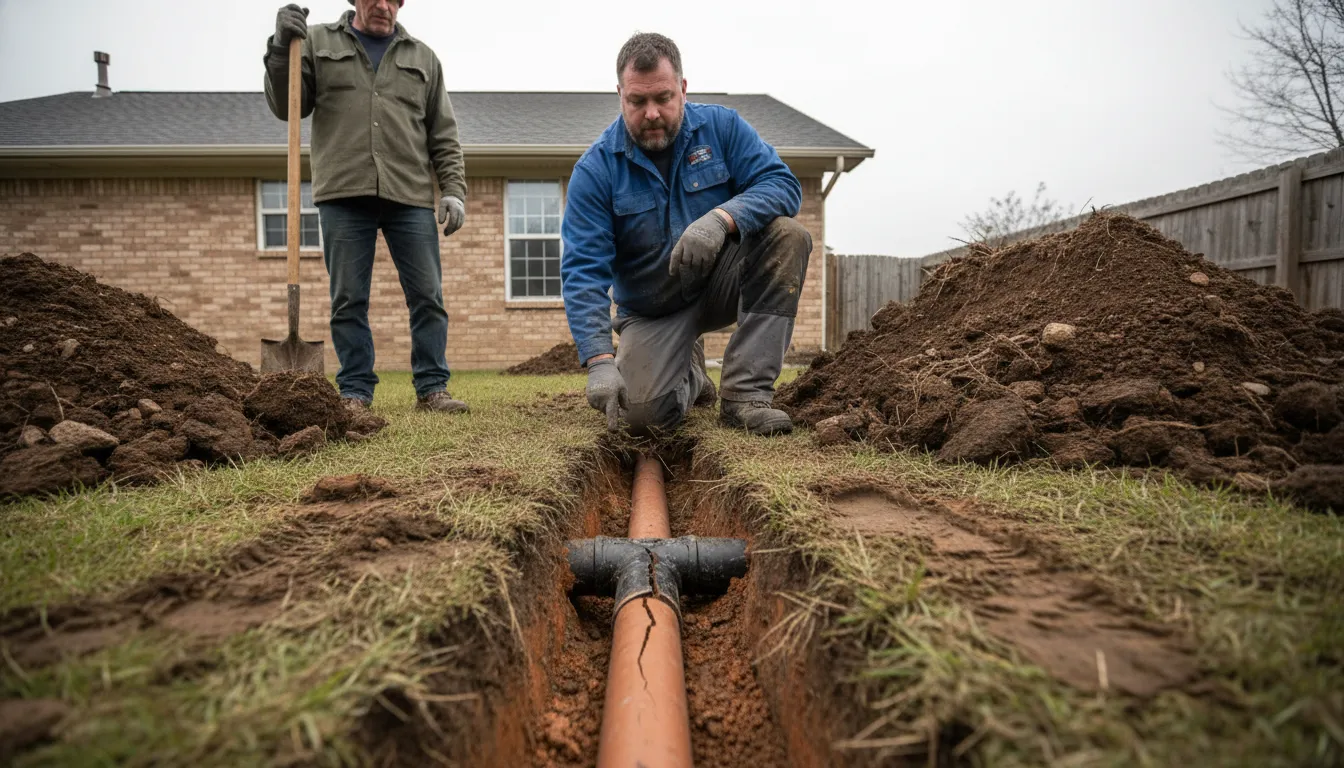
This is the conventional method where a backhoe digs a trench along the entire length of the failed sewer lateral to expose it. The old pipe is removed and a new one is laid in its place.
- Pros: It is a definitive solution for any problem, including total collapses, severe misalignment, or situations where the pipe's slope must be corrected. The entire pipe is visible and accessible.
- Cons: It is highly invasive, destructive, and expensive. It requires digging through yards, which may involve removing trees, patios, driveways, and sidewalks. The cost of labor for excavation and the subsequent surface restoration (re-paving, re-sodding) adds significantly to the project total and extends the timeline 12.
Find the perfect sewer line repair companies for your needs
Get personalized recommendations and expert advice
Cost Factors for Sewer Repair in San Bernardino
Sewer line repair costs vary widely based on the method, extent of damage, and site conditions. Here is a general overview based on regional data:
- Minor Repairs or Cleanout: Addressing a localized clog or small section issue typically ranges from $1,100 to $5,000.
- Per-Linear-Foot Costs: A common way to estimate is by the foot. In San Bernardino, costs can range from $50 to $250 per linear foot, with an average often cited around $150 per linear foot for replacement 13 14.
- Trenchless Repair Project: A typical trenchless lining or bursting project for a residential lateral often falls in the range of $3,000 to $10,000+. The long-term value is high, as the new liner can last 30-50 years 15 16.
- Traditional Excavation Project: A full dig-and-replace project commonly costs $6,000 to $12,000+. This can easily exceed $20,000 if the pipe runs under concrete driveways, pools, or extensive landscaping that requires complex restoration 17 18.
Remember: The most economical choice long-term is not always the cheapest upfront. Trenchless repairs avoid thousands in landscape and hardscape restoration, making them a cost-effective solution for eligible lines.
Maintaining Your Sewer Line
Prevention is always less expensive than repair. Protect your sewer lateral with these habits:
- Mind Your Drains: Never pour cooking fats, oils, or grease down the sink. Scrape plates into the trash.
- Flush Only Toilet Paper: Do not flush wipes (even "flushable" ones), paper towels, feminine hygiene products, or cotton swabs.
- Manage Tree Roots: Be mindful of planting trees with aggressive root systems near your sewer line's path. If you have existing trees, consider periodic professional root cutting via hydro-jetting as a preventative measure.
- Schedule Periodic Inspections: For older homes (40+ years), a professional camera inspection every few years can catch small issues before they become catastrophic failures.
Frequently asked questions
Sources
Footnotes
-
Private Sewer Lateral | SBMWD, CA - https://sbmwd.org/382/Private-Sewer-Lateral ↩
-
standards for sanitary sewer - Special Districts - https://specialdistricts.sbcounty.gov/wp-content/uploads/sites/54/2021/05/sewerstandards.pdf ↩
-
How to Locate Your Sewer Line: A Homeowner's Guide - Bonney - https://www.bonney.com/blog/how-to-locate-your-sewer-line/ ↩
-
Sewer Collections | SBMWD, CA - San Bernardino Water Department - https://www.sbmwd.org/177/Sewer-Collections ↩
-
Sewer Collections - San Bernardino Water Department - https://www.sbmwd.org/177/Sewer-Collections ↩
-
Unexpected Causes of Sewer Line Troubles - https://tntservicegroup.com/problems/unexpected-causes-of-sewer-line-troubles/ ↩
-
Top Causes of Sewer Line Damage and Expert Fixes - https://advancedplumbingsf.com/top-causes-of-sewer-line-damage-and-expert-repairs/ ↩
-
Five Most Common Reasons a Sewer Line Could Collapse - https://mainlinewaterandsewer.ca/five-most-common-reasons-a-sewer-line-would-collapse/ ↩
-
Trenchless vs Traditional Sewer Repair Methods - https://www.powerproplumbing.com/blog/comparing-sewer-repair-methods ↩
-
Sewer Repair Options: Trenchless vs. Traditional Methods | TYCO - https://tycoplumbingco.com/sewer-repair-options-trenchless-vs-traditional-methods/ ↩
-
Trenchless Sewer Line Repair/Replacement - Steve's 5 Star Service - https://www.stevesair.com/trenchless-sewer-line-repair.php ↩
-
Sewer Repair Cost: Trenchless Vs Traditional Methods - https://www.superbrothers.com/sewer-repair-cost-trenchless-vs-traditional-methods/ ↩
-
Sewer Line Replacement vs Repair: A Cost-Benefit Analysis ... - https://www.alpineplumbingandair.com/sewer-line-replacement-vs-repair-a-cost-benefit-analysis-for-california-homes/ ↩
-
Trenchless Sewer Repair vs. Traditional Methods in the Bay Area - https://total-uc.com/trenchless-vs-traditional-sewer-repair/ ↩
-
Sewer Pipe Lining vs Residential Excavation - 128 Plumbing - https://www.128plumbing.com/sewer-pipe-lining-vs-residential-excavation/ ↩
-
Trenchless Pipe Relining - A-1 Total Service Plumbing - https://a-1totalserviceplumbing.com/trenchless/trenchless-pipe-relining/ ↩
-
Cost Comparison: Trenchless vs. Traditional Sewer Line Repair - https://www.advancedtrenchlesssolutions.com/blog/cost-comparison-trenchless-vs-traditional-sewer-line-repair ↩
-
How much does it cost to dig up and replace a sewer line? - https://vipdrainservices.com/how-much-does-it-cost-to-dig-up-and-replace-a-sewer-line/ ↩