Find the Best Sewer Line Repair Companies for Your Business
No obligation • Fast responses • Nationwide coverage

Why you can trust Search a Plumber
Search a Plumber is a leading United States resource for finding and evaluating professional plumbing services. Our team researches licensing, experience, and customer feedback to create unbiased, fact-driven overviews. Companies cannot pay to change ratings or placement, ensuring homeowners get trustworthy information.
Search providers near you
Top Sewer Line Repair Companies in Oakland, California Ranked
Dealing with a failing sewer line is a stressful and urgent situation for any Oakland homeowner. When your main sewer line is damaged, it can lead to slow drains, foul odors, sewage backups, and significant property damage. Understanding your repair options, from traditional excavation to modern trenchless methods, is crucial for making an informed decision that protects your home and your budget. This guide provides detailed information on sewer line repair and replacement in Oakland, helping you identify local experts who can assess your specific situation and recommend the best solution.
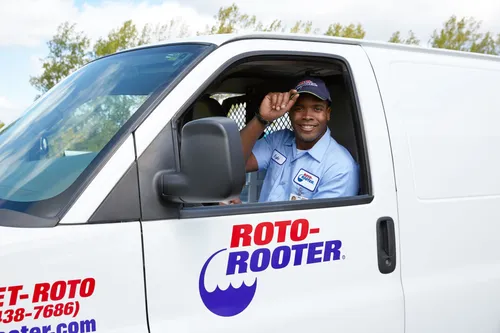
Roto-Rooter Plumbing & Water Cleanup
1780 Whipple Rd Ste 203G, Union City, CA 94587
Roto-Rooter Plumbing & Water Cleanup provides comprehensive plumbing services in San Jose, CA, specializing in residential and commercial plumbing solutions. Their offerings include sewer and drain cleaning, water heater repair and installation, leak detection, gas line installation, and trenchless sewer repair. The company is equipped to handle emergency plumbing situations with 24/7 availability, ensuring prompt response to issues like burst pipes and sewer backups. With extensive experience and advanced technology, Roto-Rooter addresses complex plumbing challenges efficiently. They also offer floodwater cleanup and mold remediation services, supporting property restoration after water damage. Serving the San Jose area and nearby communities, Roto-Rooter is a licensed and insured provider known for its broad range of plumbing capabilities and emergency service availability.
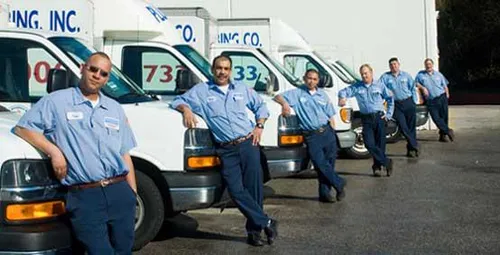
George Salet Plumbing, Inc.
200 Valley Dr, Brisbane, CA 94005
George Salet Plumbing, Inc. is a full-service plumbing contractor serving San Francisco, CA, and the Peninsula. With over 40 years of experience since 1979, they provide installation, repair, drain cleaning, leak detection, and sewer line repair services for residential and commercial clients. Their skilled technicians are known for clean, honest work and offer flat-rate pricing with guaranteed results. The company emphasizes thorough plumbing knowledge and ongoing technician training to address complex plumbing issues effectively.
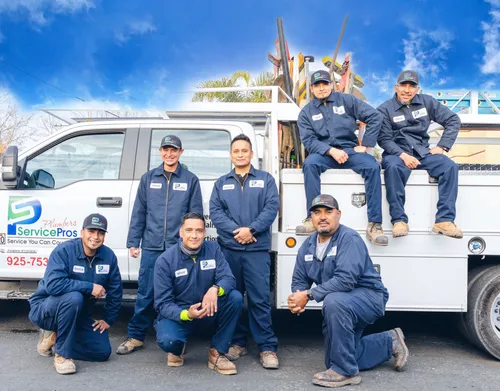
Service Pros Plumbers, Inc.
1320 Willow Pass Rd, Concord, CA 94520
Service Pros Plumbers, Inc. is a family-owned plumbing company serving Oakland, CA, with over 25 years of experience. They provide a wide range of plumbing services for residential and commercial customers, including water heater repair and installation, drain cleaning, sewer line replacement with trenchless options, leak detection, and gas line installation. Their licensed plumbers also offer whole-house repiping to improve water pressure and system efficiency. Service Pros Plumbers offers 24/7 emergency plumbing services to address urgent issues such as burst pipes and clogged drains promptly.
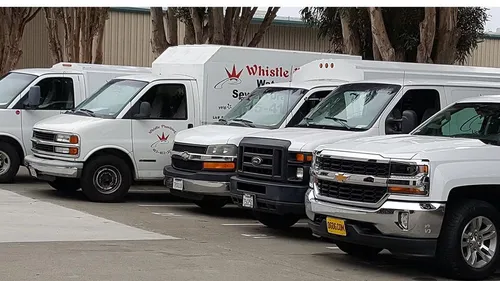
Whistle Plumbing
158 Dennis Dr, Daly City, CA 94015
Whistle Plumbing is a family owned and operated plumbing company based in Daly City, CA, serving San Francisco and surrounding areas including San Bruno and South San Francisco. They handle both residential and commercial plumbing projects with services such as water heater installation, drain cleaning, and sewer line repairs. Established in 2011, Whistle Plumbing is fully licensed and insured and maintains a strong presence in the local community.
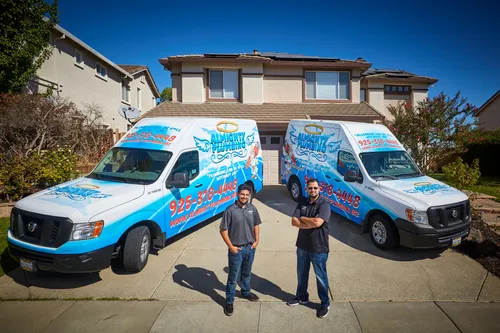
Almighty Plumbing
1309 Mokelumne Dr, Antioch, CA 94531
Almighty Plumbing is a family-owned and operated plumbing company serving Oakland, CA, and the greater East Bay area. They provide a wide range of plumbing services including water heater repair and installation, tankless water heater services, water softener installation, drain cleaning, sewer line repair, repiping, and garbage disposal repair. The company also specializes in bathroom remodeling and water filtration system installation. With a focus on honest, fair service tailored to customer needs, Almighty Plumbing offers multi-year warranties on repairs and installations. They also provide emergency plumbing services to address urgent issues promptly.
Understanding Your Sewer Line System
Your home's main sewer line is a critical underground pipe that carries all wastewater from your house to the city's sewer main, typically located under the street. In Oakland, these lines usually run from your home's foundation, across your property, and under any obstacles like driveways, patios, or landscaping to reach the property line. Knowing the path and condition of this pipe is the first step in addressing any problems.
Common Causes of Sewer Line Failure in Oakland
Several factors unique to the Bay Area contribute to sewer line deterioration and failure. Recognizing these causes can help you identify issues early.
- Tree Root Intrusion: This is a leading cause of blockages and breaks. Roots from Oakland's many mature trees are naturally drawn to the moisture and nutrients in sewer pipes. They can infiltrate through tiny cracks or pipe joints, eventually growing and causing complete blockages or fracturing the pipe.
- Seismic Activity and Ground Shifting: The Bay Area's seismic activity can cause the soil to shift and settle. This movement puts tremendous stress on underground pipes, leading to cracks, misaligned joints, or even complete separation of pipe sections.
- Aging Pipe Materials: Many older Oakland homes were built with clay (terra cotta) or cast iron sewer pipes. Clay pipes are brittle and prone to cracking, while cast iron corrodes and rusts over decades. Both materials have a finite lifespan and are common culprits in sewer line failures.
- Improper Slope and Bellies: Over time, ground settling can cause a section of the pipe to sink, creating a "belly" or negative grade. This low spot allows waste and solids to collect instead of flowing freely, leading to chronic blockages.
Repair vs. Replacement: Evaluating Your Options
Not every sewer line problem requires a full replacement. A professional inspection, typically using a sewer camera, will determine the extent of the damage and whether a targeted repair or a complete line replacement is necessary.
- Repair: Suitable for isolated damage, such as a single crack, a small hole, or a root-intruded joint. Methods like spot repair or pipe lining can often fix these issues without replacing the entire line.
- Replacement: Necessary when the pipe has multiple failures, has completely collapsed, has severe corrosion, or is made of obsolete material like Orangeburg pipe. A full replacement provides a long-term, durable solution.
Trenchless vs. Traditional Sewer Repair Methods
Once the need for a significant repair or replacement is confirmed, you'll face a choice between two primary methodologies: traditional excavation (open-cut) and trenchless technology.
Traditional Excavation (Open-Cut Repair)
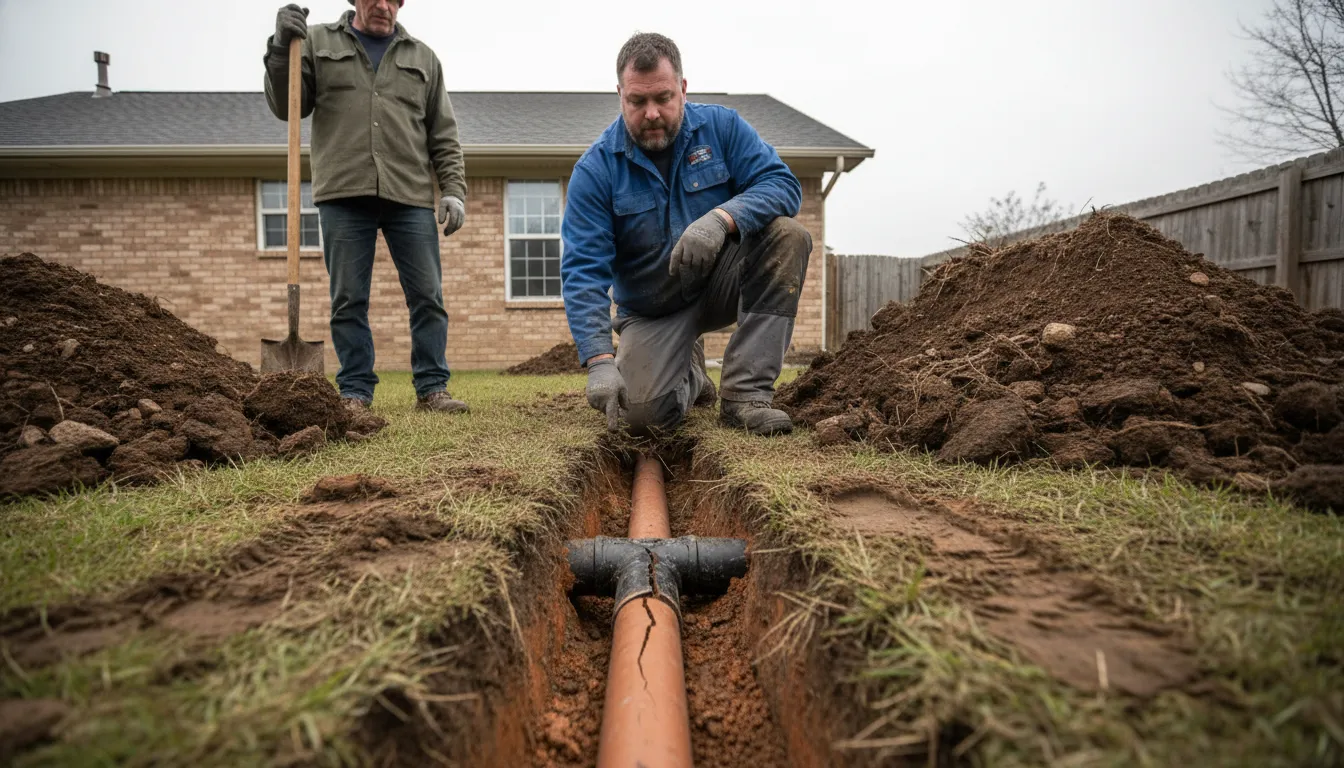
This is the conventional method that involves digging a large trench along the path of the sewer line to fully expose the damaged pipe.
- How It Works: Heavy equipment is used to excavate a trench from the surface down to the pipe, which is then removed and replaced with new piping. The trench is backfilled, but significant restoration of landscaping, concrete, or hardscaping is often required.
- Pros:
- Often has a lower upfront cost for the repair itself, especially for shallow, easily accessible pipes.
- Can address severe damage, including completely collapsed pipes.
- Allows for correction of improper pipe slopes and alignment.
- Cons:
- Highly disruptive to your property, destroying lawns, gardens, driveways, and patios.
- The cost of restoring your yard, concrete, and other surfaces can add thousands to the final bill.
- The process is time-consuming, noisy, and leaves a large construction site on your property.
Trenchless Sewer Repair
Trenchless technology has revolutionized sewer line work by minimizing excavation. The two most common trenchless methods are pipe lining and pipe bursting.
-
Pipe Lining (Cured-in-Place Pipe): A flexible, resin-saturated tube is inserted into the old pipe and inflated. The resin hardens, creating a seamless, jointless "pipe within a pipe" that is highly resistant to roots and corrosion.
-
Pipe Bursting: A conical bursting head is pulled through the old, damaged pipe, fracturing it outward while simultaneously pulling a new, durable pipe (like HDPE) into place behind it.
-
Pros of Trenchless Methods:
-
Minimal Disruption: Only requires small access pits at the beginning and end of the line, preserving your landscaping, driveway, and hardscape 1.
- Durability: The new liner or pipe can have a lifespan of 50 years or more and is resistant to root intrusion 2.
-
Speed: The process is often completed in one or two days, much faster than traditional excavation 3.
- Stronger Pipe: Creates a seamless, jointless line that improves flow and prevents future leaks at joints.
-
Cons of Trenchless Methods:
-
Higher Initial Cost: The specialized equipment and materials can make the upfront price higher than basic excavation.
-
Not for Every Scenario: It may not be suitable for pipes that have lost their structural integrity (fully collapsed), have severe misalignment, or need a change in grade.
Find the perfect sewer line repair companies for your needs
Get personalized recommendations and expert advice
Cost Considerations for Oakland Homeowners
Sewer line work is a significant investment. Costs in the Bay Area vary widely based on the method chosen, the extent of damage, and property-specific factors.
- General Repair Costs: For targeted repairs, homeowners might pay between $1,400 and $5,300, with a Bay Area average around $3,300.
- Trenchless Repair/Replacement: Trenchless lining or bursting projects typically range from $4,000 to $12,000 or more, with costs potentially reaching $20,000 for extensive lines. Pricing is often calculated per foot, ranging from $135 to $285+ 4 5 6.
- Traditional Full Replacement: A complete sewer line replacement using open-cut excavation can cost between $8,000 and $15,000, and easily exceed $20,000 when factoring in the cost of restoring landscaping, concrete driveways, or other surfaces 7 8 9.
Key Factors That Influence Your Final Cost
- Pipe Material & Age: Replacing fragile clay or heavily corroded cast iron is more involved than working with modern PVC.
- Location and Depth: Pipes buried deep underground or located under concrete slabs, driveways, or mature trees are more expensive to access 10 11.
- Length of the Line: The distance from your house to the city main directly impacts material and labor costs.
- Severity of Damage: An isolated crack is less expensive to fix than a line with multiple breaks or a complete collapse.
- Property Restoration: With traditional excavation, always budget for the added cost of repairing your yard, pavement, or other disturbed areas 12.
Choosing the Right Service Provider
Selecting a qualified professional is the most important step. Look for a licensed, insured plumber or sewer specialist with specific experience in both trenchless and traditional methods. They should perform a thorough video camera inspection to diagnose the problem accurately before recommending a solution. Be wary of quotes that seem unusually low, as they may not include necessary permits or restoration costs. A reputable provider will explain all your options, provide a detailed written estimate, and help you navigate any required city permits for work on the sewer lateral.
Frequently asked questions
Sources
Footnotes
-
Trenchless Sewer Repair vs. Traditional Excavation - AQUALIS - https://aqualisco.com/trenchless-sewer-repair-vs-traditional/ ↩
-
Trenchless Sewer Line Replacement Oakland, CA - Pipe Spy - https://www.pipespy.com/services/trenchless-sewer-line-repair-replacement ↩
-
Sewer Repair Cost: Trenchless Vs Traditional Methods - https://www.superbrothers.com/sewer-repair-cost-trenchless-vs-traditional-methods/ ↩
-
Cost Comparison: Trenchless vs. Traditional Sewer Line Repair - https://www.advancedtrenchlesssolutions.com/blog/cost-comparison-trenchless-vs-traditional-sewer-line-repair ↩
-
Trenchless Sewer Repair vs. Traditional Methods in the Bay ... - https://total-uc.com/trenchless-vs-traditional-sewer-repair/ ↩
-
Trenchless vs. Traditional Sewer Repair - https://sewerlinesonly.com/trenchless-vs-traditional-sewer-repair-which-is-more-cost-effective-for-lakewood-homeowners/ ↩
-
Sewer Line Replacement vs Repair: A Cost-Benefit Analysis ... - https://www.alpineplumbingandair.com/sewer-line-replacement-vs-repair-a-cost-benefit-analysis-for-california-homes/ ↩
-
Sewer Line Repair Cost Guide in Bay Area - https://www.bellowsservice.com/how-much-do-main-line-sewer-repairs-cost/ ↩
-
Sewer Line Replacement in Oakland, CA - Costs 12 / 2025 - Homeyou - https://www.homeyou.com/ca/sewer-line-replacement-oakland-costs ↩
-
Cost To Repair Sewer Line: 2023 Options & Affordable Services - https://www.superbrothers.com/cost-to-repair-sewer-line-2023-options-affordable-services/ ↩
-
Trenchless Sewer Repair vs. Traditional Excavation: Which is Better? - https://alphaenvironmental.net/blog/trenchless-sewer-repair-vs-traditional-excavation-which-is-better/ ↩
-
TRENCHLESS vs. TRADITIONAL SEWER REPAIR: cost & time ... - https://epoxypipeline.com/blog/trenchless-vs-traditional-sewer-repair-comparison/ ↩