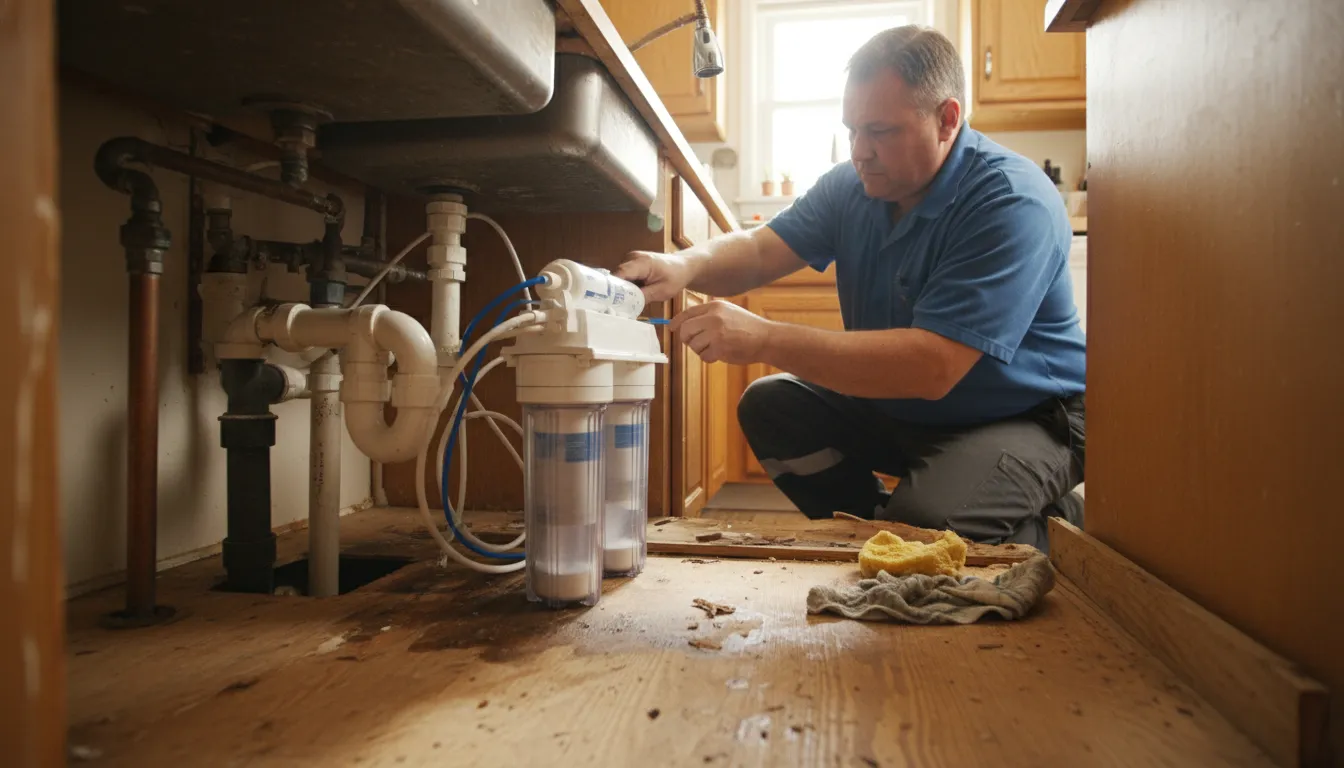
Find the Best Water Treatment Installation Companies for Your Business
No obligation • Fast responses • Nationwide coverage

Why you can trust Search a Plumber
Search a Plumber is a leading United States resource for finding and evaluating professional plumbing services. Our team researches licensing, experience, and customer feedback to create unbiased, fact-driven overviews. Companies cannot pay to change ratings or placement, ensuring homeowners get trustworthy information.
Search providers near you
Top Water Treatment Installation Companies in Providence, Rhode Island Ranked
Living in Providence means enjoying a rich history and vibrant culture, but the quality of your home's water is a fundamental part of daily comfort and health. While Providence's municipal water is generally considered soft to moderately soft, many residents seek solutions to improve taste, address specific contaminants, or protect their plumbing and appliances from scale buildup. This guide will help you understand your local water profile, explore the types of water treatment systems available, and outline the key steps for selecting and maintaining the right solution for your home.
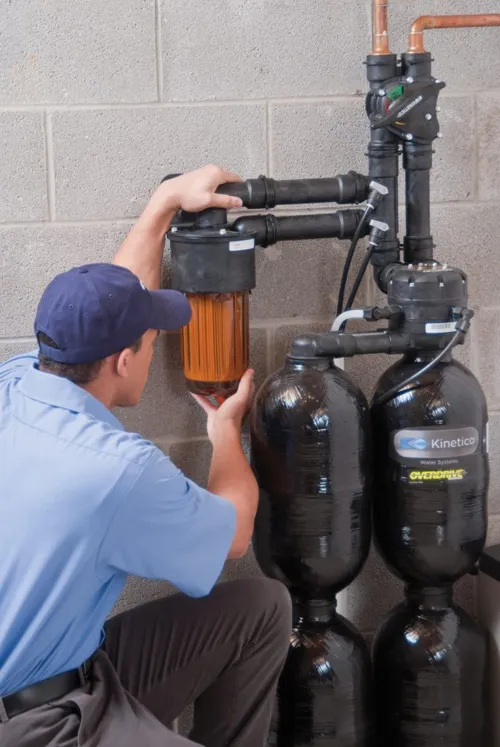
Premier Water Systems, Inc
Headquarters: (Serving Ma & RI, 591 Providence Hwy, Walpole, MA 02081
Premier Water Systems, Inc provides water softener installation and plumbing services in Boston, MA. They specialize in professional water filtration installation and maintenance, focusing on improving water quality with Kinetico water treatment systems. With 36 years of experience, their certified professionals deliver tailored solutions to address hard water, contaminants, and other common water issues. Premier Water Systems serves the New England and Rhode Island areas, offering advanced water softeners and filtration systems designed to enhance water safety and taste.
Roto-Rooter Plumbing & Water Cleanup
175 Maple St, Stoughton, MA 02072
Roto-Rooter Plumbing & Water Cleanup provides comprehensive residential and commercial plumbing services in Boston, MA, and the surrounding areas. They specialize in sewer line inspections, repairs, and trenchless pipe replacement, as well as water heater installation and repair, drain cleaning, leak detection, and water softener installation. The company is equipped to handle emergency plumbing situations with 24/7 availability, including floodwater cleanup and mold remediation. With extensive experience servicing the local community, Roto-Rooter uses advanced technology such as hydro jetting to address tough clogs and sewer line issues efficiently.

Clear Water Pump and Well Service
28 Tosca Dr, Stoughton, MA 02072
Clear Water Pump and Well Service provides water softener installation and plumbing services in Boston, MA. They specialize in custom-designed water filtration systems made with high-quality materials and craftsmanship. With over 15 years of experience, they have served more than 11,000 customers and maintain an A+ rating from the BBB. The company offers 24/7 emergency response to address urgent water system issues promptly and professionally.
Understanding Providence's Water Profile
Before investing in any treatment system, it's crucial to know what's in your water. Providence Water, the local supplier, draws from surface water sources like the Scituate Reservoir. The treated water meets all federal and state safety standards, but that doesn't mean it's perfect for every household's preferences or specific plumbing situation.
- Hardness Level: Providence water is classified as soft to moderately soft, with hardness levels typically ranging from 40 to 70 parts per million (PPM) of calcium carbonate 1 2. For perspective, water is considered "hard" above 120 PPM. This means the mineral content (calcium and magnesium) that causes scale buildup in pipes, on fixtures, and in appliances is relatively low. Consequently, a traditional water softener for hardness removal is not always a top priority for every home 3.
- Common Concerns: The most frequent complaints from Providence residents involve taste and odor, primarily due to chlorine used in the municipal disinfection process 4. Another significant consideration, especially in homes built before 1986, is the potential for lead leaching from older service lines or household plumbing fixtures. While the water leaving the treatment plant is lead-free, it can pick up lead as it travels through these older pipes.
- The Importance of Testing: General water quality reports are published annually, but they reflect the system-wide average. The only way to know what's specifically coming out of your tap is to test it. A certified lab test can identify the exact levels of hardness, chlorine, lead, copper, or other potential contaminants. This report is the essential first step, as it will dictate which type of water purification or conditioning system you truly need.
Types of Water Treatment Systems for Your Home
Depending on your test results and goals, different systems serve different purposes. Here's a breakdown of the primary technologies available to Providence homeowners.
Point-of-Use Filtration: For Drinking Water
These systems treat water at a single tap, usually the kitchen sink, and are ideal for improving water used for drinking and cooking.
- Under-Sink Reverse Osmosis (RO): This is considered the gold standard for producing high-purity drinking water. An RO system uses a semi-permeable membrane to remove a vast array of contaminants, including dissolved salts, metals like lead and copper, chlorine, and many chemicals. It's an excellent choice if your primary concern is lead or you simply want the best-tasting water from your kitchen faucet.
- Under-Sink Carbon Filters: Simpler and more affordable than RO, these filters use activated carbon to adsorb chlorine, bad tastes, and odors. They are effective for improving taste but remove a narrower range of contaminants compared to RO systems.
Point-of-Entry Treatment: For the Whole House
These systems are installed where the main water line enters your home, treating all the water used throughout the house-for showers, laundry, appliances, and every sink.
- Whole-House Filtration Systems: These units typically use large sediment and carbon filters to reduce chlorine, sediment, and volatile organic compounds (VOCs) from all the water in your home. This means better-tasting water from every tap, softer-feeling water for bathing, and protection for your appliances from sediment.
- Traditional Water Softeners (Ion Exchange): Despite the soft local water, some homes may still experience minor scale buildup over time. A traditional softener exchanges calcium and magnesium ions (hardness minerals) for sodium or potassium ions, effectively eliminating scale. This can help appliances like water heaters and dishwashers run more efficiently and extend their lifespan.
- Salt-Free Water Conditioners: These are an alternative to traditional softeners. Instead of removing hardness minerals, they alter their structure so they don't stick to pipes and surfaces as scale. They don't add sodium to the water, require no electricity or drain line in many cases, and are lower maintenance, making them a popular choice for scale prevention in areas with already moderately soft water.
Find the perfect water treatment installation companies for your needs
Get personalized recommendations and expert advice
The Process: From Testing to Installation
Making an informed decision involves a clear process. Rushing into a purchase without the right information can lead to an undersized, ineffective, or unnecessarily expensive system.
- Test Your Water: Start with a certified laboratory water test. You can purchase a test kit from a local provider or a state-certified lab. This will give you a concrete report on your water's hardness, pH, and levels of specific contaminants 5.
- Identify Your Goals: Based on your test results, define what you want to achieve. Is your goal to have lead-free drinking water? To eliminate chlorine taste throughout the house? To prevent any potential scale in your new water heater? Your goals will narrow down the system type.
- Consult a Professional: For whole-house systems, consulting with a local water treatment specialist is crucial. They can help you interpret your test results, recommend a correctly sized system for your home's water usage and flow rate (typically 8-15 gallons per minute for a household), and provide a detailed quote 6.
- Professional Installation: Proper installation is key to performance and warranty protection. A professional will ensure the system is plumbed correctly, that drain lines are properly set up (for RO and softeners), and that the unit is programmed and calibrated for your water conditions 7 8.
Cost Considerations for Providence Homes
The investment for water treatment varies widely based on the technology, capacity, and complexity of installation.
- Equipment & Installation Costs:
- Under-Sink RO System: The unit and professional installation typically range from $250 to $1,800.
- Whole-House Filtration System: A more significant investment, with total costs (unit + install) generally falling between $1,000 and $6,000 9.
- Water Softener/Conditioner: For a traditional ion-exchange softener, expect to pay between $700 and $4,600 installed. Salt-free conditioners often fall in a similar or slightly lower price range for the unit and installation.
- Ongoing Maintenance & Operating Costs: This is a critical part of the long-term cost. All systems require upkeep to function properly.
- Filter Changes: RO systems and whole-house filters require periodic filter and membrane replacements, which can cost $100 to $300+ per year 10.
Choosing to improve your home's water is an investment in your property, your health, and your daily quality of life. By starting with a water test and understanding the solutions tailored to Providence's specific water conditions, you can make a confident choice that delivers clean, great-tasting water for years to come.
Frequently asked questions
Sources
Footnotes
-
Rhode Island - HydroFLOW USA: Award Winning Water ... - https://hydroflow-usa.com/rhode-island-water-hardness/ ↩
-
Water Hardness Rhode Island | Aquatell US. - https://www.aquatell.com/pages/water-hardness-rhode-island ↩
-
Water Quality FAQ | Providence Water - https://www.provwater.com/water-quality/water-quality-overview/water-quality-faq ↩
-
Do you drink PVD tap water? : r/providence - Reddit - https://www.reddit.com/r/providence/comments/1b4q57y/do_you_drink_pvd_tap_water/ ↩
-
Filtration and Treatment of Private Well Water - https://health.ri.gov/private-wells/filtration-and-treatment-private-well-water ↩
-
Whole house water filtration - Rhode Island - H2O Care - https://h2ocare.com/whole-house-water-filtration-rhode-island/ ↩
-
Providence RI Home Water Treatment Systems - SafeWell - https://safewell.us/providence-ri-home-water-treatment-systems/ ↩
-
Purchasing and Maintaining A Water Softener - https://www.energy.gov/energysaver/purchasing-and-maintaining-water-softener ↩
-
How Much Does It Cost to Install a Water Filtration System In 2026? - https://modernize.com/water-treatment/types/water-filtration-system-cost ↩
-
Cost to install water filter system in Providence, RI - https://www.handoff.ai/construction-costs/install-water-filter-system/providence-ri ↩
-
Home Water Treatment Systems: Types, Features, Benefits & More - https://modernize.com/water-treatment ↩
-
Water Softener Installation Cost Guide Jan, 2026 - https://www.softprowatersystems.com/pages/budgeting-for-water-softener-installation-average-costs ↩