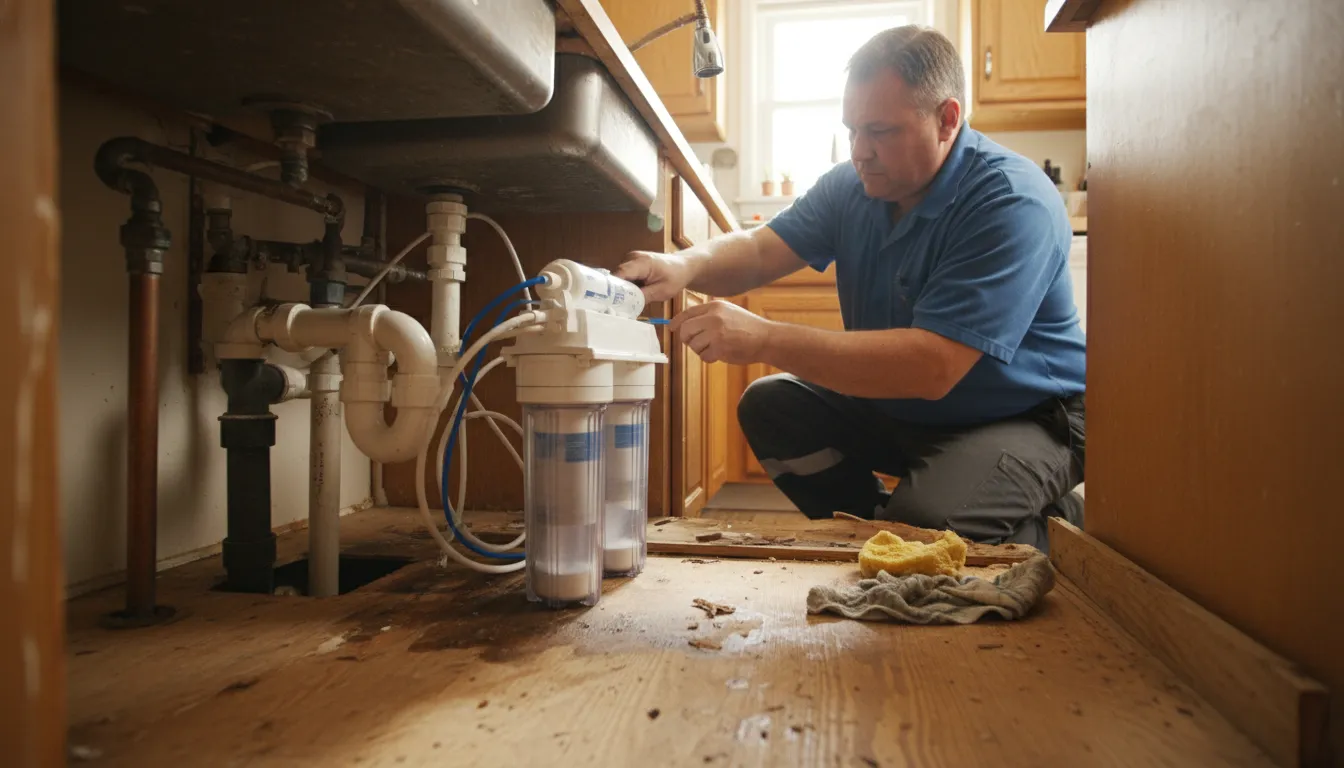
Find the Best Water Treatment Installation Companies for Your Business
No obligation • Fast responses • Nationwide coverage

Why you can trust Search a Plumber
Search a Plumber is a leading United States resource for finding and evaluating professional plumbing services. Our team researches licensing, experience, and customer feedback to create unbiased, fact-driven overviews. Companies cannot pay to change ratings or placement, ensuring homeowners get trustworthy information.
Search providers near you
Top Water Treatment Installation Companies in Taylor, Michigan Ranked
Living in Taylor means dealing with the realities of the local water supply. While safe to drink, the water in our area is known to be moderately hard, containing minerals like calcium and magnesium that can lead to scale buildup in pipes, appliances, and on fixtures. This guide is designed to help you understand your options for water treatment, from whole-house softening systems that tackle hardness to point-of-use filters that purify your drinking water. Whether you're looking to protect your plumbing, improve water taste, or address specific concerns, finding the right local professional for installation and service is the key to success.
Davison Home Services
360 E Maple Rd suite j, Troy, MI 48083
Davison Home Services provides water softener installation and plumbing services in Detroit, MI. They offer water softener diagnostics and installation to help prevent hard water buildup and related issues. The company also supports smart home technology with WiFi thermostat installation. Financing options are available to assist customers with their service needs.
K.C. Plumbing
Detroit, MI
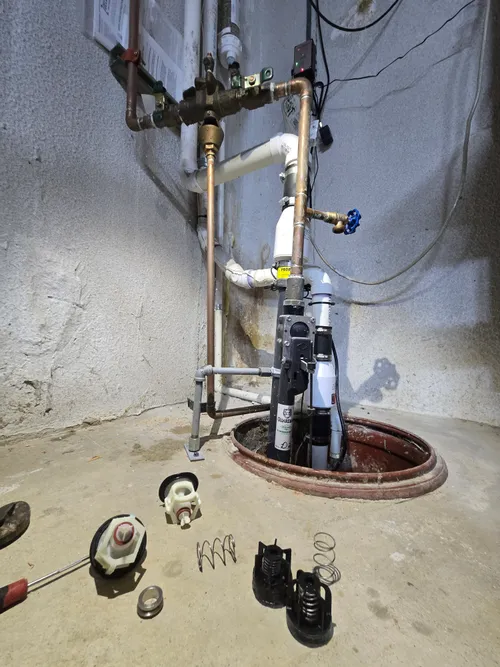
K.C. Plumbing is a plumbing service provider based in Detroit, MI, offering residential and commercial plumbing solutions. They serve the Metro Detroit area, including Macomb, Wayne, and Oakland counties. Their services include water softener installation, water filter installation, repair, and maintenance to ensure quality water. K.C. Plumbing provides 24-hour emergency plumbing services to address urgent plumbing issues at any time.

Culligan of Windsor, ON
3918 Walker Rd, Windsor, ON N8W 3T3, Canada
Culligan of Windsor, ON offers water treatment services in Detroit, MI, focusing on providing cleaner, safer, and better-tasting water. With over 85 years of experience, they specialize in water softener installation and other water treatment solutions tailored for both city and well water. Their expertise includes expert installation and maintenance of water softeners and reverse osmosis systems, helping customers improve water quality and protect plumbing fixtures. Culligan is known for its long-standing history in water treatment and commitment to sustainability-driven innovation.
Delta Plumbers Windsor
Detroit, MI
Delta Plumbers Windsor is a full-service plumbing company serving Detroit, MI, with over 17 years of experience. They provide a wide range of plumbing services including sewer camera inspections, water heater installation and repair, drain cleaning, hydro jetting, sump pump repair, and trenchless sewer line repair. Their team uses advanced technology such as video camera inspections and leak detection equipment to diagnose and fix plumbing issues efficiently. Delta Plumbers Windsor offers 24/7 emergency plumbing services to address urgent problems like burst pipes and sewer backups, ensuring reliable support any time of day or night.
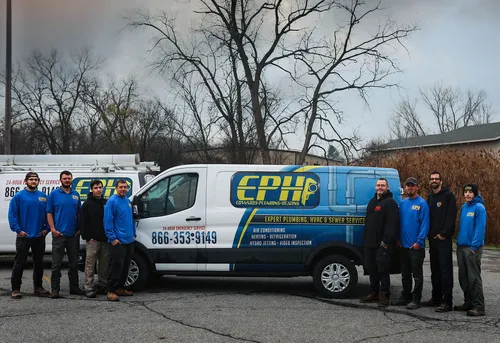
Edwards Plumbing & Heating
20992 Bridge St, Southfield, MI 48033
Edwards Plumbing & Heating is a full-service plumbing and HVAC company serving Detroit, MI, and the surrounding metro area. They offer a wide range of services including water heater repair and installation, water softener installation, drain cleaning, sewer line repair, leak detection, repiping, gas line installation, and toilet repair. The company is equipped to handle both plumbing and HVAC needs, with capabilities such as emergency plumbing repairs and comprehensive HVAC system maintenance and installation. With over 35 years of experience, Edwards Plumbing & Heating serves multiple counties in Michigan, including Oakland, Macomb, and Wayne. They provide reliable service backed by trained technicians and a commitment to customer satisfaction.
Understanding Taylor's Water Quality
The first step in choosing a water treatment system is understanding what's in your water. For most Taylor residents, the primary concern is water hardness.
What is Hard Water? Hard water contains high levels of dissolved minerals, primarily calcium and magnesium. These minerals are picked up as groundwater moves through rock and soil. In Taylor, the water is classified as moderately hard. You might notice the effects of hard water as white, chalky scale on showerheads, inside your kettle, or as spots on glassware after washing. Over time, this scale can reduce the efficiency and lifespan of water heaters, dishwashers, and other appliances.
Beyond Hardness: Other Potential Contaminants While hardness is the most common issue, a comprehensive water test is the only way to know exactly what's in your tap water. Testing can check for other parameters, including lead (which can leach from older plumbing), copper, chlorine, and various other sediments or contaminants. Identifying specific issues allows you to tailor your filtration system for targeted results, ensuring you invest in the right technology for your home's needs.
Types of Water Treatment Systems
There are several effective technologies for improving your home's water, each serving a different purpose. The right choice depends on whether you want to treat water for the entire house or just at specific taps.
Whole-House Water Softeners
This is the most common solution for combating hard water throughout your entire home. Traditional salt-based water softeners use a process called ion exchange. They contain resin beads that attract and hold the calcium and magnesium ions, swapping them for sodium or potassium ions. Periodically, the system regenerates by flushing the beads with a salty brine solution, which recharges them and flushes the accumulated minerals down the drain.
Key Benefits:
- Eliminates scale buildup in pipes and appliances.
- Makes soap and detergent lather more easily, requiring less product.
- Can lead to softer skin and hair after bathing.
- Helps clothing last longer by preventing mineral deposits in fabrics.
Salt-Free Water Conditioners
For those who prefer not to add sodium to their water or handle salt bags, salt-free water conditioners are an alternative. These systems don't remove hardness minerals. Instead, they use a physical process, often called Template Assisted Crystallization (TAC), to alter the structure of the minerals so they don't stick to surfaces as scale 1. They are maintenance-friendly, requiring no salt or electricity in many models, and are effective at preventing scale.
Point-of-Use Filtration Systems
These systems treat water at a single outlet, such as your kitchen sink, and are ideal for producing high-quality drinking and cooking water.
- Reverse Osmosis (RO) Systems: Considered the gold standard for drinking water purification, an RO system forces water through a semi-permeable membrane that filters out up to 99% of dissolved solids, including hardness minerals, lead, nitrates, and more 2. They are often installed under the kitchen sink and include a dedicated faucet. Many homeowners in Taylor pair a whole-house softener with an under-sink RO system for comprehensive treatment-soft water for the house and ultra-pure water for drinking.
- Activated Carbon Filters: These are excellent for improving taste and odor by removing chlorine, volatile organic compounds (VOCs), and some chemicals. They are commonly found in pitcher filters, faucet-mounted filters, or as part of a larger under-sink system.
Find the perfect water treatment installation companies for your needs
Get personalized recommendations and expert advice
The Professional Installation Process
Installing a water treatment system is not a typical DIY project. It involves tying into your home's main water line and requires knowledge of local plumbing codes. Here's what a professional installation typically involves:
- Comprehensive Water Testing: A reputable provider will start by testing your water to measure the exact hardness level (in grains per gallon, or gpg) and identify any other contaminants 3. This data is critical for proper system sizing and selection.
- Right-Sizing the System: Based on your water test results and household size (number of bathrooms and occupants), the professional will calculate the required system capacity. An undersized softener will run out of capacity too quickly, while an oversized one is inefficient 4. Capacity is measured in grains, such as a 30,000 or 48,000-grain system.
- Physical Installation: The technician will identify the best location (often near where the main water line enters the home, like a basement or utility room), cut into the plumbing, and install the softener or conditioner unit. This includes adding bypass valves for easy maintenance and connecting a drain line for the regeneration discharge 5.
- System Programming & Setup: For salt-based softeners, the control head must be programmed with your water hardness number and the time for regeneration cycles. The brine tank will be filled with salt and water to create the necessary solution 6.
- Education & Walkthrough: A good installer will explain how your new system works, show you how to add salt (if applicable), and discuss the maintenance schedule.
Costs and Investment
Investing in a water treatment system involves upfront equipment and installation costs, followed by ongoing maintenance expenses. Prices can vary based on system type, capacity, brand, and the complexity of the installation.
- Equipment & Installation: For a professionally installed system, total costs in the Taylor area typically range from $1,000 to $7,000 7. A standard salt-based water softener often falls in the $1,000 to $3,000 range. Adding a reverse osmosis system for drinking water can add another $1,000 to $3,000 to the project cost 7 8.
- Ongoing Maintenance: All systems require upkeep. For salt-based softeners, the primary cost is the salt used for regeneration. Expect to spend $20 to $50 per month on salt, depending on your water hardness and usage 9 10. Filter-based systems, like conditioners and RO units, require periodic filter changes, which also contribute to the monthly operating cost.
Maintaining Your System
Regular maintenance ensures your system operates efficiently and lasts for years.
- Salt-Based Softeners: Check the salt level in the brine tank monthly and keep it at least half full. Use high-purity salt pellets to minimize residue buildup in the tank. The system should be inspected annually for proper operation and settings 11.
- Salt-Free Conditioners: These have fewer moving parts but still require annual check-ups and media changes every few years, as recommended by the manufacturer.
- Reverse Osmosis Systems: Most RO systems have multiple filter stages (pre-filters, membrane, post-filter) that need replacing on a schedule, typically every 6 to 12 months for pre-filters and 2 to 3 years for the membrane.
Local providers, such as Michigan Pure Water in Taylor, can offer service plans to handle this regular maintenance, giving you peace of mind.
Frequently asked questions
Sources
Footnotes
-
2025 Culligan Water Softener Costs: Price by System & Type - Modernize - https://modernize.com/water-treatment/culligan-cost/water-softener ↩
-
Drinking Water Systems | Taylor, Michigan Pure Water - https://www.mipurewater.com/drinking-water-systems/taylor/michigan ↩
-
Real Time Water Quality in Taylor, Michigan - TDSBot - https://watertds.com/real-time-water-quality/us/michigan/taylor ↩
-
How to Size a Water Softener | Angi - https://www.angi.com/articles/what-size-water-softener-do-i-need.htm ↩
-
How Much to Install a Water Softener: Comprehensive Cost Guide - https://www.benjaminfranklinplumbing.com/league-city/blog/2025/march/how-much-to-install-a-water-softener-comprehensive-cost-guide/ ↩
-
How to Choose The Right Water Softener For Your Home [2024] - https://aquaclearws.com/resources/how-to-choose-a-whole-house-water-softener/ ↩
-
2026 Water Softener Costs by Capacity, Size, Type & More - https://modernize.com/water-treatment/types/water-softener-installation-cost ↩ ↩2
-
Water Softener Systems Cost | LifeSource Water - https://www.lifesourcewater.com/blog/cost-of-water-softener-systems ↩
-
How Much Salt to Put in Your Water Softener? - Aquasure USA - https://aquasureusa.com/blogs/water-guide/salt-in-your-water-softner ↩
-
Water Softener System Maintenance Expenses Rise 🇺🇸 Nov, 2025 - https://qualitywatertreatment.com/pages/how-water-softener-system-maintenance-expenses-add-up ↩
-
Water Softener is Not Using Salt: Let's Fix It! - Parker & Sons - https://www.parkerandsons.com/blog/water-softener-is-not-using-salt-lets-fix-it ↩