Find the Best Gas Line Plumbing Companies for Your Business
No obligation • Fast responses • Nationwide coverage

Why you can trust Search a Plumber
Search a Plumber is a leading United States resource for finding and evaluating professional plumbing services. Our team researches licensing, experience, and customer feedback to create unbiased, fact-driven overviews. Companies cannot pay to change ratings or placement, ensuring homeowners get trustworthy information.
Search providers near you
Best Gas Line Plumbing Companies in Iowa Ranked
Working with natural gas or propane lines is a critical home improvement project that demands expertise and strict adherence to safety codes. Proper gas line installation and repair ensures your appliances operate efficiently and, most importantly, keeps your household safe from potential leaks and carbon monoxide hazards. In Iowa, this work is governed by local municipal codes and requires permits and professional oversight. This guide explains the process, safety standards, and key considerations for Iowa homeowners, helping you understand what to expect and how to connect with qualified local specialists for your project.
Understanding Local Permits and Inspections
In Iowa, gas line work is regulated at the city or county level, not by a single statewide authority. This means the specific rules, permit applications, and inspection schedules are managed by your local building department 1. Understanding this local control is the first step in any project.
When is a Permit Required? A permit is almost always required for any work that involves installing new gas piping, replacing gas appliances, or altering existing gas lines 2. This includes projects like adding a gas fireplace, installing a new gas range, or running a line to a new patio heater. The permit process ensures your plans are reviewed for code compliance before any work begins.
The Inspection Process The licensed professional you hire will typically handle the permit application. Inspections are a mandatory part of the process and usually occur in two stages 3:
- Rough-in Inspection: This happens after the new piping is installed but before it is concealed behind walls or under floors. The inspector checks the pipe materials, sizing, routing, and fittings.
- Final Inspection: After the system has been pressure-tested and appliances are connected, a final inspection is conducted for approval. Passing this inspection is necessary to get your project officially signed off.
The Step-by-Step Project Workflow
A professional gas line project follows a structured sequence to ensure safety and code compliance from start to finish.
1. Planning and Design This initial phase involves determining your appliance needs (BTU requirements), mapping the most efficient and code-compliant route for the new piping, and correctly sizing the gas lines to maintain adequate pressure for all connected appliances. A qualified professional will assess your home's layout and existing gas service to create a viable plan.
2. Securing Permits With a plan in place, your contractor will submit the necessary documentation to your local building authority to obtain the required work permit. This step legally authorizes the project to begin.
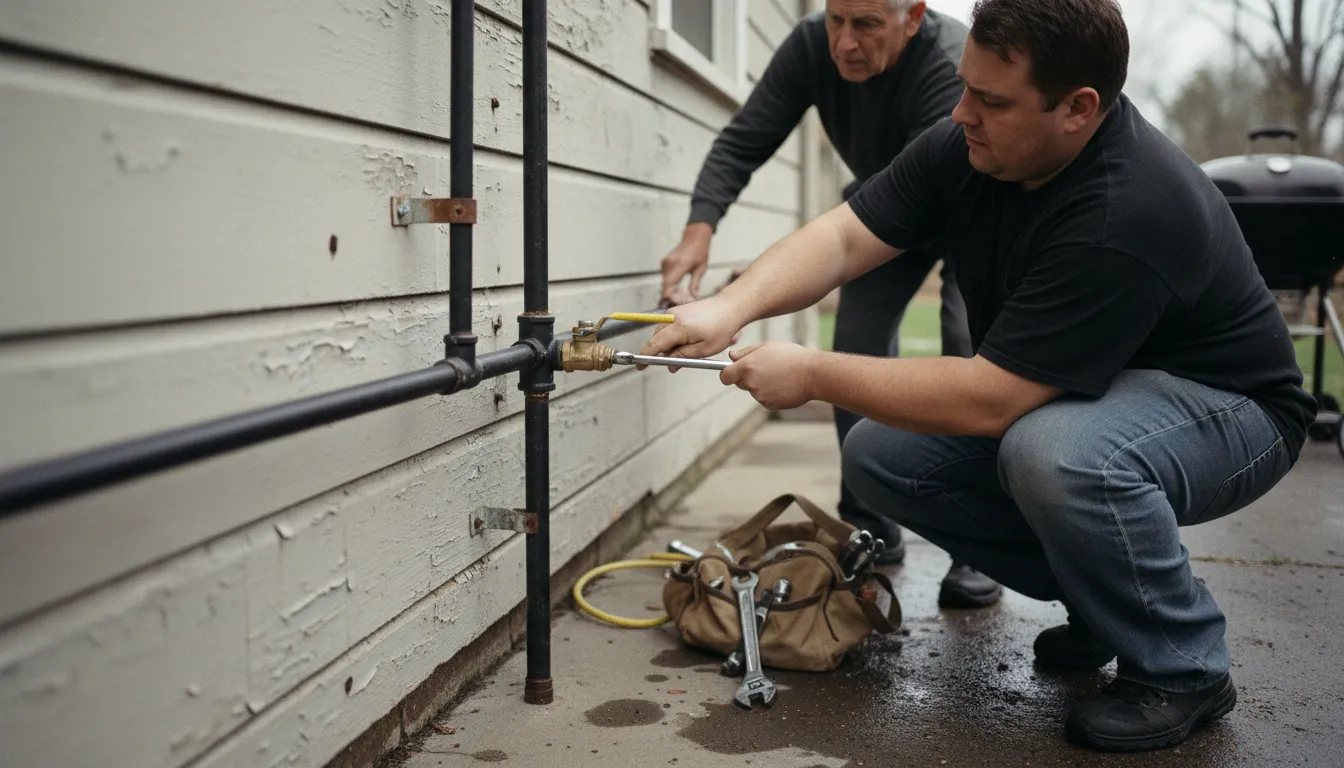
3. Professional Installation Licensed technicians will install the gas piping using approved materials like Schedule 40 black steel pipe or Corrugated Stainless Steel Tubing (CSST). Key installation elements include:
- Proper shut-off valves at the appliance.
- Drip legs (sediment traps) installed at each appliance connection to catch moisture and debris, which must be placed in areas that won't freeze.
- Secure fastening and proper support for all piping.
4. Critical Leak Testing Before the system is connected to gas, it must undergo a rigorous pressure test, often using air, to check for any leaks in the joints and fittings 4. After passing the air test, the system is tested with gas (using its odorant) to confirm integrity before the final inspection.
5. Inspection and Appliance Connection Once the system passes the contractor's tests, the local inspector is called to verify the work. After receiving final approval, the appliances can be safely connected and commissioned for use 5.
Find the perfect gas line plumbing companies for your needs
Get personalized recommendations and expert advice
Safety Standards and Best Practices
Safety is the paramount concern with any gas work. Adhering to these standards is non-negotiable.
Always Hire Licensed and Insured Professionals Gas line work is not a DIY project. Always hire a qualified, licensed, and insured plumbing or HVAC contractor with specific experience in gas piping. They carry the necessary expertise and liability coverage.
Use of Approved Materials Only code-approved materials may be used. Black iron pipe is traditional and robust, while CSST (often recognizable by its yellow jacket) is flexible and can be easier to install in certain situations. The choice depends on the project specifics and local code preferences.
Install Carbon Monoxide Detectors Iowa guidelines and best safety practices strongly recommend installing carbon monoxide (CO) detectors on every level of your home, particularly near sleeping areas and in the vicinity of gas-burning appliances 6. This is a critical backup safety measure.
Coordinate with Your Gas Utility For projects that involve a new gas service line or moving your meter, you must coordinate with your natural gas utility company-such as MidAmerican Energy or Alliant Energy-early in the planning process 7 8. The utility is responsible for the service line up to the meter; a licensed contractor handles everything from the meter outlet into your home.
Cost Considerations for Iowa Homeowners
Project costs can vary significantly based on scope, materials, distance of the pipe run, and local labor rates. Below is a general overview to help set expectations 9 10.
- Simple Appliance Hookups or Minor Repairs: For connecting an existing gas line to a new stove or dryer, or fixing a small section of pipe, costs often range from $200 to $800+. This typically includes the permit, labor, and basic materials.
- New Gas Line Runs and Major Installations: Running a new line from the meter to a new appliance location (like for a fireplace, generator, or patio kitchen) is more complex. Costs for these projects commonly range from $1,000 to $5,000 or more, depending on the length of the run, obstacles (like concrete), and the type of pipe used.
- Permit Fees: Municipal permit fees are an additional cost, usually ranging from $50 to $150+, depending on your local jurisdiction and the project's valuation 11 12.
The most accurate way to determine cost is to obtain detailed estimates from several licensed local contractors who will assess your specific situation.
Common Types of Gas Line Projects
Understanding the different project types can help you communicate your needs to a professional.
Appliance Installation: This is one of the most common requests, involving running a new branch line and installing a shut-off valve for a gas range, dryer, water heater, or furnace. Gas Fireplace or Fire Pit Installation: These projects require careful planning for venting and line routing to create a safe and aesthetically pleasing result. Service Line or Meter Work: If you're adding gas service to a home that previously didn't have it, or need to relocate your meter, this involves close coordination with the gas utility and a significant installation. Repairs and Leak Remediation: Addressing a suspected leak, corroded pipe, or damaged valve is an urgent repair that should be handled immediately by a pro.
Frequently asked questions
Sources
Footnotes
-
ARC 4611C PUBLIC HEALTH DEPARTMENT[641] - https://www.legis.iowa.gov/docs/aco/arc/4611C.pdf ↩
-
ARTICLE V. - GAS | Code of Ordinances | Des Moines, IA - https://library.municode.com/ia/des_moines/codes/code_of_ordinances?nodeId=MUCO_CH118UT_ARTVGA ↩
-
Gas & Electric Meter Permit Application Page 1 of 2 - City of Davenport - https://www.davenportiowa.com/common/pages/DownloadFileByUrl.aspx?key=T%2FXvC9cAU2bZLw2YN6gSFUEfYUWSkHVR848pXITfBMUilnLpT9D4ZuNJ%2Fdd41M5Fh85IqYI4qPxKH5ugxZgzH6Kuuy9QTmBISac%2FbJgoMsz6woIC5JG0mzRevkDPADiqevxf%2F%2FlnTF9IzzBHGyR2kos8JBXcHHinvnwQ8zgV0ot6lsM62h2J8l%2B6r8pAe7E%2B3ETpwYGiBeHauIAWYNd9P6k%2FsHU%3D ↩
-
FAQs • When are inspections required in Linn County and how - https://www.linncountyiowa.gov/FAQ.aspx?QID=288 ↩
-
Essential Guide to Gas Line Installation: Tips and Safety Precautions - https://gaeberly.com/gas-line-installation/ ↩
-
GAS PIPING GUIDELINES FOR HOMEOWNERS - https://www.cityofdubuque.org/DocumentCenter/View/329/Gas-Piping-Guidelines-for-Homeowners ↩
-
Establishing New Service for Construction and Remodeling - https://www.alliantenergy.com/customer-service/new-construction ↩
-
GAS SERVICE MANUAL | MidAmerican Energy - https://www.midamericanenergy.com/media/pdf/gas-service-manual.pdf ↩
-
Gas Line Installation | Quality Plumbing - https://qualityplumbing.cc/gas-line-installation-what-homeowners-need-to-know/ ↩
-
Gas Line Installation: What You Need to Know Before Starting Your Project - https://www.pasoroblesheating.com/gas-line-installation-what-you-need-to-know-before-starting-your-project/ ↩
-
Gas Permit - Marshalltown-ia.gov - https://www.marshalltown-ia.gov/DocumentCenter/View/355/Gas-Permit-PDF ↩
-
Process of Gas Line Installation: The Step-by-Step From ... - https://www.atlplumbingskills.com/blog/process-of-gas-line-installation-the-step-by-step-from-planning-to-completion ↩