Find the Best Gas Line Plumbing Companies for Your Business
No obligation • Fast responses • Nationwide coverage

Why you can trust Search a Plumber
Search a Plumber is a leading United States resource for finding and evaluating professional plumbing services. Our team researches licensing, experience, and customer feedback to create unbiased, fact-driven overviews. Companies cannot pay to change ratings or placement, ensuring homeowners get trustworthy information.
Search providers near you
Best Gas Line Plumbing Companies in Alabama Ranked
Installing or repairing a gas line is a critical project that directly impacts the safety and functionality of your Alabama home. This work involves running pipes to supply natural gas or propane to appliances like water heaters, stoves, and furnaces. Due to the inherent risks of working with combustible gas, these projects are strictly regulated by state and local codes and must be performed by licensed professionals. This guide explains the essential process, regulations, and safety considerations for gas line work in Alabama, helping you understand what to expect and how to connect with qualified local specialists.
Understanding Alabama's Gas Line Regulations
In Alabama, all gas piping work is governed by the state-adopted Alabama Fuel Gas Code, which is based on the International Fuel Gas Code (IFGC). This code sets the standard for the design, materials, installation, and inspection of all fuel gas systems. Compliance is not optional; it is a legal requirement designed to ensure safety.
A cornerstone of these regulations is the mandatory permit. Before any new gas line installation, appliance hookup, or significant repair begins, a permit must be obtained from your local city or county building department 1. Only a licensed Master Plumber or Gas Fitter who holds state certification can pull this permit and legally perform the work. This licensing requirement is your primary assurance that the professional understands the complex codes and safety protocols.
The permit process triggers a series of required inspections by the local building official. Key inspections typically include a "rough-in" inspection after pipes are run but before they are concealed within walls or underground, and a "final" inspection after all appliances are connected. Work cannot be covered or used until it passes inspection.
The Step-by-Step Process for Gas Line Projects
A professional gas line installation or repair follows a meticulous sequence to ensure safety and code compliance from start to finish.
1. Assessment and Planning
The process begins with a detailed evaluation. A licensed professional will assess your needs, calculate the total gas demand (load) of all appliances, and plan the safest and most efficient route for the new piping. This planning stage is crucial for determining the correct pipe size, which is based on the length of the run and the cumulative BTU requirements of the appliances.
2. Permit Application and Material Selection
Once a plan is established, your licensed contractor will submit the necessary documentation to the local building department to secure the required permit. They will also select the appropriate approved materials. Common choices include traditional black iron (steel) pipe or flexible Corrugated Stainless Steel Tubing (CSST). The choice depends on the application, local code amendments, and the specific challenges of the installation.
3. Installation and Rough-In Inspection
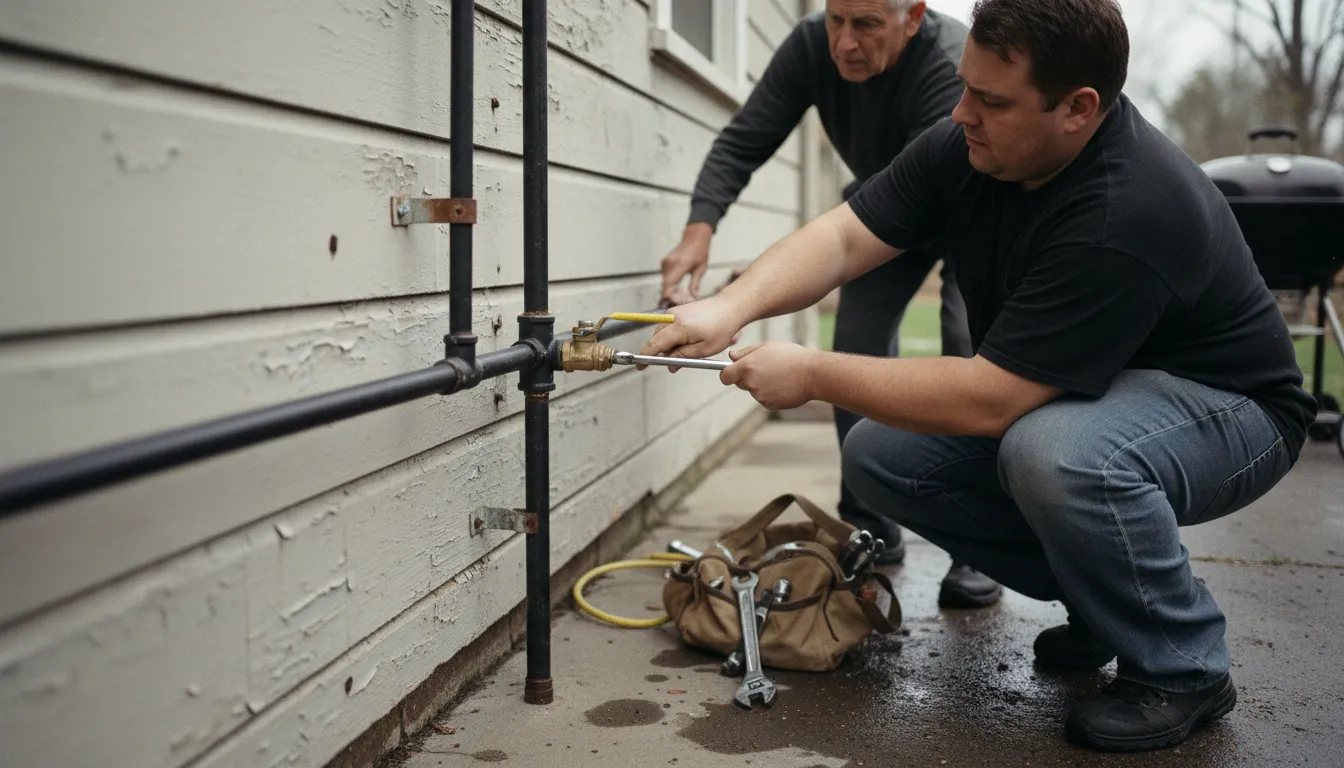
The physical installation involves running the gas lines, making secure connections at joints and fittings, and installing necessary shut-off valves 2. A critical safety step performed during installation is the mandatory pressure test. Before the pipes are concealed, the system is pressurized with air or an inert gas (often to 10 psi for 15 minutes) to check for any leaks. The contractor must then call for the rough-in inspection. An inspector will verify the installation, check the pressure test, and ensure everything meets code before giving approval to cover the pipes 3.
4. Concealment and Final Connection
After passing the rough-in inspection, the piping can be concealed within walls, under floors, or buried at the proper depth (for underground steel pipe, this is often a minimum of 18 inches). Finally, the licensed professional will make the final connections to your gas appliances, such as your stove, dryer, or furnace 4.
5. Final Inspection and Activation
A final inspection is required once all appliances are connected 5. The inspector will ensure proper hookups, adequate ventilation for combustion appliances, and that the system is ready for safe operation. Only after receiving final approval should the gas utility company or your propane supplier activate the gas supply to the new line.
Find the perfect gas line plumbing companies for your needs
Get personalized recommendations and expert advice
Critical Safety Considerations for Alabama Homeowners
The importance of safety in gas line work cannot be overstated. Adhering to the following principles is non-negotiable.
- Always Hire Licensed Professionals: This is the most important safety step. Alabama law requires a Master Plumber or Gas Fitter to perform this work 6. They have the training to handle combustible gas safely and the knowledge to navigate complex state and local codes.
- Insist on Proper Leak Testing: The mandatory pressure test is a fundamental safety check, not a formality 7 8. A professional will never skip this step. After the gas is turned on, they should also use a gas leak detection solution or electronic detector on all fittings.
- Use Correct Materials and Sizing: Using unapproved materials or undersized pipes can lead to dangerous pressure drops, appliance malfunction, or gas leaks 9 10. Your licensed professional will select materials listed for fuel gas use and perform precise load calculations.
- Ensure Adequate Ventilation: Gas appliances that burn fuel (like furnaces and water heaters) require proper venting to expel harmful combustion byproducts like carbon monoxide. The installation must comply with code requirements for vent size and routing.
- Understand Burial Requirements: For underground gas lines, specific burial depths and protection methods are mandated by code to prevent damage from corrosion or excavation 11. Your contractor will know the local requirements for your area.
Understanding Costs and Project Scope
The cost of a gas line project in Alabama varies widely based on several factors. There is no flat fee, as each job is unique.
- Permit Fees: These are set by your local municipality or county and are a fixed cost associated with the project.
- Material Costs: The type and amount of pipe needed significantly impact price. For example, CSST is often more expensive per foot than traditional black iron pipe but can be faster to install in certain scenarios.
- Labor Costs: This is typically the largest variable. Labor rates for licensed, insured professionals reflect their expertise and the liability of the work. Complex jobs that require extensive trenching, drilling through foundations, or navigating finished walls will cost more in labor than a simple appliance hookup 12.
- Project Scope: A straightforward repair of a small section of pipe will cost far less than running a new main line from the street to a house or adding multiple new appliance lines throughout a home 13.
- Re-inspection Fees: If work fails an initial inspection, a fee is usually charged for the re-inspection, adding to the total project cost 14.
Getting multiple detailed estimates from licensed Alabama contractors is the best way to understand the potential cost for your specific situation. A quality estimate should break down anticipated costs for permits, materials, and labor.
Common Types of Gas Line Services
Gas line professionals handle a range of projects for residential and commercial properties:
- New Appliance Hookups: Connecting a new gas range, fireplace, dryer, or pool heater.
- Gas Line Extensions or Adds: Running new branches from an existing line to supply additional appliances in a kitchen remodel or home addition.
- Gas Line Repairs: Fixing leaks, replacing corroded sections, or repairing lines damaged by excavation or corrosion.
- Whole-House Gas Line Installation: Installing the main gas service and distribution system for a newly constructed home.
- Conversions: Switching appliances from electric or propane to natural gas, which requires running new gas lines and ensuring proper appliance compatibility.
Frequently asked questions
Sources
Footnotes
-
Chapter 1 Scope and Administration: Alabama Fuel Gas Code 2021 - UpCodes ↩
-
Fuel Gas Codes Amended July 09, 2020 - Jefferson County, AL ↩
-
Plumbing, Gas and Mechanical Inspections | City of Montgomery, AL ↩
-
Rule 440-X-5-.05 - Gas Connections - Alabama Administrative Code ↩
-
ORDINANCE NO. 1799 An ordinance to adopt a Fuel Gas Code for ... - Jefferson County, AL ↩
-
Chapter 4 Gas Piping Installations: Alabama Fuel Gas Code ... - UpCodes ↩
-
Process of Gas Line Installation: The Step-by-Step From ... - Atlanta Plumbing Skills ↩
-
Gas Line Installation: What You Need to Know - Paso Robles Heating ↩
-
Commercial Gas Line Installation: Cost, Process & Safety - Super Brothers ↩
-
Gas Line Installation Cost: A Homeowner Budgeting Guide - Bob Vila ↩
-
ORDINANCE NO. 1815 An ordinance to adopt a Fuel Gas Code for ... - Jefferson County, AL ↩