Find the Best Tankless Water Heater Service Companies for Your Business
No obligation • Fast responses • Nationwide coverage

Why you can trust Search a Plumber
Search a Plumber is a leading United States resource for finding and evaluating professional plumbing services. Our team researches licensing, experience, and customer feedback to create unbiased, fact-driven overviews. Companies cannot pay to change ratings or placement, ensuring homeowners get trustworthy information.
Search providers near you
Best Tankless Water Heater Service Companies in South Dakota Ranked
A tankless water heater provides hot water on demand, eliminating the standby energy loss of a traditional storage tank. This can lead to significant energy savings and an endless supply of hot water for your South Dakota home. Choosing the right system and ensuring it's installed correctly is crucial for performance and safety. This guide will help you understand the key considerations, from fuel types and local codes to costs, so you can make an informed decision and connect with qualified local professionals for your project.
Understanding Tankless Water Heater Systems
Unlike conventional water heaters that constantly heat and reheat a stored tank of water, tankless models (also known as on-demand or instantaneous water heaters) heat water directly as it flows through the unit. When a hot water tap is turned on, cold water travels through a pipe into the unit, where either a gas burner or an electric element heats it instantly. This process delivers a continuous supply of hot water and is typically more energy-efficient, as it only consumes fuel when hot water is needed.
For South Dakota homeowners, this efficiency can be particularly appealing given the state's climate and utility costs. However, the "right" system depends heavily on your home's existing infrastructure, your hot water demand, and proper installation by a licensed professional familiar with state codes.
Fuel Types: Natural Gas vs. Electric
The two primary types of tankless water heaters are natural gas/propane and electric. Each has distinct installation requirements and performance characteristics.
Natural Gas/Propane Systems: These are the most common choice for whole-home applications in South Dakota, especially for larger households, due to their higher flow rate capacity. They are powerful enough to supply multiple showers and appliances simultaneously. However, installation is more complex. A gas tankless unit requires:
- Adequate Gas Supply: They often have a higher BTU (British Thermal Unit) input than a standard tank heater, which may necessitate upgrading the gas line from the meter to the unit.
- Proper Venting: Combustion gases must be safely vented outdoors. This requires installing specialized, sealed venting (often stainless steel) that complies with strict termination clearance codes.
- Electrical Connection: Even gas models require a standard 120-volt outlet for the electronic ignition and control panel.
Electric Systems: Electric tankless heaters are generally simpler to install as they don't require gas lines or complex venting. This makes them a good option for point-of-use applications (like a remote bathroom or kitchen) or homes without natural gas service. The major consideration is electrical demand:
- Significant Power Upgrade: A whole-home electric tankless system can draw a tremendous amount of power, often requiring a dedicated 240-volt circuit with very high amperage (e.g., 100-150 amps). This may exceed your home's current electrical service capacity, necessitating a costly service panel upgrade 1.
Key Installation Considerations for South Dakota Homes
A successful tankless water heater installation involves more than just swapping an old unit for a new one. Key planning steps include:
1. Sizing and Placement: Proper sizing is critical. A professional will calculate your home's flow rate (gallons per minute needed) and temperature rise (the difference between incoming groundwater temperature and your desired hot water temperature). South Dakota's cold groundwater means a system must work harder, affecting the model you need. Placement should be as central as possible to minimize wait times for hot water. Outdoor-rated models can save indoor space but must be protected from freezing.
2. Necessary Upgrades: Be prepared for potential upgrades to your home's utilities. As mentioned, this could include:
- Running a new, larger-diameter gas line.
- Installing new, code-compliant venting for a gas unit.
- Upgrading electrical service or adding a heavy-duty circuit for an electric unit. These upgrades constitute a significant portion of the total installation cost.
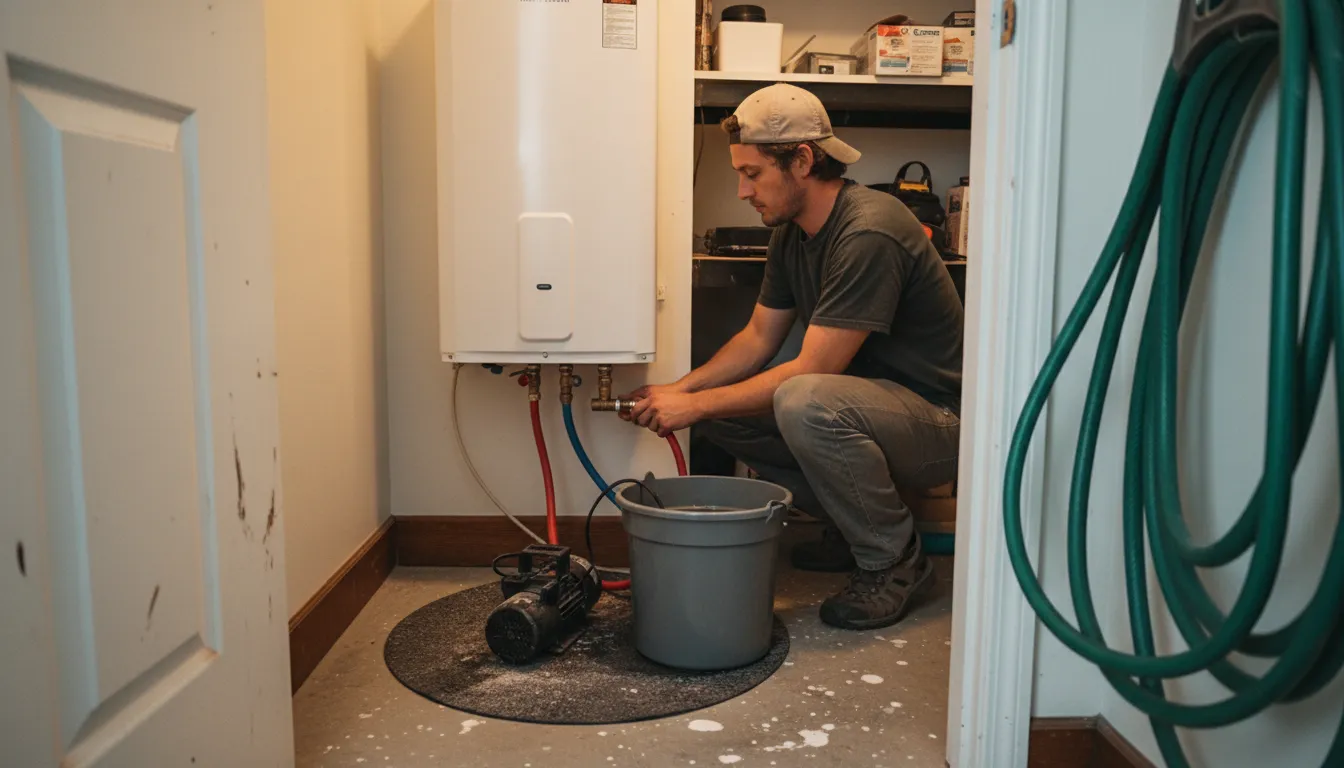
3. The Installation Process: While only a licensed professional should perform the installation, the general steps are:
- Shut off utilities (water, gas, electricity) to the existing heater.
- Drain, disconnect, and remove the old water heater tank.
- Mount the new tankless unit on a sturdy wall.
- Connect the water lines (cold water inlet and hot water outlet).
- Connect the fuel source (gas line or electrical wires).
- Install the venting system for a gas unit.
- Connect the pressure relief valve and condensate drain line (for high-efficiency gas models).
- Restore utilities, check for leaks, and test the system's operation 2 3.
Find the perfect tankless water heater service companies for your needs
Get personalized recommendations and expert advice
South Dakota Codes and Permits
All plumbing and mechanical work in South Dakota must comply with the Uniform Plumbing Code (UPC). Installing a tankless water heater is not a DIY project for homeowners; it requires permits and inspections to ensure safety and code compliance.
- Permits: You or your licensed contractor must pull permits from your local building department before work begins. This typically includes plumbing, mechanical (for gas/venting), and possibly electrical permits.
- Inspections: A city or county inspector will visit to verify that the installation-including gas lines, venting, water connections, and electrical work-meets all code requirements before the system can be used 4.
- Code Highlights: Key code points include proper gas line sizing, correct vent material and termination clearances from windows and doors, seismic strapping in some areas, and the installation of an approved pressure relief valve 5 6.
Hiring a professional who is familiar with these local codes is non-negotiable for a safe and legal installation.
Cost Breakdown for Installation and Repair
Costs for tankless water heater services in South Dakota vary widely based on the unit type, your home's existing infrastructure, and labor rates. The figures below are estimates to help you budget.
Installation Costs:
- Equipment Cost: The tankless unit itself ranges from about $250 for a basic electric point-of-use model to $3,600 or more for a high-output natural gas unit designed for a whole home.
- Basic Installation Labor: For a straightforward swap where no major upgrades are needed, labor can range from $650 for an electric unit to $1,300 or more for a gas unit.
- Upgrade Costs: This is where costs can escalate. Upgrading a gas line or installing new venting can add $1,000 to $2,000. A major electrical service upgrade to accommodate an electric system can cost $2,000 to $4,000 or more 7.
- Total Project Cost: When you combine the unit, labor, and necessary upgrades, a complete tankless water heater installation in South Dakota typically falls between $2,400 and $8,000+ 8 9.
Repair Costs: Tankless heaters are generally reliable but can experience issues with components like flow sensors, ignition systems, or heat exchangers. Repair costs are highly variable:
- Parts: Common replacement parts can cost between $100 and $500.
- Labor: A professional diagnosis and repair typically involves a service call fee plus hourly labor. Many complex repairs, especially those involving the heat exchanger, may approach the cost of a new unit, making replacement a more economical choice in some cases.
Benefits and Potential Drawbacks
Benefits:
- Energy Efficiency: By eliminating standby heat loss, tankless water heaters can be 24%-34% more energy efficient for homes using 41 gallons or less of hot water daily, according to Energy.gov.
- Endless Hot Water: Never run out of hot water during a long shower or while filling a large tub.
- Longer Lifespan: Tankless units often last 20 years or more, compared to 10-15 years for a traditional tank.
- Space Savings: Their compact, wall-mounted design frees up floor space.
Potential Drawbacks:
- Higher Upfront Cost: The initial purchase and installation cost is significantly higher than a conventional tank heater.
- Output Limitations: Simultaneous, high-demand use (e.g., two showers and the dishwasher) can exceed the flow rate of a single unit, potentially requiring a second unit or a different solution.
- Retrofit Challenges: The need for utility upgrades in existing homes can add complexity and expense.
Frequently asked questions
Sources
Footnotes
-
Tankless Water Heater Installation Guide | A.O. Smith - https://www.hotwater.com/info-center/tankless-water-heater-installation-guide.html ↩
-
Tankless Water Heater | Temprite Climate Solutions - https://www.tempriteclimatesolutions.com/blog/water-heater-service/do-i-need-to-make-any-plumbing-or-heating-changes-for-a-tankless-water-heater-installation ↩
-
Tankless Water Heater Install: A Step-by-Step Guide - Just Plumbing - https://justplumbingaz.com/blog/tankless-water-heater-install-a-step-by-step-guide/ ↩
-
Administrative Rule 20:54 | South Dakota Legislature - https://sdlegislature.gov/Rules/Administrative/20:54 ↩
-
City of Moreno Valley - TANKLESS WATER HEATERS - https://moval.gov/city_hall/forms/building-safety/TanklessWaterHeaters.pdf ↩
-
Go Tankless...and Stay in Hot Water - IAEI Magazine - https://iaeimagazine.org/2004/may2004/go-tanklessand-stay-in-hot-water/ ↩
-
Lowes Hot Water Heater Prices, Installation, Reviews (2024) - https://www.hvaccalc.org/lowes-water-heater/ ↩
-
Tankless Water Heater Installation Cost - Complete Guide - https://cycloneplumbingusa.com/tankless-water-heater-installation-cost/ ↩
-
Cost to Replace a Water Heater - The Home Depot - https://www.homedepot.com/services/c/cost-install-water-heater/9058c024e ↩