Find the Best Tankless Water Heater Service Companies for Your Business
No obligation • Fast responses • Nationwide coverage

Why you can trust Search a Plumber
Search a Plumber is a leading United States resource for finding and evaluating professional plumbing services. Our team researches licensing, experience, and customer feedback to create unbiased, fact-driven overviews. Companies cannot pay to change ratings or placement, ensuring homeowners get trustworthy information.
Search providers near you
Best Tankless Water Heater Service Companies in Delaware Ranked
Upgrading to a tankless water heater in Delaware offers a modern solution for endless hot water and improved energy efficiency. These on-demand systems heat water only when you need it, eliminating the standby energy losses of a traditional tank. However, a successful installation hinges on proper sizing, adherence to strict state and local codes, and professional execution of complex plumbing, gas, and electrical work. This guide will help you understand the key considerations, costs, and process for installing or repairing a tankless system in The First State.
Understanding Tankless Water Heater Types
Choosing the right type of on-demand water heater is the first critical decision. The two primary options-gas-fired and electric-have distinct requirements and performance characteristics suited for different homes in Delaware.
Gas-Fired Tankless Water Heaters (Natural Gas or Propane) These are the most common choice for whole-home applications, particularly in larger households, due to their high flow rate capabilities. They operate by burning fuel to instantly heat water as it passes through a heat exchanger. Key considerations for Delaware homes include:
- Fuel Source: Requires an existing natural gas line or propane tank. Converting from one fuel type to another is a major project.
- Venting: This is a non-negotiable and complex safety requirement. Combustion gases must be vented directly outside using specialized, often stainless steel, vent pipes. The installation type can be "direct vent" (pulling combustion air from outside) or "power vent" (using a fan), which impacts where the unit can be placed 1.
- Gas Line Upgrades: Most existing gas lines are sized for traditional appliances. A tankless unit's high instantaneous demand often requires upgrading the gas line from the meter to the appliance to ensure sufficient volume and pressure.
Electric Tankless Water Heaters Electric models are mechanically simpler, as they use heating elements to warm the water. They are often more compact and easier to install in terms of venting, but they place a significant demand on your home's electrical system.
- Electrical Demand: A whole-house electric tankless heater typically requires a dedicated 240-volt circuit with very high amperage (often 100-150 amps), which is a substantial portion of a home's total electrical service.
- Best Applications: Due to this high power draw, they are frequently recommended for point-of-use installations (e.g., under a kitchen sink or in a remote bathroom) or in smaller homes with lower simultaneous hot water needs.
- Installation Simplicity: They eliminate the need for gas lines and complex venting, but the electrical work is major and must be performed by a licensed electrician to meet National Electrical Code (NEC) standards.
The Installation Process: A Step-by-Step Overview
Professional installation of a tankless system is a multi-step process that integrates plumbing, gas fitting, and electrical work. Here's what a qualified technician will do:
- Assessment and Sizing: The installer will evaluate your home's hot water needs (flow rate and temperature rise) to select a properly sized unit. They will also assess your existing gas line, electrical panel, and venting options.
- Permit Acquisition: Before any work begins, the contractor will pull the required local permits for plumbing, gas, and electrical work, ensuring the project will be inspected.
- Utility Shut-Off: The water, gas (if applicable), and power to the old heater are safely turned off.
- Removal of Old Unit: The existing water heater is drained, disconnected, and removed from the premises.
- Mounting and Framing: The new tankless unit is securely mounted to a load-bearing wall. For indoor installations, proper clearances as per the manufacturer and code must be maintained.
- Water Line Connections: New water lines (often ¾-inch) are run and connected to the unit's hot and cold ports, typically using flexible stainless steel connectors.
- Venting Installation (Gas Models): This is a critical safety step. The correct type and size of vent pipe are installed, routed directly to an exterior wall or through the roof, with strict adherence to length and elbow limitations.
- Gas Line Upgrade (If Needed): A new, larger-diameter gas line is run from the meter to the unit to meet the appliance's BTU demand 2 3.
- Electrical Work (Electric Models): A licensed electrician runs a new, dedicated 240-volt circuit from the main panel to the unit's location.
- Final Connections: All utilities-water, gas, and electricity-are connected to the unit.
- Start-up and Commissioning: The system is purged of air, tested for leaks, and powered on. The installer will program the temperature settings and verify proper operation, including safe venting for gas models.
Find the perfect tankless water heater service companies for your needs
Get personalized recommendations and expert advice
Delaware Codes, Permits, and Safety Regulations
Compliance with Delaware's building codes is not optional; it is essential for safety, system performance, and insurance validity. Installations must adhere to:
- Delaware Plumbing Code: Based on the International Plumbing Code (IPC), it governs all water piping, drainage, and venting related to the installation 4.
- International Fuel Gas Code (IFGC): This code strictly regulates the installation of gas piping, appliance connections, and-most importantly-venting for gas-fired tankless water heaters to prevent carbon monoxide hazards 5.
- NFPA 70 (National Electrical Code - NEC): All electrical work, especially for electric tankless heaters, must meet NEC standards for wire gauge, circuit protection, and grounding 6.
- Manufacturer's Instructions: These installation manuals carry the force of code. Deviating from the specified clearances, venting materials, or connection methods can void the warranty and create unsafe conditions.
- Local Permits: Most municipalities in Delaware require permits for water heater replacement. The subsequent inspection by a local building official ensures the work meets all applicable codes.
Cost Breakdown for Tankless Water Heater Installation in Delaware
The total investment for a tankless system is higher upfront than for a traditional tank-style heater, primarily due to installation complexity. Costs can vary widely based on your home's existing infrastructure.
- Equipment Cost: The unit itself ranges from around $300 for a basic electric point-of-use model to $3,600 or more for a high-output, whole-house gas model with advanced features 7.
- Labor and Installation: This is where costs escalate, especially for gas conversions. Professional installation labor can range from approximately $650 for a straightforward electric install to $1,300 or significantly more for a complex gas installation requiring venting and gas line work.
- Additional Materials and Upgrades: These are often the variable cost drivers:
- Gas line upgrade: $500 - $2,000+
- New venting system (gas): $300 - $1,200+
- New 240V electrical circuit (electric): $800 - $1,500+
- Permits and incidental materials.
- Total Project Cost: When combining equipment, labor, and necessary upgrades, Delaware homeowners should budget a total range of $2,400 to $5,400 or more for a professional, code-compliant tankless water heater installation 8 9 10.
Common Repair and Maintenance Needs
While known for their longevity, tankless water heaters are complex appliances that require maintenance and may eventually need repairs.
Essential Annual Maintenance: To prevent efficiency loss and failure, a yearly service visit is recommended. This typically includes:
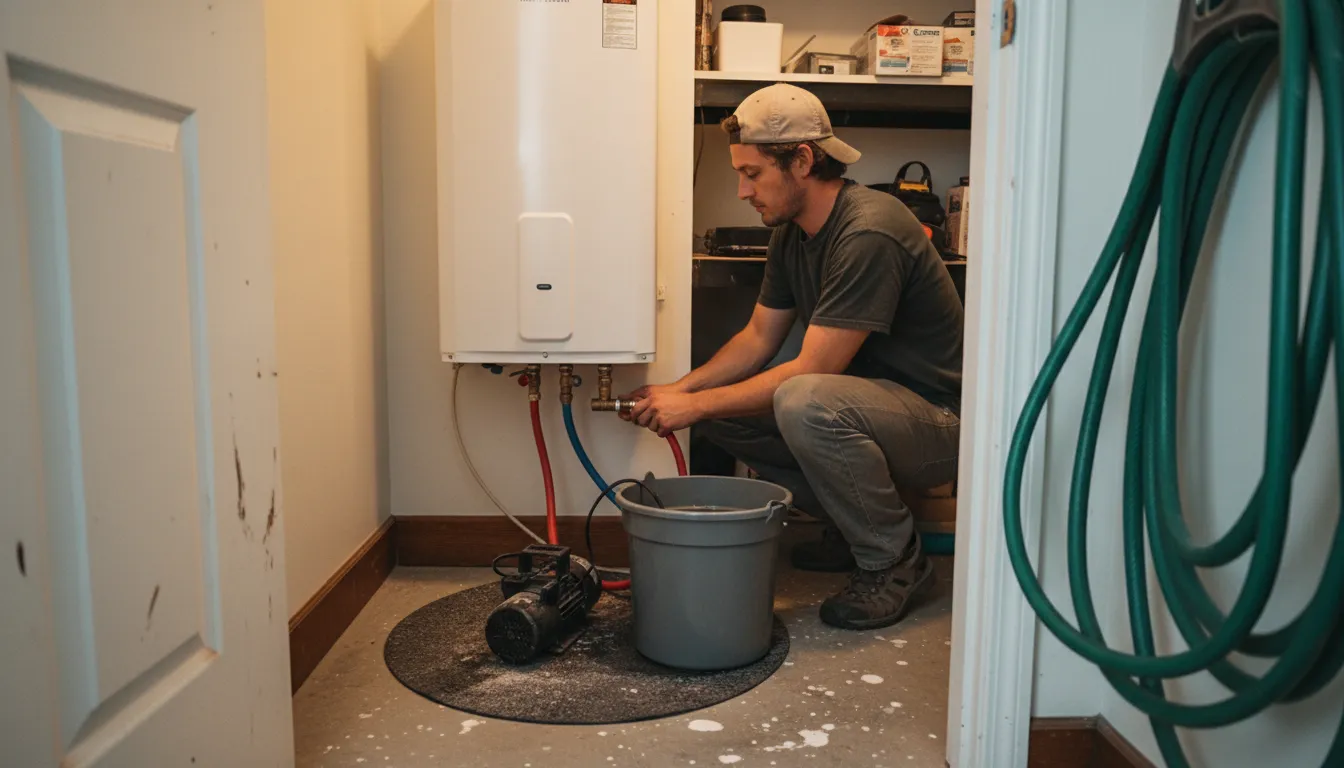
- Descaling/Flushing: Delaware's water can contain minerals that cause scale buildup inside the heat exchanger, restricting flow and reducing efficiency. A technician will circulate a descaling solution through the unit.
- Venting Inspection (Gas): Checking for any blockages, corrosion, or disconnections in the vent system.
- Filter Cleaning: Cleaning the unit's internal water filter and the incoming water sediment filter (if installed).
Common Repairs:
- Scale-Related Issues: Severe scaling can lead to overheating and error codes.
- Ignition or Flame Sensor Failure (Gas): Preventing the unit from firing.
- Flow Sensor Malfunction: The unit fails to detect water flow and activate.
- Electrical Component Failure: Issues with control boards, relays, or heating elements (electric).
DIY vs. Professional Repair: Due to the integration of high-voltage electricity, gas combustion, and complex electronics, troubleshooting and repairs should be left to certified professionals. Attempting DIY repairs can be dangerous, may violate codes, and will almost certainly void the manufacturer's warranty.
Frequently asked questions
Sources
Footnotes
-
Tankless Water Heater Installation Guide - A. O. Smith - https://www.hotwater.com/info-center/tankless-water-heater-installation-guide.html ↩
-
Tankless Water Heater | Temprite Climate Solutions - https://www.tempriteclimatesolutions.com/blog/water-heater-service/do-i-need-to-make-any-plumbing-or-heating-changes-for-a-tankless-water-heater-installation ↩
-
Does Your Home Meet the Requirements for a Tankless Water ... - https://cirielloplumbing.com/requirements-tankless-water-heater/ ↩
-
Chapter 5 Water Heaters: Delaware Plumbing Code 2018 - https://up.codes/viewer/delaware/ipc-2018/chapter/5/water-heaters ↩
-
Residenal Gas Tankless Water Heater - https://assets.hotwater.com/damroot/Original/10008/100374994.pdf ↩
-
Essential Electrical Requirements for Your Electric Tankless Hot Water - https://marey.com/blogs/blog/marey-blog-post-2 ↩
-
Tankless Water Heaters: Point-of-use VS. Whole House Model - https://camplux.com/blogs/journal-2/tankless-water-heaters-point-of-use-vs-whole-house-model ↩
-
Cost to Replace a Water Heater - The Home Depot - https://www.homedepot.com/services/c/cost-install-water-heater/9058c024e ↩
-
Lowes Hot Water Heater Prices, Installation, Reviews (2024) - https://www.hvaccalc.org/lowes-water-heater/ ↩
-
Tankless Water Heater Cost in 2024 - https://calltheotterguys.com/tankless-water-heater-cost/ ↩