
Water heater repair checklist when you have no hot water
Losing hot water usually feels urgent, but the fix might be simple-like a tripped breaker or a pilot that went out. This checklist walks you through safe, homeowner-friendly steps for both electric and gas tank-style water heaters, what not to touch, and clear signs it's time to call a professional plumber instead of DIY.
Safety first: what to do before you start
Before you touch anything on a water heater, run through these basics:
- If you smell gas (rotten-egg odor): Leave the building immediately, get everyone out, and call 911 or your gas company from outside. Do not try to find the leak or relight the pilot yourself.1
- If the tank is leaking heavily or the ceiling/floor is wet: Shut off water at the cold-water shutoff above the heater if you can reach it safely, then call a plumber.
- If you see scorch marks, melted plastic, or hear loud hissing: Turn off power or gas to the heater at the breaker or gas shutoff, then call a professional.
- Know where shutoffs are:
- Electric: dedicated breaker in your electrical panel (often labeled "water heater").
- Gas: a handle on the gas pipe near the heater; turning it crosswise to the pipe usually closes it.
If anything feels unsafe or confusing at any point, stop and call a licensed plumber or your gas utility.
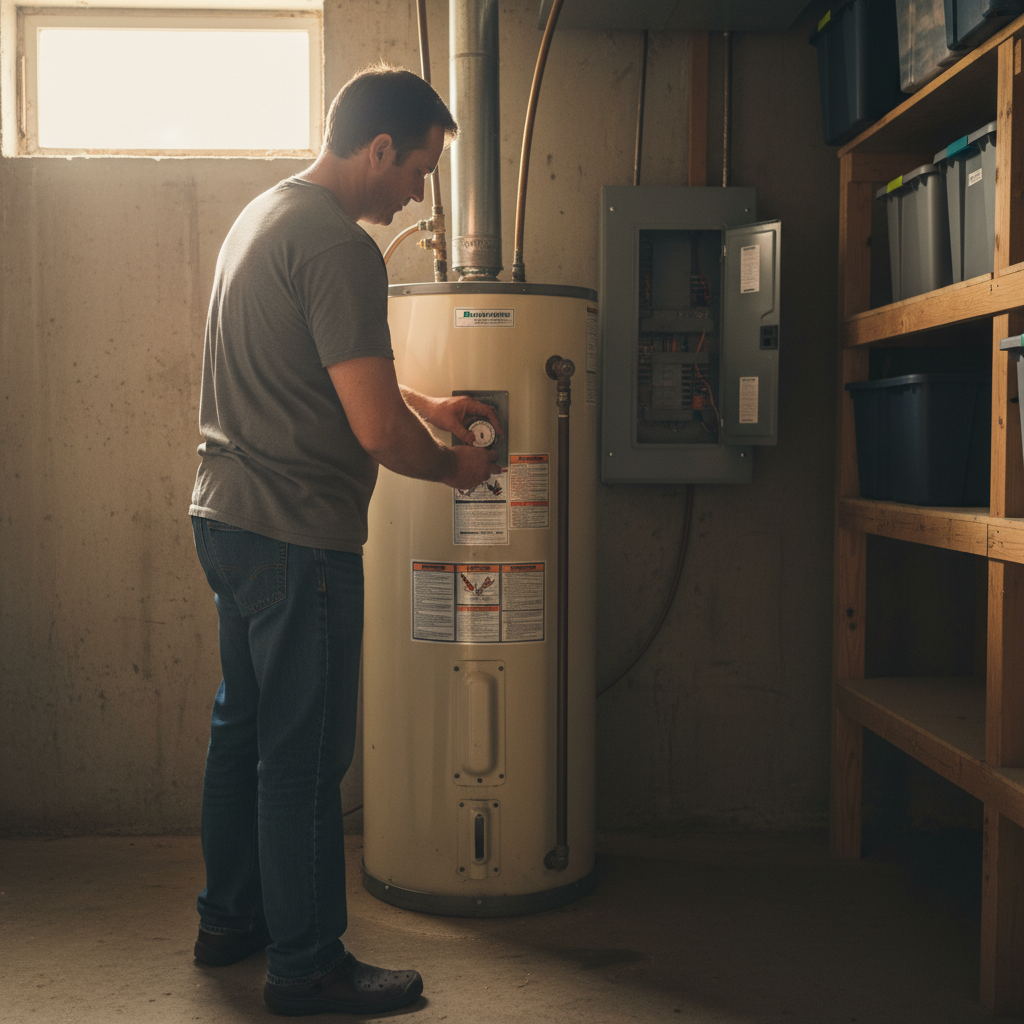
Checklist for electric water heaters (no hot water)
These steps apply to standard tank-style electric water heaters.
1. Confirm it's really "no" hot water
- Try both a sink and a shower to rule out a single bad faucet or mixing valve.
- Turn the hot side fully on and let it run for a full minute.
- If you get a few seconds of warm and then cold, your tank may be cooling too fast (failed element, heavy sediment, or undersized heater) rather than totally dead-but the checklist below still applies.
2. Check the breaker and power
- Go to your electrical panel.
- Look for a breaker labeled "Water Heater" or a double-pole breaker (commonly 30 amps).
- If it's in the middle or clearly "tripped," flip it fully OFF, then back ON.
- Wait 30-60 minutes and test hot water again (electric heaters are slower to recover than gas).
If the breaker trips again, stop there-this points to a wiring, thermostat, or heating element issue that should be checked by a professional.
3. Reset the high-limit switch (red reset button)
Most electric heaters have a safety device called a high-limit switch behind an access panel.
- Turn the breaker OFF to cut power.
- Remove the upper metal access panel on the tank (usually held by a few screws).
- Gently pull back any insulation without disturbing wires.
- Look for a red button-often labeled "RESET"-on the thermostat.
- Press it firmly until it clicks.
- Replace the insulation and cover, then turn the breaker back ON.
- Give it at least 30-60 minutes and check for hot water.
If the reset trips repeatedly, there is an underlying problem (failed thermostat, element shorting, severe sediment) that needs a plumber or electrician.
4. Check thermostat settings (if accessible)
If you're comfortable and the power is OFF:
- Many electric heaters have two thermostats (upper and lower). Check:
- Both are set around 120°F, or at least to the same mark (often labeled "A," "B," etc.). The U.S. Department of Energy notes most homes only need about 120°F, which also helps reduce scald risk and energy use.2
- No obvious burn marks, melted plastic, or loose wires. If you see any, stop and call a pro.
Do not disconnect wires or remove thermostats yourself unless you are trained-this crosses into repair, not homeowner troubleshooting.
Checklist for gas water heaters (no hot water)
This section covers standard tank-style gas water heaters with a burner at the bottom.
1. Make sure the gas supply is on
- Check that other gas appliances (like a gas stove) work.
- Confirm the gas shutoff handle on the pipe near the heater is in line with the pipe (ON position), not turned crosswise (OFF).
- If you turned it off for any reason and aren't sure how to relight or restart, call a plumber or gas utility.
2. Check the thermostat / temperature dial
- On most gas heaters, the temperature dial is on the gas control valve at the front bottom of the tank.
- Make sure it's not turned to "Vacation" or "Pilot" only; set it to "Hot" or around 120°F equivalent.
- Wait 20-30 minutes and see if the burner ignites and water warms up.
3. Check the pilot status (for standing-pilot models)
If your heater has a small viewing window near the bottom:
- Look for a steady blue flame-that's the pilot.
- If there is no flame:
- Read the lighting instructions on the label on the heater and follow them exactly if you are comfortable.
- If you smell gas at any point, stop immediately, leave the area, and call 911 or your gas company.1
Many newer heaters use electronic ignition (no standing pilot). If these lose flame repeatedly or show an error light, it's time for a pro.
4. Look and listen for trouble signs
While you're near the heater (but not removing burners or gas components):
- Listen while it runs:
- Some rumbling or popping can indicate sediment buildup.
- Look around the base and vent:
- Any soot, black streaking, or melted plastic is a red flag-turn it off and call a plumber.
- Any water pooling around the bottom or rust streaks down the tank suggests the tank may be failing.
If the pilot won't stay lit or the burner cycles off quickly, the thermocouple/flame sensor, gas valve, or venting may be faulty-call a pro rather than experimenting.
What homeowners should NOT touch
Some parts of a water heater are for trained technicians only. To stay safe:
- Don't disassemble gas controls or burners. Gas control valves, orifices, and burner assemblies can leak or misfire if disturbed.
- Don't cap or plug the temperature and pressure (T&P) relief valve. This safety valve relieves excess pressure; blocking or defeating it can allow dangerous pressure buildup and even tank rupture.3
- Don't remove wiring from thermostats or heating elements. Miswiring can cause shocks or overheating.
- Don't use open flames to "check for gas." This is extremely dangerous-never hold a lighter or match near a suspected leak.
- Don't keep flammable items near the heater. Paint, gasoline, cardboard, and rags should be stored well away from the burner area.
If a step requires tools beyond a screwdriver for an access panel-or you're unsure what you're seeing-treat that as the stopping point and call a licensed plumber.
When to call a professional plumber
Use this list to decide when it's time to stop troubleshooting and bring in a pro (often same-day for no-hot-water calls):
Call a plumber immediately if:
- The breaker keeps tripping or you see burn marks on wiring or components.
- The pilot won't stay lit, or the burner keeps shutting off.
- You see water on the floor, active dripping, or heavy rust at the bottom of the tank.
- Hot water is rusty or discolored only on the hot side (possible internal corrosion).
- Your tank water heater is around 8-12 years old and now has no hot water or leaks; that's the typical lifespan for many storage-type heaters.4
Call 911 or your gas utility (before a plumber) if:
- You smell a strong rotten-egg gas odor anywhere in the home.
- You hear hissing from gas piping.
- Someone is dizzy, nauseous, or has headaches around fuel-burning appliances (possible carbon monoxide-get outside and call 911).
When you do call a plumber, share what you've already checked (breaker reset, pilot status, leaks, age of heater). That can speed up diagnosis and help you decide between repair and replacement.
Conclusion
Focus first on safety, then walk through simple checks like power, gas supply, thermostat settings, and pilot status-if those don't restore hot water quickly, it's time to stop guessing and call a qualified water heater repair professional.
Glossary
- T&P relief valve: Temperature and pressure relief valve; a safety valve that opens if the tank overheats or over-pressurizes.
- Pilot light: Small flame used on many older gas water heaters to ignite the main burner.
- Thermostat: Control that senses water temperature in the tank and turns heating elements or burner on and off.
- Thermocouple / flame sensor: Safety device that proves flame is present on gas heaters so gas can flow safely.
- Breaker (circuit breaker): Switch in your electrical panel that protects wiring by shutting off power if there's an overload or fault.
Sources
Footnotes
-
Commonwealth of Massachusetts (Mass.gov) - official instructions on what to do if you smell natural gas indoors, including evacuating and calling 911 or the gas company: https://www.mass.gov/info-details/what-to-do-if-you-smell-gas ↩ ↩2
-
U.S. Department of Energy - guidance on water heater thermostats and typical 120°F recommendation for homes: https://www.energy.gov/energysaver/do-it-yourself-savings-project-lower-water-heating-temperature ↩
-
U.S. Consumer Product Safety Commission - recall notice explaining that failure of temperature and pressure relief valves can allow tank rupture and burn hazards: https://www.cpsc.gov/Recalls/2009/temperature-and-pressure-relief-valves-for-large-water-heaters-recalled-by-watts ↩
-
Better Homes & Gardens - overview of common signs it's time to replace a water heater and typical 8-12 year lifespan for many storage-type units: https://www.bhg.com/signs-to-replace-water-heater-8779007 ↩