
Should you repair or replace your old water heater
Quick answer
If your tank water heater is over 10 years old, leaking from the tank, or needing frequent repairs, replacement is usually the smarter move; otherwise, a focused repair often makes sense. The decision comes down to age and remaining life, the type and condition of the tank, how much the repair will cost compared with a new unit, and whether a new heater could noticeably cut your energy bills. Use the checklist below so you can have a clear, informed conversation with your plumber instead of a pressured one.
Step 1: Check age, type, and basic condition
Before you decide anything, grab a flashlight and look closely at the unit.
- Find the age. Many standard tank heaters last about 8-12 years, while tankless models often reach 15-20 years with good maintenance.1 Look for a manufacturer label or serial number (often near the top of the tank); a quick web search of the brand + serial code usually reveals the manufacture date.
- Note the type. Tank vs. tankless, gas vs. electric. Tank units wear out mainly from tank corrosion and sediment. Tankless units fail more from scale or electronics.
- Scan for obvious problems. Look for rust streaks, damp insulation around the base, scorch marks, or water pooling under or behind the heater.
- Listen and sniff. Rumbling or popping while heating often means heavy sediment. Any gas smell is an emergency: shut the gas off at the valve (if you can do so safely) and call a pro immediately.
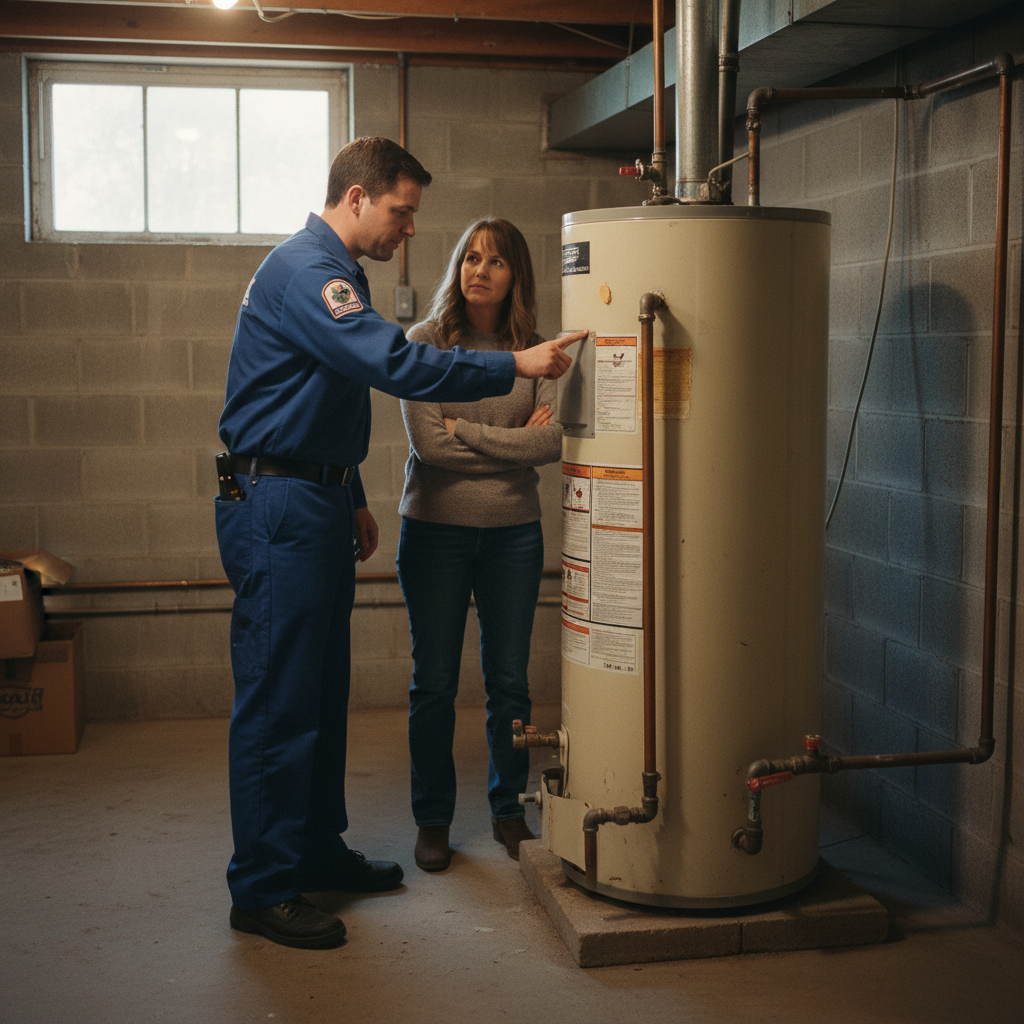
Rule of thumb on age:
- Under ~8 years and in good shape: often worth repairing.
- Around 8-12 years for tank, 15-20 for tankless: weigh repair vs. replacement carefully.1
- Beyond the typical lifespan or unknown/very old: lean strongly toward replacement.
When a repair is usually the better move
You are more likely to come out ahead with a repair if most of these are true:
- The heater is still relatively young.
- Tank: under about 8-10 years.
- Tankless: under about 15 years.
- This is a first or rare problem. No pattern of breakdowns or calls for service.
- The issue is isolated and fixable. Examples:
- Pilot light keeps going out on a gas heater.
- Electric unit has a bad heating element or thermostat.
- Temperature and pressure (T&P) relief valve is dripping, but the tank body is dry.
- Wiring connection, gas control valve, or igniter has failed, but the tank is sound.
- Repair cost is clearly lower than replacement. A typical visit plus a common part (thermostat, element, igniter, valve) often runs in the low hundreds of dollars, depending on your region, while a full replacement is commonly four figures installed.2
- Your hot water needs and energy bills are otherwise fine. You are not constantly running out of hot water, and your utility bills have not spiked for no clear reason.
Bottom line for repairs: If the heater is well within its expected lifespan, has a good history, and the quote is comfortably less than about one-third of a new, code-compliant replacement, a repair is usually a reasonable choice.
When replacement is the smarter choice
Replacement starts to look like the better investment when one or more "big red flags" show up.
Clear signs you should replace
- The tank itself is leaking. Any seepage from the body of a tank water heater (not just a loose fitting) is a strong sign of internal corrosion. A leaking tank is not realistically repairable and can fail suddenly.
- Advanced age.
- Tank heater is 10-12+ years old.
- Tankless heater is 18-20+ years old. Even if it is still running, you are in bonus time; sinking major money into repairs at this stage rarely pays off.1
- Frequent or escalating repairs. Two or more significant repairs in the last couple of years, or your plumber warns that "more parts are about to go."
- Rusty or discolored hot water. Especially if only the hot side is affected, this often points to internal tank corrosion.
- Lukewarm water plus rumbling noises. Heavy sediment can bury the burner or elements, reducing output and stressing the tank.
Money and efficiency factors
- Big repair vs. near-term replacement. If a repair will cost more than roughly 40-50% of a new, properly sized replacement, many homeowners choose to replace instead of gamble on a few more years.
- High energy bills with an older unit. Water heating typically accounts for around 13% of home energy use, so older, inefficient heaters can be a noticeable drag on your bills.3
- You want to change fuel type or capacity. If you are routinely running out of hot water, finishing a remodel, or planning to switch from gas to electric (or to a heat-pump or tankless unit), it often makes sense to do a full replacement rather than repair and redo later.
Costs and price drivers
Nationally, by early 2026, homeowners typically pay on the order of $882-$1,800 to replace a residential water heater, with many standard tank installations falling in the $600-$2,500 installed range depending on size, fuel type, and complexity.2
Tankless replacements usually cost more upfront, often around $1,400-$3,900+ installed.2
Here is how that plays into the repair-vs-replace decision:
| Scenario | Typical numbers (very rough) | What often makes sense |
|---|---|---|
| Young tank, minor part failure | Repair: low hundreds; replacement: $1,000+ | Repair and keep up on maintenance |
| 10+ year tank, major part failure | Repair: several hundred; replacement: $1,200-$2,000+ | Strongly consider replacement |
| Old, undersized, or inefficient heater | Replacement: $1,200-$3,000+ depending on type | Replace and right-size/upgrade |
Main price drivers for replacement:
- Type (standard tank vs. tankless vs. heat-pump)
- Tank size (gallons) and gas input or electric wattage
- Gas vs. electric, and whether venting or wiring must be upgraded
- Ease of access (garage vs. attic/closet/basement)
- Local code requirements, permits, and seismic/bracing rules
Because of these variables, it is worth getting at least two quotes from licensed plumbers, ideally with line-item detail showing equipment, labor, and any code upgrades.
How to talk to your plumber (and avoid upsells)
When you call a plumber, use these questions to drive a clear, apples-to-apples conversation:
- "If this were your house, would you repair or replace - and why?" Ask them to walk you through the key factors: age, tank condition, safety, and expected remaining life.
- "What exactly failed, and is it likely that other parts will follow soon?" This helps you judge whether the problem is isolated or a sign the unit is at the end of its life.
- "How much is the repair, and how much is a basic code-compliant replacement?" Get both numbers. Ask for a straightforward option, not only a top-of-the-line upgrade.
- "How long would you expect this repair to last, realistically?" A cheap repair that buys only a few months is not really a good deal.
- "What efficiency difference should I expect with a new unit?" A more efficient water heater can chip away at energy costs over time, especially if your current one is old and poorly insulated.3
If a plumber is reluctant to give you both repair and replacement options, or pressure-sells a premium unit without explaining basics, do not hesitate to get another opinion.
Simple decision checklist you can use today
Use this quick checklist to decide which side you are leaning toward before you authorize work:
- My water heater is a tank model and is:
- Under 8 years old
- 8-12 years old
- Over 12 years old
- It is / is not leaking from the tank body itself.
- I have had 0-1 / 2+ significant repairs in the last 3 years.
- The current quote to repair is about ___% of the cost of a basic new unit.
- My hot water supply and energy bills are:
- Acceptable
- Frequently a problem
If you check "older," "leaking," "multiple repairs," or the repair quote is close to half the price of a new unit, replacement is usually the better long-term move. If the unit is younger, has a clean history, and the repair is modest, repairing and planning ahead for a future replacement is often perfectly reasonable.
Conclusion
Decide whether to repair or replace your old water heater by weighing its age, tank condition, repair cost versus replacement cost, and how reliably and efficiently it still meets your household's hot water needs.