
Decoding common tankless water heater error codes
How tankless error codes work (and why they matter)
Tankless water heaters are full of sensors. When something looks unsafe or outside normal operating range, the unit throws an error code and often shuts itself down to protect you and the equipment.
A few key points up front:
- Error codes are brand-specific. A "Code 11" on one brand is not guaranteed to mean the same thing on another. Always confirm with your user manual or the label on the inside of the front cover.
- The code is a clue, not the whole story. It tells you which system is unhappy (ignition, temperature, venting, water flow, etc.), but not always the exact failed part.
- Don't repeatedly reset a unit that keeps faulting. The heater is shutting down for a reason; forcing it to run can damage components or create a safety risk.
If you ever smell gas, see smoke, or have a carbon monoxide (CO) alarm sounding, shut the unit off, leave the area, and contact your gas utility or 911 before worrying about what the code says.1
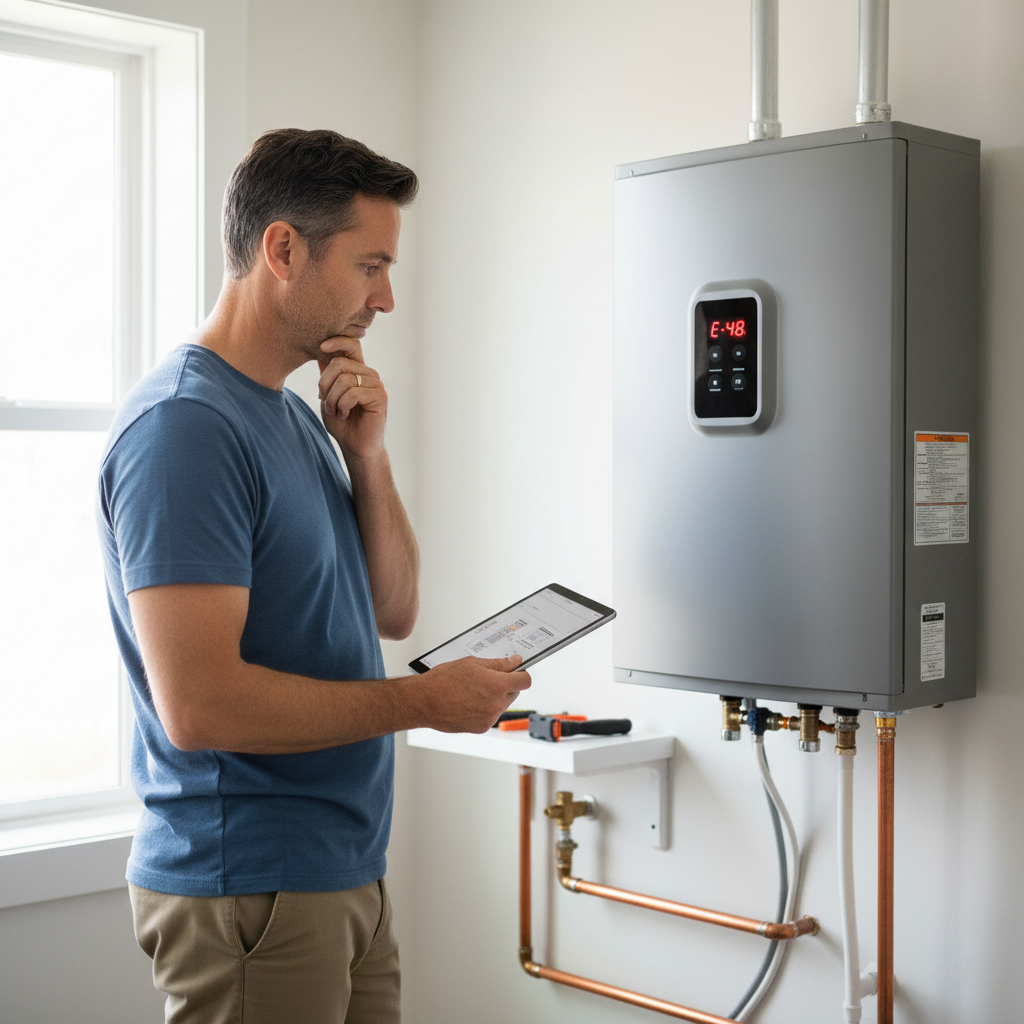
The big buckets: what most tankless error codes actually mean
While the numbers and letters vary, almost every tankless error falls into one of these categories:
-
Ignition or flame problems
The unit detects demand for hot water but can't reliably light or keep the burner going. On some models, codes in the low teens (like Noritz Code 11 for ignition failure and Code 12 for flame loss) fall into this bucket.2 -
Overheating / outlet temperature problems
The water or heat exchanger gets hotter than it should. Noritz Codes 14 and 16, for example, indicate heat exchanger and outlet over-temperature issues tied closely to scale buildup.2 -
Venting, combustion air, or condensate drain issues
The heater senses blocked exhaust, bad draft, or a problem draining condensate (on high-efficiency units). Noritz Code 29 is one example for condensate drain trouble.2 -
Water flow, supply, or freeze protection errors
The heater isn't seeing enough water flow, is detecting very low incoming temperature, or thinks there's a risk of freezing. -
Internal sensor or control faults
These are "something is wrong inside the box" alerts: failed thermistors, control boards, communication issues, or safety switches.
Thinking in terms of these buckets helps you decide what you can safely check yourself vs. when you should shut it down and call a tankless-trained plumber.
Common categories and what you can safely check
1. Ignition or flame failure errors
What it usually means: The unit tried to fire but didn't see a stable flame. Common causes include low gas pressure, closed valves, dirty flame sensors, or serious venting problems.2
What you can check (typically safe):
- Make sure the gas shutoff valve to the heater is fully open (handle parallel with the pipe). If you smell gas, do not touch valves or switches-leave the area and call your gas utility or 911.1
- See whether other gas appliances work normally (stove, furnace). If they also act up, the issue may be with your gas supply, not just the heater.
- Confirm the power supply: breaker on, unit plugged in, GFCI (ground-fault circuit interrupter) outlet not tripped.
When to call a pro right away:
- The ignition/flame code reappears after a single reset.
- You hear loud booming, popping, or whooshing at startup.
- You recently had gas piping or pressure changes.
Internal gas adjustments, burner cleaning, and combustion analysis are pro-only jobs.
2. Overheat, outlet temperature, or scale-related errors
What it usually means: Water leaving the heater got dangerously hot or the heat exchanger itself overheated, often because mineral scale has built up inside and is blocking heat transfer.2
Typical homeowner-friendly checks:
- Verify the set temperature on the remote-most homes should be at or below 120°F to reduce scald risk.
- Make sure hot-water flow is not being throttled too low at fixtures; many tankless units need a minimum flow to modulate safely.
Why scale is such a big deal: Hard water deposits on the heat exchanger act like insulation. The burner has to run hotter to get the same outlet temperature, which can trigger overheat codes and shorten the life of the unit.3 4
Most manufacturers and industry pros recommend descaling (flushing) tankless heaters about once a year, more often in hard-water areas.3 4 For many homeowners, it's smartest to have this done by a licensed plumber who works on tankless units every day.
3. Venting, combustion air, and condensate drain errors
What it usually means: The unit senses unsafe exhaust conditions-blocked vent, improper draft, or a condensate drain that's backed up or frozen.2
Safe basic checks:
- Look at any outside vent terminations: they should be free of leaves, snow, nests, or debris.
- In winter, make sure condensate drain lines are not visibly frozen or kinked.
Stop here and call a pro if:
- You see soot, scorching, or melted plastic on or near the vent or heater.
- You get a vent/combustion error along with a CO alarm.
Venting mistakes can lead to CO buildup. The U.S. Consumer Product Safety Commission specifically urges homeowners to have all fuel-burning appliances-including water heaters-inspected and serviced annually by qualified professionals to prevent CO hazards.1
4. Water flow, inlet, and freeze-protection errors
What it usually means: The heater doesn't see enough water flow to operate safely, or it thinks the incoming water is dangerously cold.
Homeowner checks that are usually OK:
- Make sure cold-water shutoff valves to the heater are fully open.
- Clean the small inlet water filter screen if your manual shows how; it's often behind a plug at the cold-water connection.
- Check for low pressure or poor flow at other faucets-if the whole house is affected, you may have a supply issue or main-line problem, not a water heater failure.
If a freeze-protection code appears during extreme cold, leave the unit powered (its internal heaters often need electricity) and call a pro for next steps.
DIY vs. pro: what's safe to tackle yourself
Usually safe homeowner steps
You're generally fine to:
- Check and reset breakers, plugs, and GFCI outlets supplying the heater.
- Confirm gas and water shutoff valves are open-again, not if you smell gas.
- Gently power-cycle the unit once using the on/off button or by unplugging it for 30 seconds.
- Clean exterior air intake screens or louvers if they're obviously dusty.
- Follow the manual to clean the inlet water filter and, if allowed, the easily accessible air filter.
If the same code returns immediately or frequently after these steps, stop and call a tankless-trained plumber.
Leave these to the pros
Call a licensed plumber or gas company technician for:
- Repeated ignition, flame, overheat, venting, or condensate codes.
- Any error code combined with gas smell, soot, smoke, or CO alarm activation.
- Full descaling/flushing if you're not very comfortable with hoses, pumps, and following manufacturer-specific procedures.
- Opening the unit to work on burners, gas valves, control boards, or sensors.
Modern fuel-burning appliances require special training and tools; federal safety guidance is clear that consumers should not service internal components themselves but rely on qualified professionals.1
When to shut the tankless heater down immediately
Turn the unit off at its power switch (or breaker) and close the gas valve, then get help, if:
- You smell gas near the heater or gas meter.
- You see smoke, charring, or melted plastic on or around the heater.
- You have repeated overheat/high-temperature codes and water is coming out scalding hot.
- You get a venting/combustion-related code and/or a CO alarm is sounding.
In these situations, treat it as a safety issue first, an appliance issue second.
Preventing future error codes
A little prevention dramatically reduces nuisance shutdowns and expensive repairs:
- Annual professional inspection: Have a licensed pro inspect and service your tankless heater and other fuel-burning appliances once a year.1
- Descale regularly: Plan on flushing/descaling every 12-18 months, or every 6-12 months in known hard-water areas, per manufacturer and industry recommendations.3 4
- Clean filters and screens: Rinse the inlet water filter and any air screens 1-2 times per year, or more often if you know you have sediment or dust.
- Maintain clearances: Keep storage, cardboard boxes, and chemicals away from the heater and its vent/intake.
- Watch for early warning signs: Temperature swings, reduced hot-water flow, or new noises are reasons to schedule maintenance before an error code pops up.
Conclusion
Tankless water heater error codes are your system's early-warning language: learn the basic categories, handle the simple checks yourself, and bring in a licensed pro quickly when the code points to gas, venting, or overheating so you can get safe, reliable hot water back fast.
Glossary
- CO (carbon monoxide): Colorless, odorless gas produced by burning fuel; dangerous at high levels.
- GFCI (ground-fault circuit interrupter): Safety outlet that trips if it senses current leakage.
- Ignition failure: The burner tried to light but did not establish a stable flame.
- Scale: Hard mineral deposits (mainly calcium and magnesium) that build up inside the heater.
- Thermistor: Temperature sensor used by the control board to monitor water and component temperatures.
Sources
Footnotes
-
https://www.cpsc.gov/Newsroom/News-Releases/2002/CPSC-Urges-Seasonal-Furnace-Inspection-to-Prevent-CO-Poisonings ↩ ↩2 ↩3 ↩4 ↩5
-
https://help.noritz.com/index.php/article-categories/error-codes/ ↩ ↩2 ↩3 ↩4 ↩5 ↩6
-
https://www.ferguson.com/content/ideas-and-learning-center/trade-talk/tankless-water-heater-maintenance-tips/ ↩ ↩2 ↩3
-
https://www.waterheatersnow.com/essential-guide-to-tankless-water-heater-maintenance-our-tips/ ↩ ↩2 ↩3